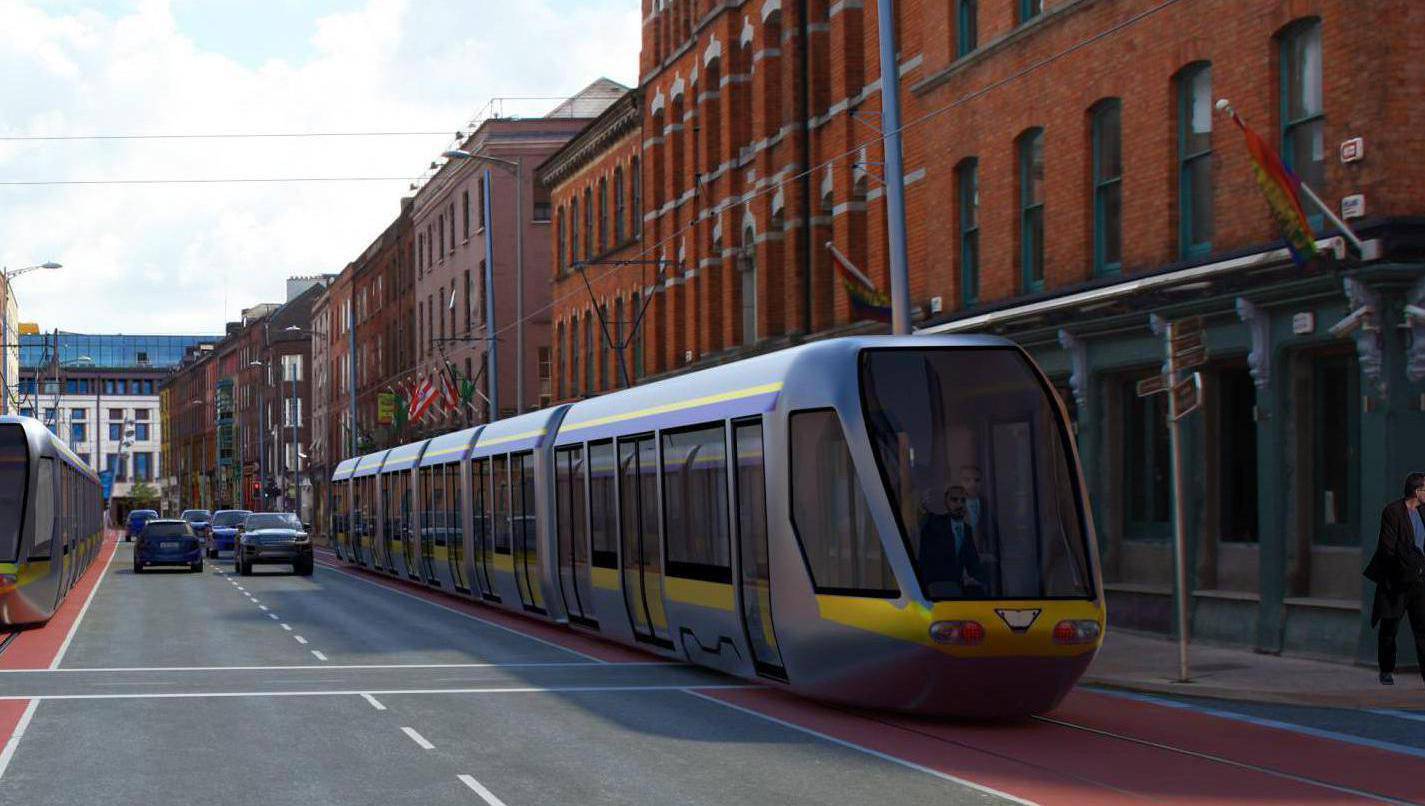
Regarding your reports and editorial of Wednesday, January 3, which seem to suggest support for a Dart-style heavy urban commuter rail solution to expanding rail transport for Cork — rather than the more versatile Luas-style light rail — there are several reasons why the vision of a Dart-style system is a non-starter.
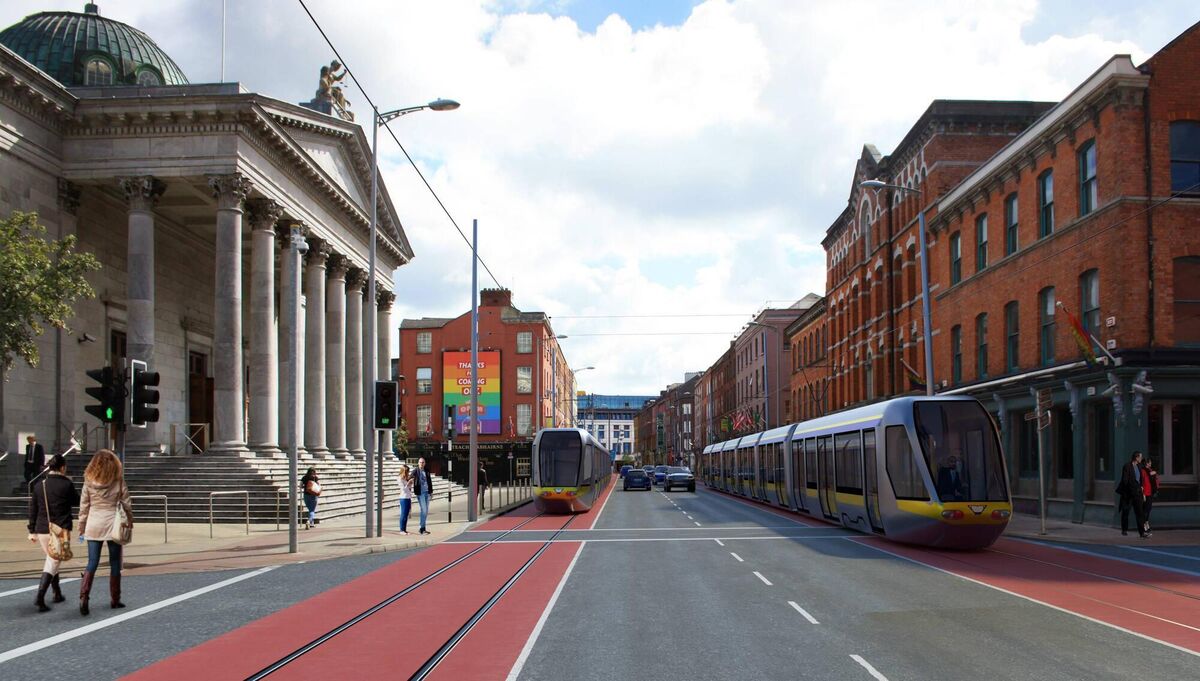
While it is a great idea to electrify the only two suburban Cork rail routes from Kent Station to Midleton and Cobh for heavy Dart-style trains, on many similar routes in many other cities around the world — such as Amsterdam, Koln, and Manchester — sections of former heavy commuter rail route (e.g the Manchester-Bury line) have been successfully converted to light rail, boosting capacity and enabling addition of many new stations due to the lower cost of constructing stations for trams over full-size trains.
As trams are much lighter than Dart-style trains, they consume less power and — therefore — the actual power supply infrastructure, such as substations and overhead wires, are much cheaper than for mainline trains.
As trams have much lower floors, they require only low platforms at stations — enabling easy access for disabled passengers.
At present, it is impossible for someone with a wheelchair or heavy luggage to board trains for Cobh or Midleton at Kent station — because the train floor is as much as 30 cm above the platform level.
In addition to these advantages — unlike a Dart-style train — Luas-style light rail would allow safe access by tram right through the city centre, via links along streets such as Patrick St, Grand Parade and Washington St, or via Brian Boru Bridge and Capwell bus/tram interchange and on to Anglesea St to Mahon, and even destinations such as Wilton and Bandon along sections of disused rail route — such as the old Passage and Bandon lines.
The cost of refurbishing infrastructure, such as the Chetwynd Viaduct for a light rail route, would be far smaller than for full size Dart trains — where entirely new bridges or tunnels would be needed.
In terms of time, converting the Midleton and Cobh rail routes to Dart-style routes would take far longer than converting them to light rail.
These two routes would become the first phase of a cross-city light rail network, which I christened Alvin — Axial Lee Valley Integrated Network — and presented in a proposal to Cork City Council some 20 years ago.

The Alvin network would consist of about eight different routes, numbered from “909” to “989”: 909 from Little Island to Mahon Shopping Centre, 919 from Cobh to Blarney, 929 from Midleton to a future interchange with Iarnród Éireann at Blackpool Shopping Centre, 939 from Youghal to Ringaskiddy (a heavy rail link from Kent station to Ringaskiddy would be necessary so as to also carry freight), 949 from Blackpool/Douglas to Bandon, 959 from Kent Station to Cork Airport, and in addition a few other possible links or special services — such as to Páirc Uí Caoimh on matchdays.
The Midleton-Youghal section has long been in need of reopening as a rail route, but instead the Government has seen fit to squander millions in turning it into a so-called “greenway” for cyclists and walkers — few of whom will use it anyway as it is not suitable for work/school/shopping journeys.
This route and other outer routes, such as Bandon-Kinsale and Cork-Ringaskiddy, might be best operated by battery equipped trams — which will be much more affordable as technology improves in the next decade.
In theory, the Bandon-Skibbereen route and the route to Macroom could eventually be reopened in this way, revolutionising transport in increasingly popular towns of West Cork.
Another technological development which will be crucial to the success of converting the Cobh and Midleton routes to light rail, will be the use of “tram-trains” — a hybrid type of tram which can run on street sections of route, but which is also designed to mainline rail safety and performance standards.
Several cities in Germany operate tram-trains on certain routes, and one city in England — Sheffield, where I live — has a short, but very successful tram-train route which shares the railway with traditional suburban trains between Sheffield and Rotherham.
Finally, because the Cork Alvin network would link existing rail routes with new tram routes — unlike the Luas in Dublin, which is a different gauge (standard 142cm) from Iarnród Éireann’s gauge of 160cm — all Alvin tram routes would be built to 160mm gauge, to ensure maximum economy and flexibility in terms of common usage and maintenance of the entire system.
Dan J. J. Kahn
Sheffield,
England
Memory of strikes a reminder words not enough
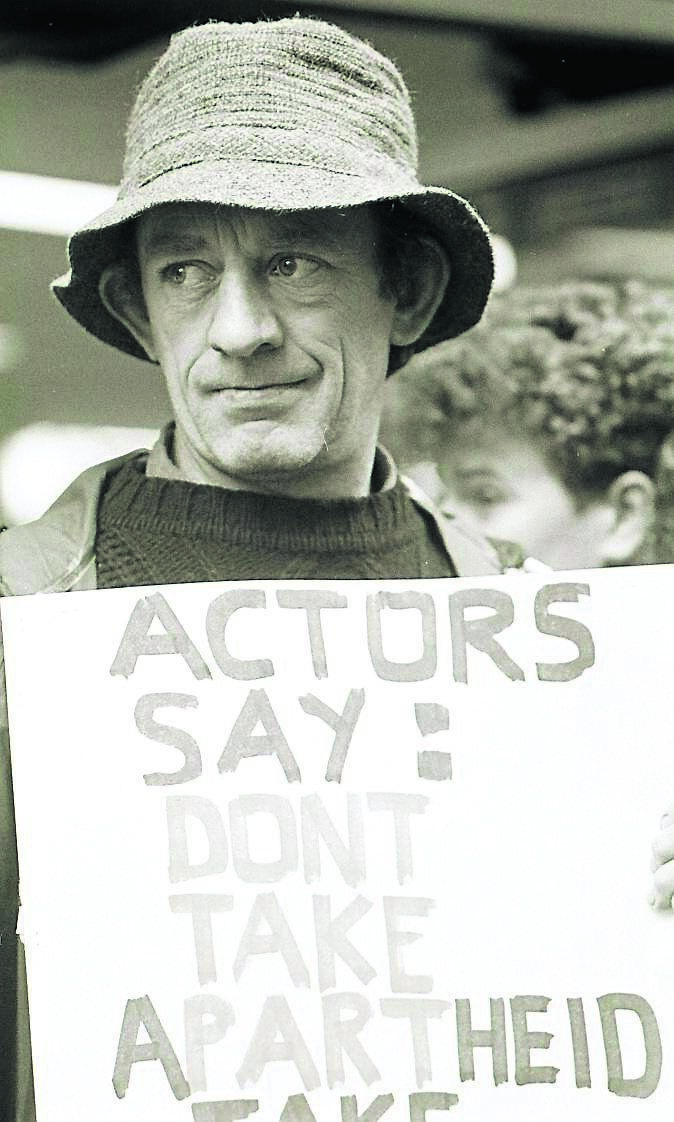
It was interesting to read Mick Clifford’s excellent feature on the brave Dunnes Stores anti-apartheid strikers of 1984 to 1987 ( Irish Examiner, January 4).
The article brought back memories of when I was involved with the Dunnes Stores strikers’ support group in Cork at that time.
We distributed leaflets in solidarity with the striking workers, and regularly picketed Dunnes Stores shops on Patrick St and North Main St in Cork, while the strike was ongoing in Dublin.
Mick Clifford accurately captures the atmosphere at the time.
The gardaí and establishment in Cork certainly treated us as troublemakers. With regard to the strike itself, the Government was deeply unhelpful and did not support sanctions against apartheid South African goods.

Looking back now, people often assume that Ireland took a principled anti-apartheid stance. In fact, the Government had to be pushed into taking practical action. Little has changed in that regard.
With Gaza under attack and nearly 23,000 people now dead, the Government bafflingly still opposes the deployment of boycott, divestment, and sanctions against the apartheid Israeli state.
Likewise, it has failed to apply the Occupied Territories Bill. In truth, it is long past time for the Irish State to acknowledge that soft words are not enough and that practical action is now needed.
Fintan Lane
Lucan,
Co Dublin
Challenge for parties before election
Ivana Bacik argues that there is no ideological difference between Labour and the Social Democrats ( Irish Examiner, December 3), and states that this is similar to the position concerning Fianna Fáil and Fine Gael.
This is not the case.
On housing and on public services, for example, Fine Gael’s approach has always been very market-led.
While Fianna Fáil is a pro-enterprise party, we believe that there are circumstances where the State must intervene — particularly on housing.
It is for that reason that my party went into Government, and where we are now seeing the biggest ever investment in home building as well as in public services generally.
As a centrist party, like our Fine Gael colleagues though, we differ sharply from those parties on the left as Sinn Féin and People Before Profit who in their policies do not support the aspiration to home ownership — something that is a core value for us.
The challenge for parties such as Labour and the Social Democrats, during and after the next election, will be whether they will align with a Fianna Fáil- led Government — that balances economic security with investment in public service, as well as taking an active role in the EU and facing up to the reality of climate change (as we are doing with our coalition partners, Fine Gael and the Greens) — or propping up a populist Sinn Féin/Hard Left alliance that is Eurosceptic, climate sceptic, opposed to supporting home ownership, and which will put the economy and jobs at risk.
Senator Malcolm Byrne
Seanad Éireann
Tubridy better placed in highlights slot
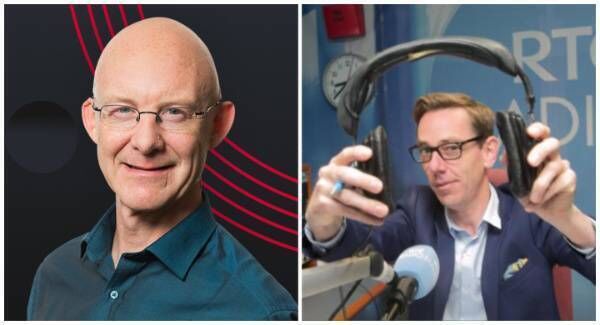
I am really disappointed that our Sunday’s Oldies and Irish is being cut in half to facilitate Ryan Tubridy coming on air.
I have no issue with Ryan at all.
I am really annoyed that it’s our beloved Sunday show has to make way for him.
Could he not be slotted in where there’s a highlights show broadcast over the weekend on 96FM?
I won’t be listening at 10am.
I’ll be moving the dial to C103 until 12 noon.
Mary Horgan
Ballyvolane,
Cork
O’Callaghan puts ‘big talent’ to shame
The best part of a relaxing Sunday was having a leisurely breakfast, listening to Oldies and Irish on the radio.
I definitely will not be turning on 96FM at 10am to listen to the dreadful Ryan Tubridy.
I had to turn him off on RTÉ as he was so frenetic, not a calming presence on the radio, and would he ever stop taking about books that he was reading or had read?
Another issue was the usual suspects making their interview money.

Tubridy has made his money at the expense of the Irish public who paid their TV licences.
A big fish in a small pond!
Let’s get real, I hope he survives as a small fish in a big pond, where there are wonderfully talented presenters.
Oldies and Irish is a top-class programme with Derry O’Callaghan, that puts the “big talent” to shame.
Bring back the 10am start for Oldies and Irish, forget about Tubridy.
Sunny Birr
Deerpark,
Cork
Why must ‘wonderful programme’ be slashed?
Oldies and Irish is part of our Sunday morning.
I look forward to the four hours of Derry O’Callaghan’s eclectic music choices.
Why must this wonderful programme be slashed in half to accommodate Tubridy?
This is not a good decision, 96FM.
Find another slot for him.
Moya O’Donoghue
Carrigaline,
Cork