Letters to the Editor: Emotional wreck after return of live music
Hearing singers sing live again, and witnessing the emotional reactions of the audience, feels like a reason for living
Letters to the Editor: Emotional wreck after return of live music

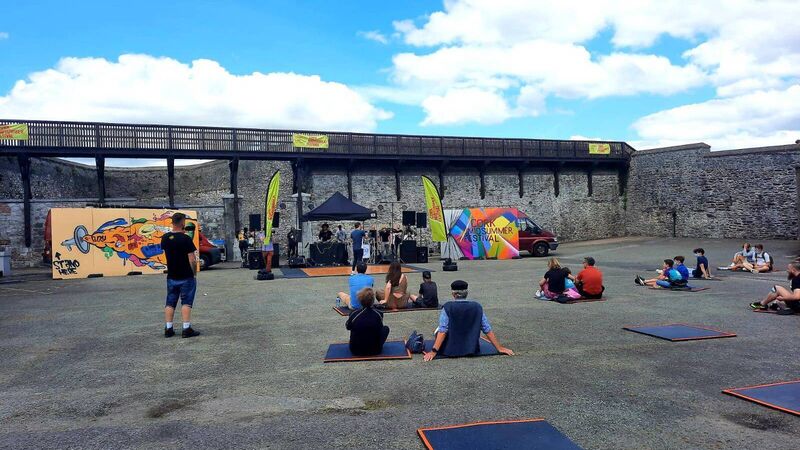
Elizabeth Fort is celebrating its successful hosting of a range of in-person events for Cork Midsummer Festival. Picture: Jessica Cull.

Rachel and Gavan’s voices soared in 'O soave fanciulla', and the tears started streaming down my face. 

Puccini’s La Bohème was the first of three abridged operas (with four singers, an actor, and a piano) that I am making with the Opera House, and performing outdoors across the city in July. 

Hearing singers sing live again, and witnessing the emotional reactions of the audience, feels like a reason for living.

The last 16 months have been very difficult. Apart from a few beautiful exceptions, there have been very few live performances, and none for a live audience. Until June.

The lockdowns involved long periods of doing nothing, then getting so bored that I started to go a bit mad, then trying to compose something, hating what I wrote, and back to the beginning of the cycle.

Two commissions from Cork Midsummer Festival saved my mental health.

I wrote a big piece for string quartet and actor that explores the black humour of the pointlessness of life, and existential angst. It’s based on the book of Ecclesiastes, and it was quite helpful to ponder the thoughts and feelings of a 3,000-year-old Middle Eastern scribe who had similar thoughts and feelings to me now.

Hopefully we can hear it performed live later this year, or maybe next Midsummer.

A chat with Lorraine inspired ‘Lullaby for the City (in a Time of Pandemic)’, a piece for chamber orchestra that we recorded and performed live outdoors for inner-city communities in Cork. 

It was written to maybe give some comfort to people of all ages — not least myself — in this time when the long days mean that sleep may not come so easily. 

There’s a gorgeous video with our recording and a collage of Jed’s photos at www.corkmidsummer.com/whats-on/midsummer-lullaby.

It was strange standing in front of an orchestra again for the first time in so long;  it’s already a nervewracking job. 

The larger distances between the players meant that they had to work so much harder to be together, but they achieved that and much more, with the unusual circumstances lending a particular emotional charge. 

Ciara and Kieran’s solo lines, singing the lullaby melody on the oboe and flute, were especially spell-binding.

Next up is a live gig with Karen as part of the Everyman’s outdoor season at Elizabeth Fort.

Gigs with Karen are always extraordinary. This one will be especially so after such a long time. We’re having so much fun picking our favourite songs to share joy with everyone. 

It sold out within hours, so there’s an audience ready to hear and celebrate with us too. We’ve just added a second date on August 22, so come join us.

Karen Underwood will perform as part of the Everyman’s outdoor season at Elizabeth Fort. Picture: Jed Niezgoda

I’m writing this on the train to Dublin — the first time leaving the county since last summer. We’re doing auditions for Éadaoin’s fun, crazy, profound, beautiful play Heart of a Dog which is going to be on (hopefully live — fingers crossed!) at the Everyman and the Civic, Tallaght (as part of Dublin Theatre Festival) in September and October. 

As restrictions and guidelines shift and move, it’s been tough on the nerves, but infinitely better than the dark days of lockdown when nothing seemed possible. 

It’s been strange trying to make creative things mostly on zoom, but, I’m also very grateful for the technology.

My existential angst is a bit more balanced by hope these days: feeling useful again; the privilege of receiving a vaccine (one shot down — the second due any day now); the beautiful efficiency and care shown in the vaccination centre at City Hall; the solidarity of fellow artists; good local food; love, etc.

After the last year, I’m a bit of an emotional wreck with the outpouring of feeling that comes from the return of live music to my life, and realising how important it is to other people too, and how privileged I am to have that connection with an audience.

John O’Brien

Cork

  • John is a conductor, director and composer based in Cork. He will appear with Karen Underwood as part of The Everyman @ Elizabeth Fort Summer Season on Friday, July 23, in ‘What a Difference a Day Makes’.

An Olympic feat from public health

The Tokyo 2020 organisers, the government of Japan and its ministry of health can demonstrate the positivity of effective public health measures to safely host the upcoming Olympics.

It will be an amazing achievement during a pandemic. The role of public health leaders, practitioners and educators is vital.

Preventive measures can stop Covid-19 transmission. Every infection averted is a success in containing this invisible virus, protecting populations, especially the most vulnerable.

Facilitating equitable access to Covid-19 vaccines is a priority to protect all people in all countries worldwide.

It is particularly sad for the athletes that there will be no spectators present in Tokyo 2020, but every effort and medal secured will be watched, reported and celebrated globally.

All good wishes to Team Ireland, and hoping everyone stays safe during Tokyo 2020.

Breda Gahan

Cabra

Dublin

Lift harvesting ban for growers’ sake

The impacts of the cessation in Ireland of the production of horticultural peat was brought into focus by the gathering outside the Convention Centre where the Dáil was in session, as recorded by RTÉ on Wednesday, July 14. 

A very logical case was made by the growers. A reason for the cessation was related to the perceived evolution of carbon dioxide (CO2) from the biological degradation of the harvested peat and from the drained bogland sources.

Amazingly, peat could be imported to meet the needs of the growers. 

That peat, sourced in Northern Europe, especially in the Baltic countries and Sweden, is considerably more expensive for the growers, and will of course, have a significant carbon transport footprint.

The cessation of the use of our great peat resource for energy is understandable, but it is appropriate to ask if those responsible for the cessation of harvesting our peats for horticulture had any awareness of the compositions, the quality, and the performance of our peats relative to those of the imported products. 

The compositions of the imports are very different from those of the horticultural peats sourced in our Midland bogs. 

These imports have significant mosses (Bryophyta) contents and are readily biodegradable. In contrast our peats have a high level of altered lignocellulose components and some humified (humus-type) materials. 

The growers know that the imported peats degrade rapidly and leave little meaningful residual product. In contrast our peats transform slowly, significantly enhance crop growth, and leave a humified residue that is an excellent soil amender. 

Have those who initiated the ban considered that the additional transformation of atmospheric CO2 resulting in enhanced crop yields through photosynthesis far exceeds its evolution from the biological degradation of the substrate?

We have a significant and very successful mushroom industry; its success is based on the quality of the casing or topping material placed over the growth medium. 

The black basal peat overlying the marl in our Midland bogs arguably provides the world’s best casing material. Surely our mushroom growers deserve to have access to as much of this material as they require.

There can be a great future for our horticultural industry. 

At the present time it is worth about €500m. In contrast, horticultural exports from the Netherlands are worth about €67bn. 

The Netherlands is smaller than the combined areas of Munster and Connaught. Surely there is great potential for the expansion of horticulture in Ireland.

The threat from the peat harvesting ban to the livelihoods of our growers and their employees should be removed allowing them to obtain from indigenous sources as much peat as they need. 

It should be made obvious to all who wish to expand their operations and for newcomers to the industry that peat supplies will be available for them for as long as is needed. 

Inevitably peat substitutes can emerge, but that will take time and considerable research input and support. It is essential that acceptable peat substitutes will be required to match the properties of our native product.

Michael HB Hayes

Aillroe Beg

Labasheeda

Co Clare

Ukraine: Russia wants a peaceful political settlement

I would like to comment briefly on the article 'Putin’s Dangerous Ukraine Narrative' ( Irish Examiner, April 20, 2021). 

This is the kind of story that in fact creates a really dangerous narrative by inflating the subject of confrontation. No serious or competent expert would find Russia’s interest in war, least of all in Ukraine. 

It’s obvious that, as indicated by Anders Åslund, there are certain groups that are interested in keeping the conflict in Ukraine alive, contrary to the interests of the Ukrainian and Russian people. 

However, evidence is out there that for a number of years, starting from 2014, Russia has been advocating peaceful political settlement of the conflict in Ukraine, both individually and in the framework of the Normandy format, pushing the Kiev Government to implement the Minsk agreements, designed to stop the war by Kiev against its own population.

Victoria Loginova

Press Secretary of the Embassy of the Russian Federation in Ireland

184-186 Orwell Road

Rathgar

Dublin 14

x

More in this section

Revoiced

Newsletter

Sign up to the best reads of the week from irishexaminer.com selected just for you.

Cookie Policy Privacy Policy Brand Safety FAQ Help Contact Us Terms and Conditions

© Examiner Echo Group Limited