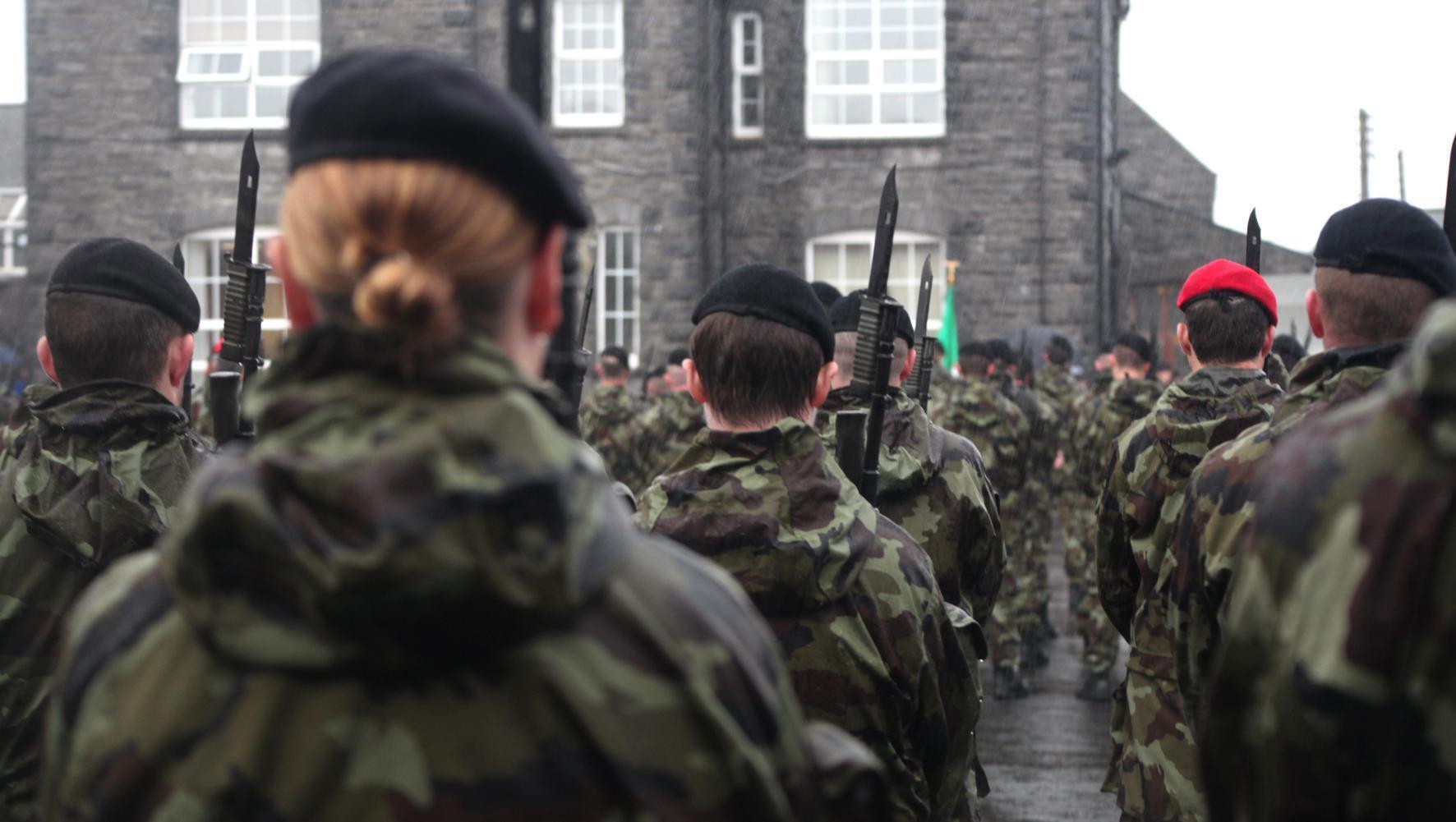
Initially in his article on the Defence Forces (, June 3) Colonel Dorcha Lee claims that defence spending has plummeted since 1980, and halved from 2012 to 2020. It simply has not. It went from $1.3bn to $1bn between 2012 and 2020.
Defence spending is 2.5 times higher than it was in 1980. His claim was made relative to the flawed comparison of GDP.
Spending has decreased, he says, from 1.67% of GDP in 1980 to 0.56% in 2012 to just 0.27% in 2020.
However, GDP increased nearly twentyfold from 1980 to 2020 — from about $20bn to $400bn. Since 2012, GDP has nearly doubled.
He also states that Ireland does not have modern interceptor aircraft nor a single true warship, and this is true. But it also is true that Ireland has never had these.
Ireland’s Defence Forces for a brief period in the 1940s had a small amount of some obsolescent equipment the UK couldn’t find a better use for in the Second World War. That was its zenith. Since then, its capabilities have only decreased. Its predicament is nothing new.
The basic cost of a modern fighter is about €100m per unit, with a basic frigate coming in at a whopping €1.2bn. An outlay of €5bn would get just a squadron of fighters and three frigates.
None of the other substantial costs included, of course, such as persons with skills to operate them, industries to create or arm any part of them, nor the expensive infrastructure to host these assets securely.
But what would be the bigger point of having them?
Who and what are we defending ourselves against?
The US and the UK are the only nations that have the capacity to
invade us. And why would they? Is it prudent to remove resources from housing and health at a time like this for non-existent threat so some people can play at being soldiers?
When the HSE was attacked recently the Defence Forces were of no use.
The same could happen to our electricity grid, or any key service. What good are an abundance of army privates armed with guns in these scenarios? Or even a modern interceptor, or a frigate?
Joe Rourke
Donabate
Co Dublin
We can’t sweep our shameful scandals under the carpet
The mother and baby homes must be one of the greatest scandals ever in Ireland.
innocent women and babies by this State is unforgivable to say the least.
9,000 of our citizens died in these
homes throughout the country.
The clergy of this country had a lot to do with all of this, and had too much power over communities.
Fianna Fáil and Fine Gael were in power throughout this period and had a duty of care, which they utterly failed to honour.
We have heard far too many belated apologies about such as the one offered to Joanne Hayes of the Kerry Babies case.
It took her over 30 years to get an apology and compensation for her and her family over false statements pressured from her and nobody was ever convicted for what she and her family went through.
The focus should be on achieving real justice in a timely and appropriate way for all of this and other scandals, and not sweep them under the carpet hoping things will go away.
Noel Harrington
Kinsale
Co Cork
Proposed plans for historic Moore St
Media reports that Hammerson are to restore the historic street pattern of Moore St in Dublin are entirely misleading. They plan to do nothing of the sort.
A cursory glance at the Hammerson proposal in fact shows a complete disregard for the existing street pattern with the creation of entirely new streets and public squares.
Their further claim that they will retain “all pre-1916 buildings and fabric along Moore Street” is simply not true.
No 18 Moore St is a pre-1916 structure, according to leading conservation architect Gráinne Shaffrey, who identified this building as pre-1916 in a conservation report drawn up on behalf of developers Chartered Land.
This building — which has important architectural features within — will be demolished to facilitate a new street connection to the Ilac entrance opposite.
For the record, The 1916 Relatives Association, of which I am a founding member, has not suggested names for the proposed new archway as was reported in other media.
The Hammerson plan has yet to be considered by the members, who have consistently called for the preservation and protection of the Moore St terrace in its entirety. That remains our objective.
James Connolly Heron
The 1916 Relatives Alliance
Ranelagh
Dublin 6
Living a virtual life can do us harm
Modern expectations of self and others can overwhelm personal
coping mechanisms, when must-win and must-have attitudes dominate.
There’s little room for empathic caring and supportive understanding within the driving dash for profit and performance.
Virtual living invades the intrapersonal space which demands time for reflection and self-awareness building.
Cybercrime and cyberbullying are risks to all. Nowadays, there’s always a new app to encumber us with further needless reliance on tech gadgets to facilitate even the simplest of tasks,
towards an oblivion of dependency.
Hyper-competitive societal expectations render little of lasting value to the wellbeing of the individual.
It’s heartwarming to realise that many people still feel moved to turn to the creative arts of literature, visual art, music, and dance at their times of need.
Creative arts therapies can flourish in lieu of pills and potions — not a new concept at all, since Hippocrates used music to tend his emotionally-disturbed patients around 400BC.
Jim Cosgrove
Lismore
Co Waterford
We have a choice between borrowing to spend and building prosperity
Leo Varadkar’s advice for “recovery” is for savers to spend, spend, spend. I suppose it’s a slight improvement on Government policy of borrowing to spend, which indeed appears to be the only economic policy the world depends on at present.
Perhaps a little prudence and caution with savings should not be entirely dismissed as revenue from corporation tax and home-based economic performance are not as secure as they might be.
On a somewhat related economic issue, Mr Varadkar, in response to a Dáil question, recently dismissed out of hand consideration of a four-day week as is happening in Spain: Such thinking had no relevance whatsoever to Ireland.
Mr Varadkar is entitled to his opinions. It is rather unfortunate however that a person of such limited vision of future economics and flawed understanding of present economics should be Tánaiste and soon to be Taoiseach of our country again at probably the most critical economic juncture ever experienced by human beings.
Choices ahead are brilliant or dreadful. We can embrace, adapt to, and create an ideology compatible with — and capable of administering — an unprecedented technological ability to provide abundance for all while dependence on work diminishes and living experience is enhanced way beyond anything ever thought possible before.
Or — persisting with historic and totally outdated and inadequate ideology which evolved to cope with continual failure and misery — we can create such inequality, failed economics, and social division that international hostility could jeopardise everything.
Padraic Neary
Tubbercurry
Co Sligo
Treasuring our basking sharks
The basking shark ( Irish Examiner, June 7) should be protected fully in Irish waters with immediate effect. In my childhood there were annual trips to the Saltee Islands in June, and watching basking sharks was always a major part of the excitement.
Nesta FitzGerald
Skeaghvosteen
Co Kilkenny