Letters to the Editor: Racism is learned behaviour — we must stop teaching children that it's acceptable
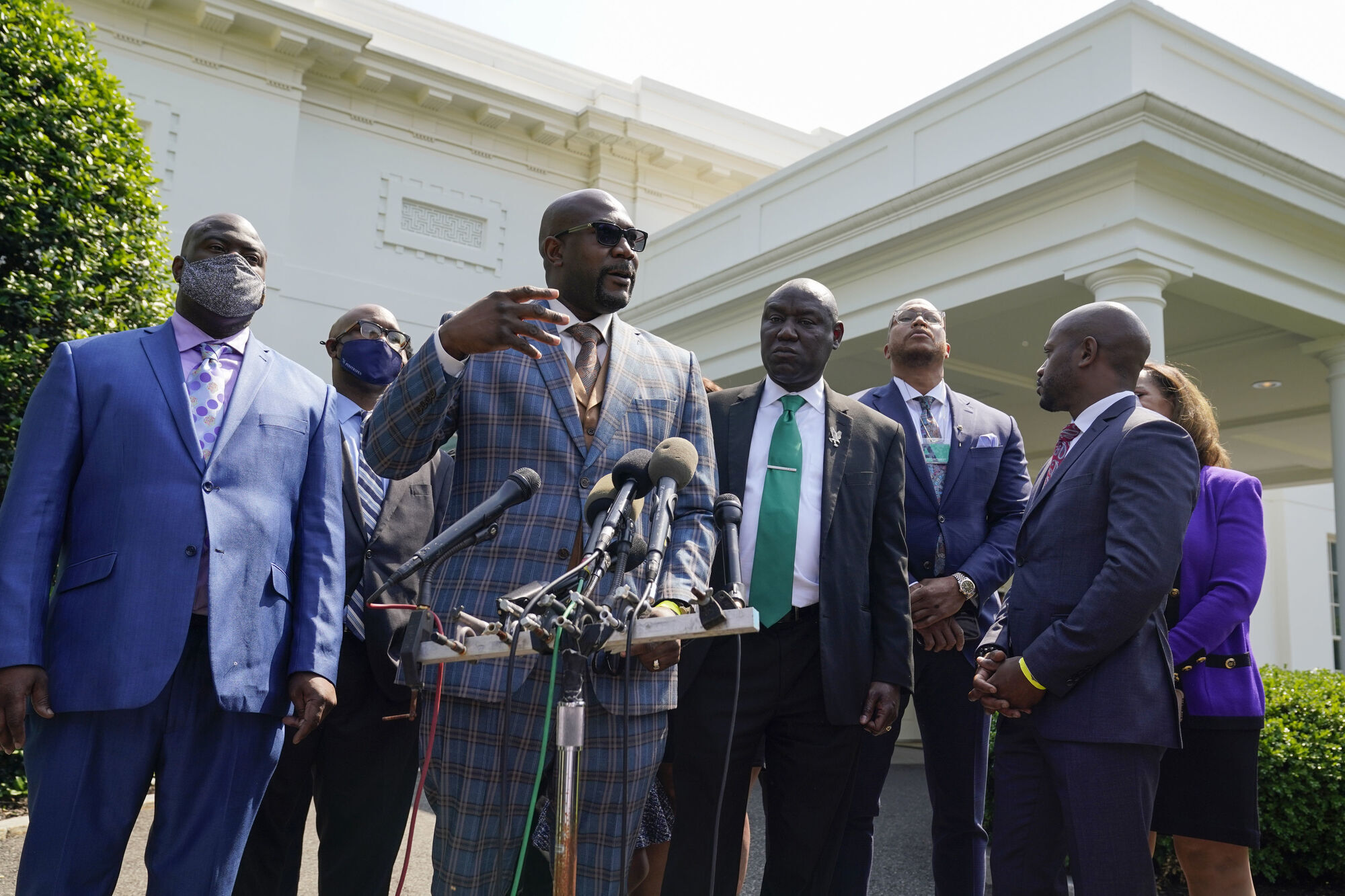
Philonise Floyd, the brother of George Floyd, talks with reporters with other family members after meeting with President Joe Biden at the White House, this week in Washington. At left is Rodney Floyd. Picture: AP Photo/Evan Vucci
Last year, on May 25, the death of George Floyd was caused as a result of police brutality. Many of us have seen the footage of officer Derek Chauvin kneeling down on Mr Floyd and killing him.

I don’t think there is any one solution to racism but I think certain people need to be willing to change their prejudicial ways, to always encourage diversity and to strive for a non-violent social change.
I have been wary of the electronic patient record (MN-CMS) from its inception and was in a minority by not championing Cork University Maternity Hospital becoming the “first fully digital hospital in Ireland” a few short years ago.
Whatever its advantages, it is indecipherable to the outsider. It consists of a series of computer-generated material on sheets of paper, generally undated, with unhelpful titles such as “Miscellaneous Notes”, “Scanned Documents”, “Orders” and “PowerForm Textual Rendition Notes”, etc.
Very few of these notes contain any handwriting or any recognisable input from a person. Instead, they appear to be computer-generated material whose origins are not evident to the reader.
While such a method of notation may be intelligible to those familiar with its use the system is, for all practical purposes, completely unintelligible to the outsider.
In particular, it is very difficult to recreate a chronology from such isolated pieces of paper.
Once in hospital, a patient is subject to this form of disjointed record keeping. I am sure clinicians find the electronic patient record a challenging system to navigate.
It is difficult to find key information such as risk factors which do not appear in the banner bar. If this is so, how can a patient injured by negligence be expected to establish the facts and prove her case to a judge in court?
Similarly, how can a hospital death be properly investigated by a coroner when it is near impossible to construct a narrative from the medical records?
Technology can be both a blessing and a curse.
Sadly, we are now seeing the downside to going paperless. I hope that this current crisis resolves with minimal damage and that the HSE can learn an important lesson from it. My thoughts are with all those affected.