Letter to the Editor: Psychological toll of war on Syrians must concern us all
Although a political solution must be found to end the fighting in Syria, the importance of addressing psychosocial needs is critical to the survival and wellbeing of those affected by the conflict
Letter to the Editor: Psychological toll of war on Syrians must concern us all

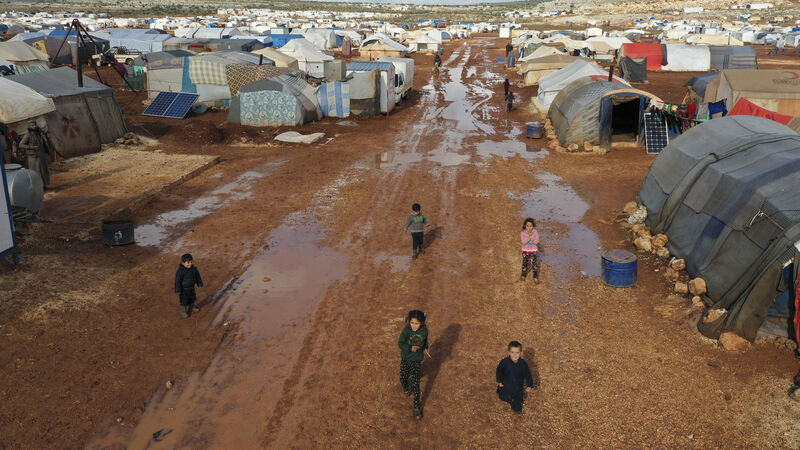
Syrian refugees walk through a camp for displaced muddied by recent rains near the village of Kafr Aruq, in Idlib province, Syria. The Syrian conflict, which marks 10 years later this month, has resulted in the largest displacement crisis since the Second World War.Picture: Ghaith Alsayed/AP


By now we are all familiar with the images that regularly appear from Syria. Photographs of buildings destroyed, of people injured, displaced and distressed. Less visible however is the legacy of these traumatic events and what a decade of conflict can do to the mental health of the people who live there, and the people who are forced to leave.

This week marks 10 years since the conflict in Syria began and in that time the Syrian people have been exposed to repeated trauma and stress while also living in a near-permanent state of uncertainty. 

A recent survey commissioned by the International Committee of the Red Cross showed that two-in-three young Syrians have experienced anxiety, and more than half have struggled with depression and distress. 

These numbers paint a sombre picture of a generation of Syrians who have grown up in the shadow of relentless violence and destruction, who have missed many milestones of childhood and adolescence and face the prospect of many more missed milestones in their future.

In our work with Syrians in Ireland, the Irish Red Cross has seen first-hand the immense psychological toll that ongoing conflict and displacement can take on people. 

While many Syrians express relief at reaching safety on these shores, they also grapple with intense feelings of worry and guilt about the people they had to leave behind.

We welcome the personalised support for vulnerable people as outlined by Minister Roderic O’Gorman in the recently published white paper on the development of Ireland’s International Protection system. 

We trust that mental health services for those seeking international protection will receive priority and funding in equal measure.

Although a political solution must be found to end the fighting in Syria, the importance of addressing psychosocial needs is critical to the survival and wellbeing of those affected by the conflict. 

However, access to appropriate psychosocial support services is extremely limited and nowhere near sufficient. 

It is estimated that there are only 83 psychiatrists left working in all of Syria, making it difficult to access services for mental health when they have never been needed more. 

The impact of un-met needs extends beyond direct psychosocial suffering among individuals and families; the human, social and economic consequences are long-term and far-reaching for entire communities and societies.

Young Syrians will likely shoulder much of the responsibility for the reconstruction of their country, the very least we can do is listen to their calls for psychological support so that, when the time comes, they can begin the slow road to recovery.

Trevor Holmes

Secretary General

Irish Red Cross

Wind energy 22km zone is a disaster

Offshore wind energy is absolutely critical to decarbonising Ireland’s energy supply and so it is disappointing to see calls for an effective ban on proposed offshore wind developments — 'Offshore turbines 'should be at least 22km from shore'' (Irish Examiner, March 15) — by campaigners seeking a 22km exclusion zone around Ireland’s coast.

Around a third of Europe’s existing 25GW of offshore wind energy is located within 22km and there is at least another 16GW of projects in the European pipeline within that distance.

Fixed-bottom wind turbines cannot be deployed in depths of much greater than around 50 metres.

The waters off Ireland’s coast get very deep, very quickly, so an exclusion zone of 22km is, in effect, a ban on offshore wind energy development.

It means that every project designated by the Government as a priority offshore wind project to be completed by 2030 — every single one of them — will be banned.

It is true to say that floating wind energy can be deployed at much greater distances from shore.

Indeed, it is our members who are developing these very projects. It is our members who will make floating wind energy a central part of our energy future.

But there is no way to develop enough floating wind energy, still a relatively new technology, to achieve our 2030 renewable energy targets, nor to supply power — for now — at a cost comparable to fixed-bottom offshore wind energy.

Calling for a 22km exclusion zone is calling for more carbon emissions, for more fossil fuel imports, and for higher electricity bills.

It is a call designed to cripple action on climate change.

It is a call which must be rejected.

Justin Moran

Head of Public Affairs

Wind Energy Ireland

‘The Path Ahead’ — or ‘Back to Square One’

A mere few weeks ago, amid calls from many angles to abandon its failed ‘Living With Covid-19’ plan, the Government opted to give it a lick of paint and rebranded it ‘The Path Ahead’, confirming that it would not be pursuing either a ‘Zero Covid’/elimination strategy or anything close to it. 

In fact, the Government and its cheerleaders spent more time attacking and misrepresenting plans it had no intention of following than explaining how the one it intended to follow would work in reality.

This so-called strategy has effectively put all our eggs in one basket, that of vaccine rollout. 

In the intervening period there have been a whole host of setbacks which has left this newly rebranded strategy in absolute tatters.

Therefore, opposition parties, government TDs with any semblance of backbone and all of civil society needs to quickly coalesce around the view that ‘The Path Ahead’ must be scrapped immediately, along with all the half-measures that it contains. 

It would be more aptly named ‘Square One’ as that is clearly where we are all headed. 

The greatest gift that this Government has is that most of us care too much about one another to jeopardise public health efforts to hound them out of office.

Glenn Fitzpatrick

Blessington

Co Wicklow

We need a strong leader in health

At times of crisis, we need leadership. Health Minister Stephen Donnelly isn’t providing it. I appeal to Taoiseach Micheál Martin to address this. 

We need a strong leader in health now and not a person that sounds as if he’s waffling all the time.

Eddie Leahy

Mallow

School staff are high-priority group

Many parents, grappling with home-schooling on top of their own work, have gained huge insights over the past year into the daily challenges faced by the nation’s teachers while educating our children.

A handful may even have realised that the teacher was not the problem. 

As schools re-opened, teachers and other educational staff once more become frontline workers in a time of pandemic. As such, they deserve to be treated as a high-priority group for vaccines against Covid-19.

This move would acknowledge the essential role they play in society. It would also constitute a very wise precaution against further school closures, this time through unavailability of staff due to avoidable illness.

Sinéad Boland

Kilmacanogue

Co Wicklow

Leo didn’t benefit — but did his friend?

The chorus of well-practised responses from the choir of Fine Gael, Fianna Fáil and Green ministers defending Leo Varadkar’s leaking of a document strike an off-chord. 

They say he should not resign while he is under criminal investigation because of their big centrepiece defence: they say the then taoiseach did not benefit personally from his action.

This reasoning is a clever deflection, and it twists what actually did happen — a friend of a politician benefited from insider access.

It makes no difference if Leo Varadkar had no apparent gain. The gain is the same in any friendship when you do a favour ‘selflessly’. It’s not tangible, but it’s there. 

Friendship of this kind has no place in government.

This is why the taoiseach’s office under Varadkar spent €100,000 a month on PR. It’s worth the expert advice when you need to bend the truth to your own needs.

Jack Desmond

Bandon

Davy above censure, nothing changes

Michael Clifford’s article 'Neither fear nor shame for the Money Men' (Irish Examiner, online, March 15) in relation to the Davy stockbroker fiasco asks: “Where is the shame, where is the fear?”

The article confirms once again, certain structures in society seem to act with “impunity”.

No respect for decency, integrity, or laws.

It seems these “people” believe they are above “question” and certainly above “reproach” in their actions.

This is a culture which, unfortunately, has been allowed continue from British colonial days.

Irish Republicans in their fight for Irish Freedom — showed a distinct lack of confidence in various elements of society, among which was the “banking system”.

It seems nothing has changed.

Shame on our elected representatives.

Michael A Moriarty

Rochestown

Cork

More in this section

Revoiced

Newsletter

Sign up to the best reads of the week from irishexaminer.com selected just for you.

Cookie Policy Privacy Policy Brand Safety FAQ Help Contact Us Terms and Conditions

© Examiner Echo Group Limited