Letters to the Editor: Rural roads need gritting in a cold spell
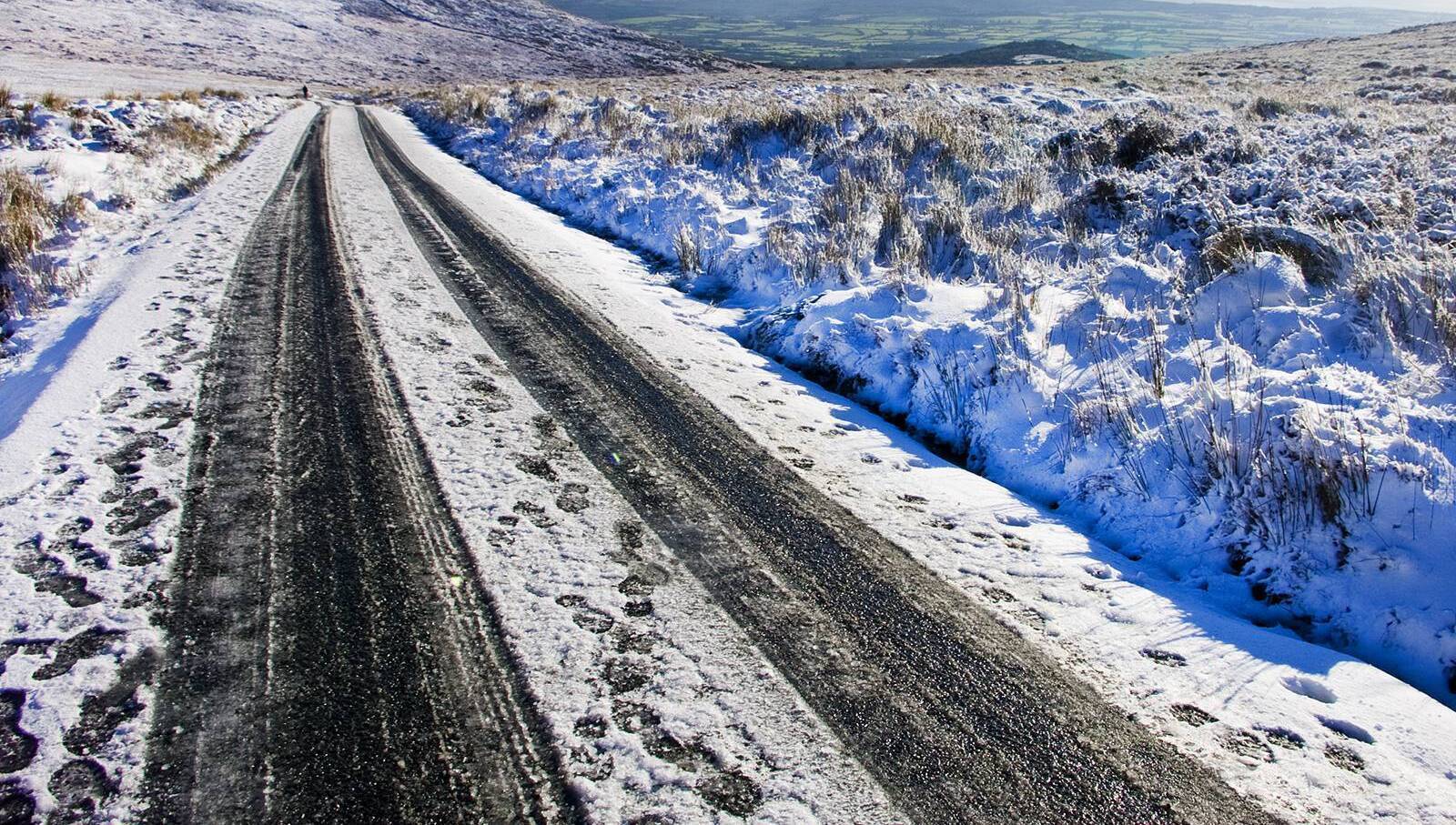
A snowy road in the Comeragh Mountains of Co Waterford. Stock image
As I type, school buses and workers are sliding their way home on our minor routes like some crazy game of bumpers, playing chicken with any driver they approach.
We are a country awash with wealth. Surely to God the salt of the earth inhabitants of rural Ireland deserve a bit of road gritting. Would it break the bank to help prevent our rural drivers from breaking their backs?
One has to wonder if all the increasing taxes we pay are just thrown into a big black icy hole somewhere never to be seen again.
The word salary originated in Rome, where soldiers were allocated an allowance to purchase salt. Perhaps our treasured governors could take up the spirit of the word and pay for a few extra bags of salt so we can get out on our daily business.
The Health Research Board tells us that cocaine was the second-most common drug in use in 2022 (the last year figures are available for), involved in one in three drug poisoning deaths that year.
In 2022, eight in 10 deaths involving cocaine also involved other drugs, with research stating that, between 2013 and 2022, cocaine poisoning deaths increased by 259% — the largest increase of any drug group.
To say we have a serious drug problem in this country is a gross understatement when there were 343 drug poisoning deaths in 2022. This contrasts with what has been described as a devastating year on Irish roads in 2025 with 190 fatalities. Any loss of life, whatever the cause, has huge consequences. However, it is surely beyond time for sustained action on drug-related deaths.
The impact of sustained drug use is catastrophic for those caught in its grip, especially if debts are owed.
Recent media reports have laid bare the traumatic consequences of intimidation tactics, with innocent people targeted in their homes by those ruthlessly recouping debts owed. The impact on bereaved families, children, communities, and society in general, not to mention our already over-stretched healthcare system is simply too great to continue to bury our heads in the sand on this issue.
How many more unnecessary funerals will it take before action to reduce these deaths takes place?
I obviously don’t know what terms of reference were given to the respondents, but I was somewhat surprised that nothing of the spiritual dimension of our lives was mentioned, much less any deeper awareness of the meaning of our existence, or any comfort and happiness derived from faith beliefs. This is in no way to imply that the respondents don’t ponder these matters. I simply don’t know the answer to this.
Pascal Bruckner, the political philosopher, has written that we are the world’s first societies that make “people unhappy, not to be happy all the time”.
So what exactly can "happiness" mean in an age of noise and manufactured excitement — an age, not by accident, rich in anxiety and conflict. Happiness and joy are related but they are very different things.
Joy lifts our hearts toward something beyond our world, something of the holy and eternal, and it cannot be captured or repeated on command.
CS Lewis wrote that “if we find ourselves with a desire that nothing in this world can satisfy, the most probable explanation is that we were made for another world”. The heart is yearning for the beauty of that other world: such is the nature of joy.
So in this Christmas season I am all for happiness but even more so for joy.
Regarding the article — "Up to 75% of short-term lets empty as homelessness nears 17,000, new figures show" ( online, January 3) — while the statistics in the copy make for good headlines, the inferred conclusion does not tell the real story.
This may not be the case in Dublin, Cork, or Galway, but in most of the country, these short-term lets are not under-utilised long term homes. They are farm cottages, glamping tents, or family vacation homes. They never were, and will never be on the long-term market.
Short-term letting allows these properties to be part of the flexible housing ecosystem, for relocating families, contract workers, as well as tourists.
In New York City, Barcelona, Edinburgh, Lisbon, and Amsterdam, the decrease in the number of short-term rentals because of strict policies did not have the desired effect, with rents and hotel prices as much as doubling.
We should learn from these cities, with as much as 10 years experience regulating short-term rentals. Instead, we have legislation before the registration which would have allowed us to fine-tune it to create a good balance. Hopefully it’s not too late.
As Independent TD Michael Healy-Rae said recently “people involved in catering short-term ... didn’t create the housing crisis in Ireland. Neither are they the solution to it”, but is anybody in Government listening?
Focussing on occupancy levels obtained by ‘data scraping’ is a disingenuous attempt — once again — to point the finger of blame for the housing crisis at the self-catering sector.
Here are some facts: There is not a single shred of evidence that the Short-Term Letting Bill will force self-catering operators like myself into the long-term rental market. Conversely, in a poll of members, the Irish Self Catering Federation, who represent more than 6,700 self-catering properties, found over 90% would not move their properties into the long-term rental market.
If the owners of the 35,400 short-term rental properties do not get their planning sorted by May they will be obliged to close. Where does this leave Mr Burke’s ambition to grow tourism numbers by 7% annually when self catering accounts for 40% of tourism beds in Ireland.
Where will people stay — particularly in rural Ireland where there is a paucity of hotels? Ireland needs self-catering but without exemptions for existing operators like myself or a moratorium on planning requirements our cherished self-catering industry will disappear.
It was with great sadness I heard of the death of John Quinn, who I first met over 30 years ago in a tiny bare basement office in RTÉ. He interviewed me on a very basic recorder, far removed from the technological apparatus of today’s world. The topic was for a radio documentary later to be published in book form by Town House in 1997.
Over the years, I felt privileged to be included in many of his publications and events. He was a true and inspiring friend. He always focused on the importance of curiosity, on looking outside the box, and dare I say the label. The difference between schooling and education was foremost in his mind. My last contact with him was when he so kindly contributed to a book we produced on our work of 50 years in November past,
To see his books, especially and on reading lists in educational settings would go a long way to encourage much needed real debate and discussion. In 2018 Veritas published his book Gratias: A Little Book Of Gratitude. He recalled an inscription on a bench in Shanganagh Cemetery, the place where John will now rest.
“A word — Be gentle/ And generously embrace the wonder/ And the beauty of the universe."
His wise words will continue to inspire and challenge us. Hopefully on RTÉ Radio 1 will give us a chance to listen to his mellifluous voice from time to time and again acknowledge his important contribution to Irish life.