Irish Examiner view: Life has not been the same since 9/11
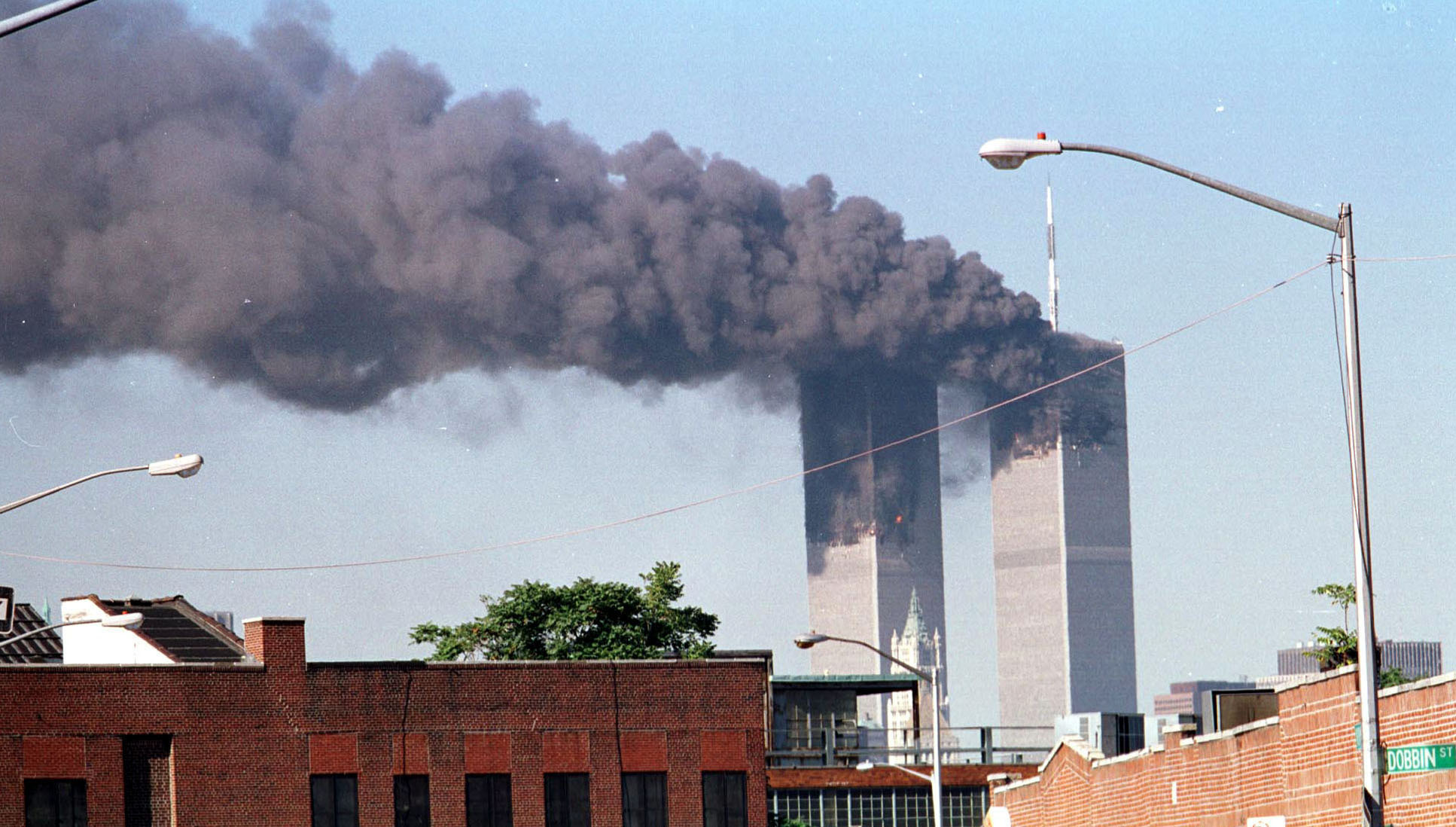
'Even here in Ireland, at a remove of thousands of miles, the sight on TV screens of the planes hitting the twin towers of the World Trade Center in New York had a visceral impact.' File picture: Jim Burke/PA
Describing events as watershed moments in history can often sound like an exaggeration, but not in the case of September 11, 2001. It is fair to say that modern life has never been quite the same since that autumn day 25 years ago.
For those who followed the sequence of events on the day, the sense of shock is easily recalled. Even here in Ireland, at a remove of thousands of miles, the sight on TV screens of the planes hitting the twin towers of the World Trade Center in New York had a visceral impact. The fact that that visual impression was so strong and immediate at the time helps to revive the disbelief experienced by all.

Between the World Trade Center, the plane flown into the Pentagon in Washington DC, and another hijacked plane that crashed in Pennsylvania, more than 3,000 people were killed directly in the attacks on 9/11. Since then, many more are believed to have died by suicide due to trauma, and from illnesses caused by the toxic materials emitted by the collapse of the twin towers.
A decade after the attacks, their mastermind Osama Bin Laden was killed by US forces in Pakistan, but the death toll has mounted ever higher over the years.
Brown University’s Costs of War project has estimated that American military operations in Iraq, Afghanistan, Syria, Yemen, and Pakistan after 9/11 killed nearly one million people between 2001 and 2023, a figure which includes more than 400,000 civilians. And that does not count the thousands of American and allied troops who have died in action or by suicide in the same period.
The appalling cost in human lives is bad enough, but the attacks also contributed to geopolitical destabilisation, a roiling atmosphere of distrust between nations, and a growing number of violent conflicts.
Those phenomena all existed long before that day 25 years ago, but 9/11 had an accelerating effect which persists to this day.
The Economic and Social Research Institute (ESRI) has issued its annual report on poverty, income inequality, and living standards, and it includes deeply concerning statistics on child poverty.
As reported here by Imasha Costa, the report has found that the number of children living below the poverty line has risen by almost 30,000, bringing the total to 200,000.
The statistics can also be interpreted in a way that hikes the number even higher. The poverty line is defined as a figure that is less than 60% of median household income, but if housing costs are taken into account, the number of children in poverty rises to 260,000.
This is a terrible indictment of Irish society in the broadest sense.
The ESRI reports that, in general, there is strong growth in average household income, while at the same time 9% of children under the age of 16 have experienced both child-specific deprivation and household deprivation.
That suggests the growth in average income household income is extremely unbalanced: If almost one child in 10 is deprived, that income growth is certainly not spread across all cohorts of the population, and some sectors are suffering far more than others.
Significantly, Taoiseach Micheál Martin contested the ESRI’s figures. He questioned some of the methodology used, saying that was important “because it’s not taking into account the range of measures we’ve taken over the last two budgets”.
However, he also acknowledged that the level of child poverty “is not acceptable”. There is no disputing that.
It beggars belief that a nation with our resources cannot keep such a huge cohort of children out of poverty. At a time when — as noted by the ESRI — there is strong growth in average household income, many people are simply being left behind. That cannot continue.
Readers may be aware of a public exhibition in Cork which features one of Ireland’s most significant historical documents.
The exhibition, in University College Cork’s Glucksman Gallery, features the Annals of Inisfallen, an Irish medieval manuscript collection. It opened last week and will run until November 1.

The annals offer detailed descriptions of remote historical events ranging from the invasions of Ireland by the mythical Tuatha Dé Danann, Viking raids on Skellig Michael off the coast of south Kerry, and the coming of the Normans in the 12th century. However, some observers are focusing on far more recent developments.
The annals were part of the collection of 17th-century Irish historian James Ware before passing to Richard Rawlinson, whose bequest brought them to the Bodleian Libraries at the University of Oxford. They have been preserved there for over 250 years and have been loaned by Oxford to UCC.
Should they be given back?
Sinn Féin TD Donnchadh Ó Laoghaire has said the annals should be kept in Ireland, adding: “Many such items were stolen from Ireland in the first place, in a form of colonial plunder, and they should return to Irish ownership.”
The ownership of artefacts raises vexed questions in many jurisdictions: Take Greece’s long-standing call for the return of the Elgin Marbles, taken from Athens by the British two centuries ago. France recently lent the Bayeux Tapestry to Britain for a special exhibition, a diplomatic initiative driven by French president Emmanuel Macron himself.
Perhaps new British prime minister Andy Burnham could be prevailed on to sign off on the annals remaining in Cork?