Irish Examiner view: Where will horror in Gaza all end?

There are now widespread reports of looting, but given that the population is on the brink of famine and the entire infrastructure has been devastated, that’s hardly surprising
Irish Examiner view: Where will horror in Gaza all end?

Palestinians carry sacks of flour unloaded from a humanitarian aid convoy that reached Gaza City from the northern Gaza Strip on Tuesday. Picture: Jehad Alshrafi/AP

Only the wilfully ignorant would disagree with UN secretary general Antonio Guterres when he describes Gaza as “a horror show”. UNRWA commissioner general Philippe Lazzarini, meanwhile, says Gaza, still subject to a blockade by Israel, is “hell on Earth” and that the Gaza Humanitarian Foundation aid sites are “a sadistic death trap”.

Mr Guterres told the UN security council: “Now we are seeing the last gasp of a humanitarian system built on humanitarian principles. That system is being denied the conditions to function. Denied the space to deliver. Denied the safety to save lives.”


Local health officials report that at least 80 children have died of hunger during the war, along with another 20 or so adults. However, they say the pace of death through malnutrition is increasing, with a six-week-old baby among 15 such victims in just the past 48 hours.

The Gaza Humanitarian Foundation has tried to shift the blame to the UN, saying it is refusing to deliver aid that “could help end the desperation”.

Beyond desperation is perhaps a better description.

The number of Palestinians killed trying to access food and water is now more than 1,000 — compared with an official death toll of 59,000 overall in the 21-month war — with some families releasing footage from dead loved ones’ phones showing their final moments.

There are now widespread reports of looting, but given that the population is on the brink of famine and the entire infrastructure has been devastated, that’s hardly surprising. The Norwegian Refugee Council says whatever it had available has been given away, and that its own staff are starving.

Meanwhile, WHO housing and warehouses came under fire from Israeli forces yesterday, not once but three times, meaning the agency’s work is compromised.

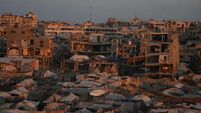
It comes as one of the least damaged parts of Gaza, a key route for both people and aid, comes under attack. Of course, to say “least damaged” is a bit tautologous, given that an estimated 90% of buildings in Gaza have been destroyed or damaged and most of its more than 2m people displaced.

Such a level of wanton devastation must surely be deliberate policy. The amount is so catastrophically high that any claims of targeting Hamas militia or tunnels or hidden arms caches every time cannot be credible. The country’s politicians and military keep saying they are protecting civilians, but such protests ring depressingly hollow given that civilians are the ones dying by the legion.

Where does it end? With the complete clearing of the region, which we learned yesterday is so heavily piled with rubble that could take as long as four decades?

And if that’s the case, where do the people go?

We have heard Donald Trump talk about turning Gaza into a sort of Riviera of the Middle East, and of Israeli demands to hold on to 40% of the territory in exchange for a ceasefire — talks on which are reportedly on the verge of collapsing. None of this is either legally or morally defensible.

The mass starvation we were warned of some months ago now appears to have arrived, weaponised and exacerbated by military and political actions. We will all have to live with this stain on our humanity.

Water shortages

The phrase “dying for a drink” is usually said in jest, but for how much longer?

As it is, millions of people across the world are suffering either through polluted water or, increasingly, a complete lack of it. Some of this is down to climate, with soaring temperatures in summer now the norm, and some of it is down to either the weaponising of water access or its destruction due to military actions.

And climate is a major factor, with runaway heat leading to evaporation as well as increased demand for increasingly pressured supplies. The lack of water access hinders everything from growing vegetables to planning permission for housing, and whole cities have to grind to a halt, rightly, if it gets too hot to be safe to work.

Just this week, Iran’s capital, Tehran, urged residents to conserve water as the heat reaches 50C and above. We should expect that sort of restriction to become regular in our part of the world, even if we may never reach those temperatures. Existing infrastructure was not designed to cope with it.

Elsewhere, only recently we read of an Israeli strike killing children and adults as they queued for water in Gaza, which has long relied on desalination plants, many of which are now no longer functioning.

Meanwhile, in eastern Ukraine, where between 3m and 3.5m people live under Russian occupation, some cities have had to cut water supplies to every two or three days. People aren’t even able to flush their toilets, reduced instead using plastic bags for human waste which are later thrown away. This situation has been attributed to everything from damage and supply restrictions due to the ongoing war, chronic mismanagement, heat, and general neglect. Nonetheless, there have been warnings that it will lead to outbreaks of disease, which will only exacerbate things.

Those are only three examples, but the truth is water shortages are now a global concern from the US to Asia. As it is, few regions emerge unscathed over the course of a year. Soon, none of them will.

Modern mystery

What’s in a name? Well, if you’re the writer Liadan Ní Chuinn, a defensive screen against prying eyes.

Ní Chuinn, whose real name has not been made public but who is finding success with her short story collection Every One Still Here, is a refreshing enigma in an industry that demands almost saturation when it comes to self-promotion.

Plenty of writers have pen names. Some have a different name for each genre they write in — JK Rowling, itself something of a pseudonym so boys would think the Harry Potter books were written by a man, is also Robert Galbraith while writing crime fiction. 

But typically, the person behind the pseudonym is still to the fore in some degree. That could be running their own social media with a photo of them included, or it could be attending in person events on book tours, if they’re fortunate enough to be able to cover the cost of them.

Ní Chuinn, reputedly from Northern Ireland and born in 1998, rebuffs all of that with the full support of her publisher, The Stinging Fly.

In a world where most of us spend far more time than is good for us online, there is something to be said for removing oneself from the equation and allowing the art to speak for itself.

More in this section

Revoiced

Newsletter

Sign up to the best reads of the week from irishexaminer.com selected just for you.

Cookie Policy Privacy Policy Brand Safety FAQ Help Contact Us Terms and Conditions

© Examiner Echo Group Limited