Irish Examiner view: We can only speculate about Ireland’s ‘Great Beyond’
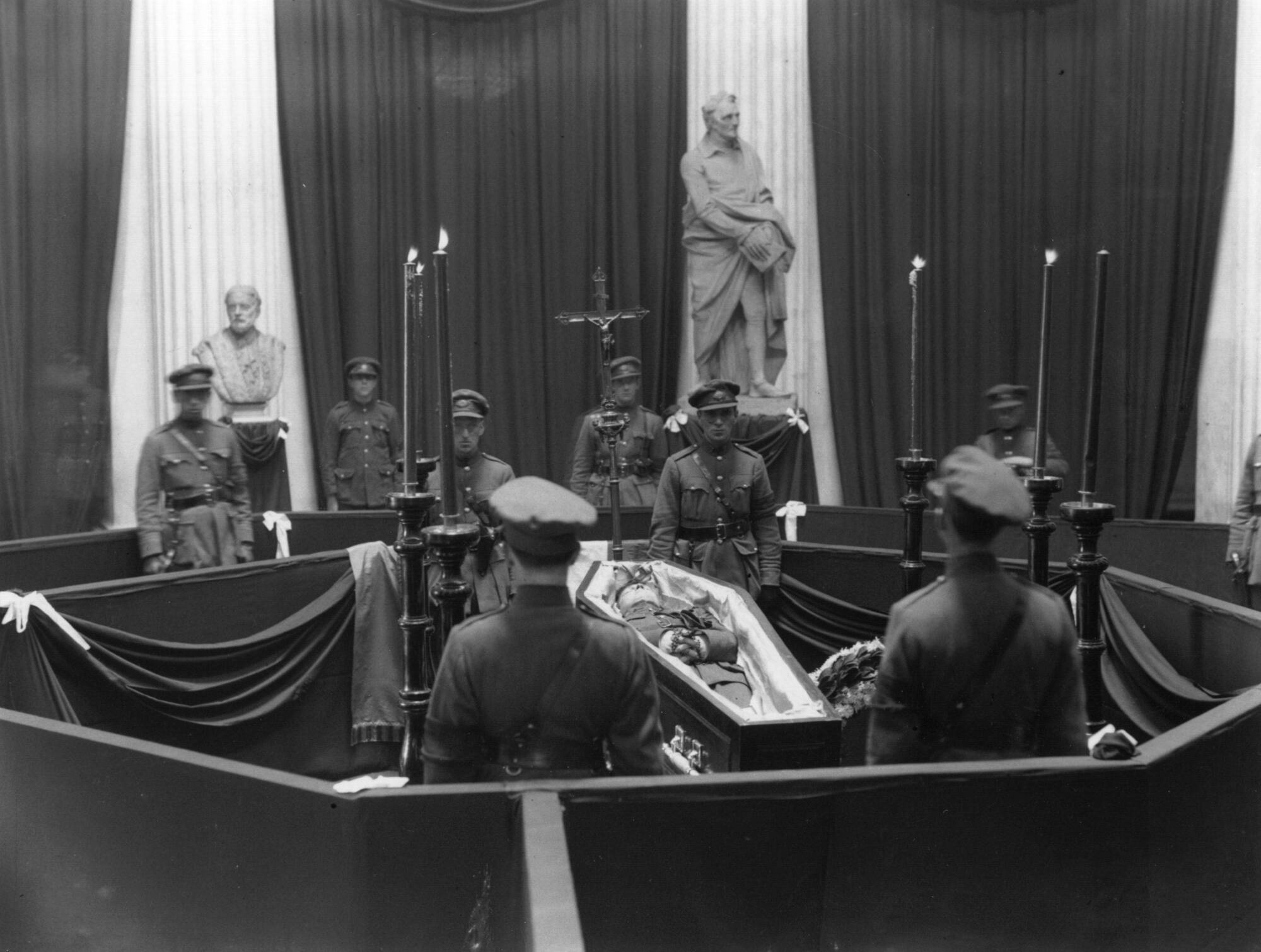
Michael Collins lying in state in Dublin. Collins was shot dead in Béal na Bláth, Co Cork, 100 years ago. Picture: Central Press/Getty Images
Given the totemic symbolism of Michael Collins in the creation and development of modern Ireland, it may appear to be a little slow on the uptake that this year’s centenary commemoration of the killing of the War of Independence leader at Béal na Bláth is the first to be screened live by the national broadcaster.
In a series of firsts, Micheál Martin will become the first Fianna Fáil Taoiseach to address the event, a platform he will share tomorrow with the Fine Gael leader and Tánaiste Leo Varadkar, creating a sense of unity that did not exist a century ago.

An outside broadcast company has been hired to provide a reliable live feed of the commemoration which will be available on RTÉ’s News Now channel.

Yesterday, RTÉ Radio 1’s broadcast from the Munster Arms Hotel, Bandon, where Collins was last photographed 30 minutes before his fatal rendezvous with destiny at Béal na Bláth.

Many thousands of people are expected to attend the commemoration and Cork County Council, with assistance from three Government departments, have been able to complete
a major, and overdue, renovation of the site to make it more accessible to visitors and the legions of people throughout the world who are admirers of, and intrigued by,‘The Big Fellah’.
Many thousands, or millions, of words, will swirl around the reputation and legacy of Collins, including our own tribute, ‘The Lost Leader’, to be published on Monday.
There will also be an RTÉ cold-case analysis chaired by former State pathologist Marie Cassidy this coming Wednesday, which will attempt to draw conclusions about the assassination which changed the course of the Republic’s history.

The Government has ruled out any official inquiry into what happened on that mid-Cork road a century ago, with the Taoiseach stating that the concept was “anathema”.
He said last year: “History is complex. There are many variables, there’s never one simplistic narrative. We’re all biased to certain extents, to certain degrees.”

There was no inquest into the death of Collins, no death certificate was issued and the autopsy report was lost. Theories and suspects abound.
Last year, we asked whether it mattered to know the truth after the passage of all this time. Our rhetorical answer was “yes”.
The assassination of Michael Collins, if that is what it was, is one of the foundation myths of the State and it resonates to this day. If there is truth to be found, it is always best and safer to unearth it. It prevents the past from being hijacked and distorted, often to serve political ends.
Collins always viewed the treaty as the best deal that could be gained at that time and that it provided “the freedom to achieve freedom”.
captured the mood when it reported on August 24, 100 years ago, that “tragedy and sorrow — as deep as the waters on the Western Coast — fills the hearts of the people. Michael Collins, soldier, statesman, and patriot, has passed into the Great Beyond, and a bereaved nation, stunned by the calamity, can scarcely yet appreciate its full import.”
What the “great beyond” would have been for us if Collins had lived, we can now only speculate. But his memory is at the front of our minds at a time when the tectonic plates of political thinking, leadership, and alliances are shifting and the winds of change are blowing.
Collins would have seen the opportunities within that volatility, and it may be that the modern people of Ireland will as well.