Irish Examiner view: Oligarchs must pay the price for Russia's invasion of Ukraine
In advance of the full invasion, the EU, the UK, and the US announced it would target Russian banks, businesses, oligarchs, and State-linked entities with financial sanctions
Irish Examiner view: Oligarchs must pay the price for Russia's invasion of Ukraine

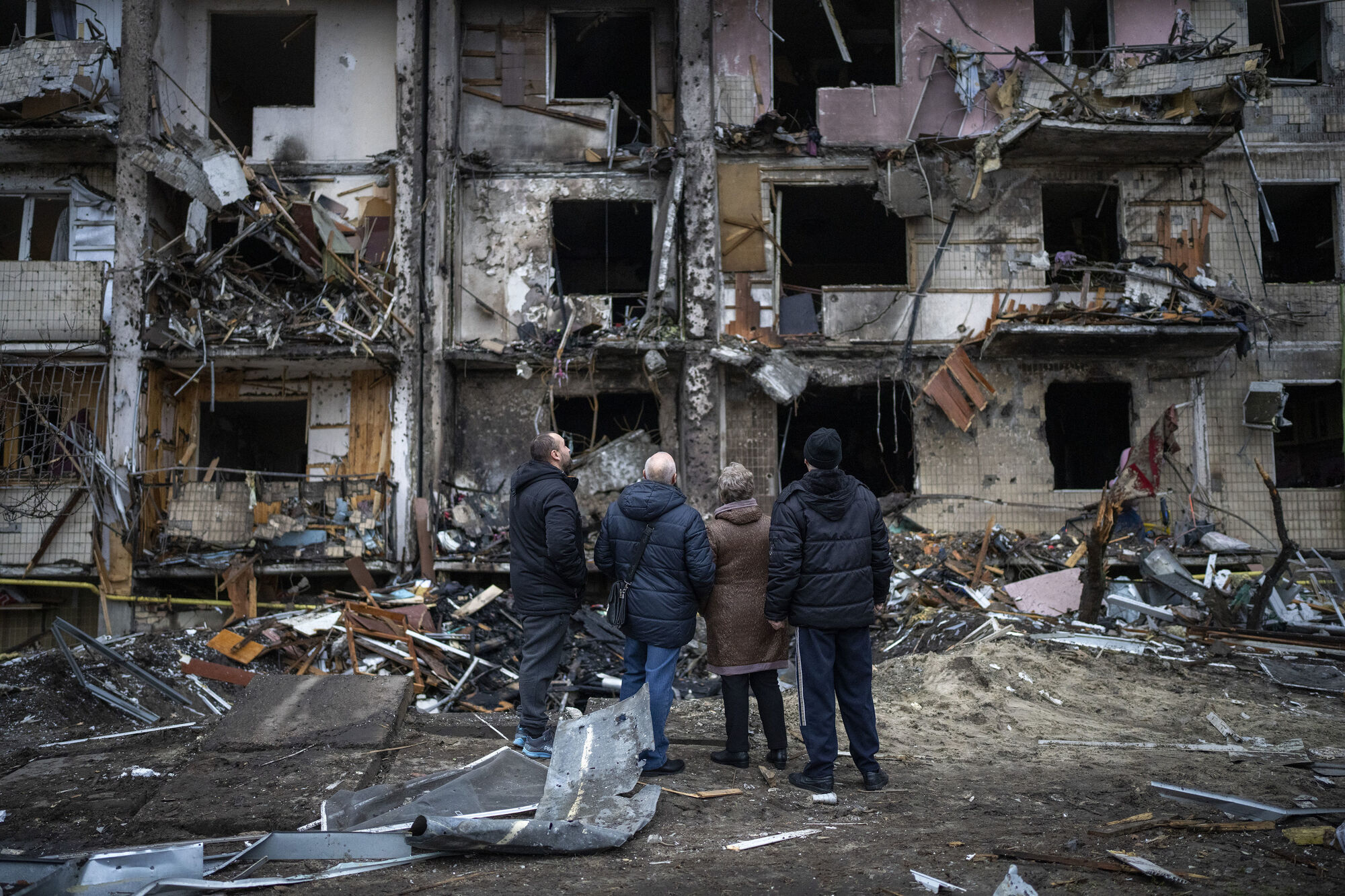
People look at the damage following a rocket attack the city of Kyiv, Ukraine, on Friday. Picture: Emilio Morenatti/AP

Vladimir Putin’s invasion of Ukraine is a cautionary reminder of how wars happen in spite of the near-universal desire for peace among nations.

War is never inevitable but neither is peace. The century since the end of the Napoleonic wars was the most peaceful time Europe had known since the fall of the Roman Empire. 

Europe had not been entirely free of wars in the 19th century but they were limited in duration and scope, nothing to compare to the drawn-out conflicts of the 18th century or the wars of the French Revolution and later those of Napoleon.

The 20th century saw the great Paris Exhibition of 1900 which celebrated global culture and scientific achievement and produced the Eiffel Tower while the second modern Olympic Games took place nearby in the Bois de Boulogne as part of the Exposition.

In the first years of the 20th century, with advances in industry and technology, most Europeans believed they could look forward to unrestrained progress and a peaceful and prosperous future. 

However, colonialism, imperialism, and ethnic rivalries along with shifting alliances helped to bring about the failure of the 100-year long peace and the outbreak of a war that devastated Europe and led to the loss of more than 60m lives.

The invasion of Ukraine has been widely condemned in the West. In a special televised address yesterday, Taoiseach Micheál Martin described it as “an outrageous and moral breach of the most fundamental principles of international law".

The problem is that Putin has no respect for law — international or otherwise. 

He has made it clear in his policies over the past two decades that he does not regard Ukraine as a legitimate nation and is determined to end Ukraine’s 30 years of independence.

It may be harder than he thinks, though. Despite Russia’s overwhelmingly military superiority, the Ukrainians are a determined people and their forces are capable of mounting significant resistance and inflicting heavy casualties on Russian troops. 

Ukraine is a vast country, the second largest in Europe after Russia, and that will make it more difficult to contain. 

As the Americans found in Vietnam and the Russians themselves in Afghanistan, invasion is the easy bit, asserting and then retaining control is much harder, particularly if civilians are hostile.

Insurgencies most often succeed when an occupying power, tired of increasing casualties and the growing amount of money required to defeat the rebels, gives up and goes home. 

Russia’s defeat by insurgents in Afghanistan three decades ago contributed to the collapse of the Soviet Union, which Putin has called the greatest calamity of the 20th century.

So what is the West going to do or what can it do? Appeasement has failed. 

The West has been appeasing Putin for years. Western leaders let him get away with occupying parts of Georgia in 2008; then in 2014, he rolled into Crimea and, despite protests, got away with that.

Diplomacy has also failed and a military response by the US has been ruled out on the grounds that it could lead to a nuclear conflict. 

That leaves sanctions; so far, these have been too puny and tepid to be of any effect but there is a growing realisation that they must be ratcheted up considerably. 

Speaking ahead of an emergency EU council meeting, Micheál Martin said Putin "must be held accountable", as he warned that the EU is to adopt tougher sanctions than ever before “to hit Putin and his henchmen where it hurts".

Where it hurts — or could be made to hurt — is in the pockets of the Russian oligarchs who support Putin. 

In advance of the full invasion, the EU, the UK, and the US announced it would target Russian banks, businesses, oligarchs, and State-linked entities with financial sanctions.

We in Ireland have our own role to play, as it is becoming increasingly clear that London is not the only clearing house for Russian money. 

If EU, UK, and US sanctions bite, there is a danger that Ireland could be seen as a safe haven by the oligarchs.

As Labour Party leader Alan Kelly asserts, Ireland is at risk of becoming “the best small country in the world to funnel corrupt dirty Russian oligarchs’ money”.

He said that an estimated €118bn flowed through the International Financial Services Centre (IFSC) to Russian entities from 2005 to 2017.

The invasion of Ukraine will test Western resolve but we must not be found wanting. Thousands — perhaps millions — of lives may depend on it.

x

More in this section

Revoiced

Newsletter

Sign up to the best reads of the week from irishexaminer.com selected just for you.

Cookie Policy Privacy Policy Brand Safety FAQ Help Contact Us Terms and Conditions

© Examiner Echo Group Limited