Irish Examiner view: Ireland must face up to security threats
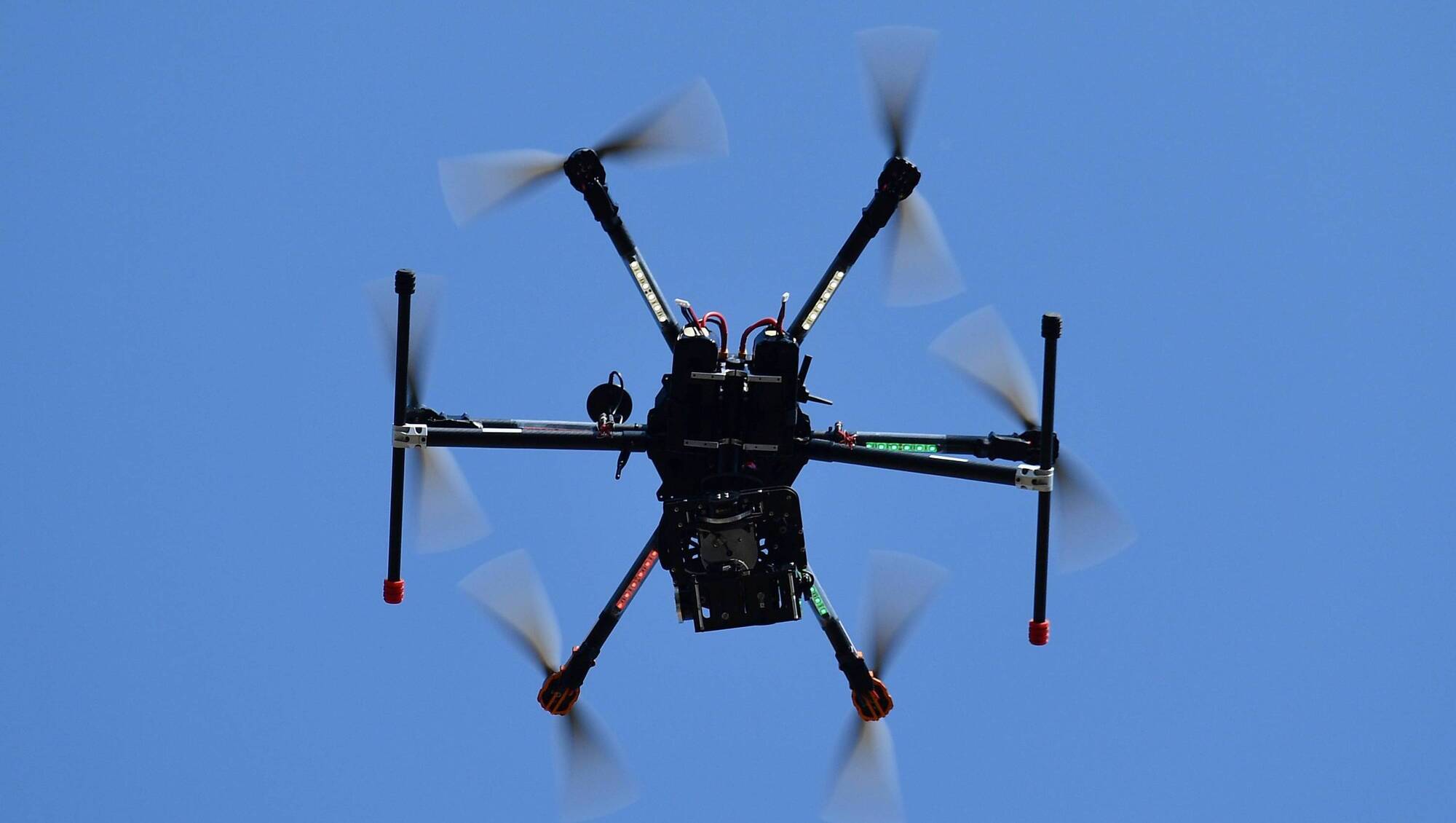
The incursion of drones into the flight path of the jet carrying Ukrainian president Volodymyr Zelenskyy as it arrived into Dublin Airport is but the latest evidence of the security threat looming over Ireland. Picture: Vincenzo Pinto/AFP/Getty
This country is inexorably headed for a lengthy and divisive debate about our long-standing neutrality in the near future. Meanwhile, the events of recent weeks have highlighted another pressing and worrisome matter: Defending our country against malign threats.
In recent months, the Government has committed to a massive increase in spending on the Defence Forces.
However, incidents such as the incursive drones being flown on the flight path of the jet carrying Ukrainian president Volodymyr Zelenskyy into Dublin last week highlighted the lack of a plan and resources and an absence of organised co-ordination against foreign actors. We do not yet know who was responsible for the drone activity that sent our security forces into a complete tailspin, although justice minister Jim O’Callaghan has confirmed it was not some back-garden enthusiast.
Regardless, we appear defenceless against such threats.
That this was, according to the minister, a “co-ordinated threat against European interests” is quite chilling. That it happened here in Ireland clearly illustrated our almost complete inability to do anything about such threats.
It also sparked a rift between An Garda Síochána and the Defence Forces about their willingness — or lack of it — to shoot these drones down. It embroiled the Department of Defence in questions about what exactly its role in the whole matter was.
Ahead of our forthcoming presidency of the EU, this was a startling reminder of how unprepared we are in a world where the rapid deployment of hybrid warfare tactics by any number of malign forces can easily cause mayhem and havoc.
Taoiseach Micheál Martin said it was “not a surprise” that drones were spotted during Mr Zelenskyy’s visit, noting that there has been a “pattern” emerging over recent months, including incursions in the UK, France, Denmark, and Belgium.
The National Security Council would meet shortly he said and produce a report. However, he conceded that increased investment would be required ahead of the EU presidency, including cybersecurity and radar.
“We understand the challenges, no more than any other member of the European Union who has had to deal with this,” he said.
While the impending debate on our neutrality will generate much heat, before we even embark down that road we need to implement basic security measures in a co-ordinated manner which will, at least, secure our evidently open-to-all-comers seas and skies.
The indications yesterday that the Government plans to spend some €15m-€17m on anti-drone technology is a good sign, but we are obviously chasing our own tail here and trying to slam the stable door long after the horse has bolted.
The spectre of the health system straining under the weight of hundreds of flu patients is yet another reminder of the shortage of hospital beds across the country ... as if one was needed.
With hospitals running at or above full occupancy even before flu season, there is no capacity to deal with increased demand. It was a point taken up by Peadar Gilligan, a consultant in emergency medicine in Beaumont Hospital and a member of the consultant committee of the Irish Medical Organisation. He said:
“This allows for little or no capacity to deal with any increase in workload. Most Irish acute hospitals, even before the influenza season started, were utilising their surge capacity ie sitting in-patients in chairs, managing in-patients on trolleys in day wards, in endoscopy suites, in cardiology day wards, as extra patients on wards, and on the corridors of emergency departments and wards.”
While doctors are advising it is not too late for people to be inoculated against flu and secure vaccination protection and visitors restrictions in place in some hospitals, the inability of general practices and hospital emergency units to cope with the numbers projected suggests an absence of any concerted planning for what is now an annual crisis.
We have seen in times past the effects of political stasis, but it has been nothing like the scale of that currently extant in Belgium. Here, the country’s capital has been without any effective government for nearly 550 days.
Brussels prides itself on being at the forefront of European political compromise. However, the Brussels capital region, which governs Belgium’s main city and its 1.25m residents, has not had a government since elections in June 2024.
The city has now surpassed the country as a whole, which hit the headlines in 2010/11 when it took 541 days to form a national government — the longest peacetime absence of administration ever seen in Europe.
The problem is that there is a distinct likelihood the crisis will not be solved any time soon. Some 14 parties won seats in the 89-seat parliament which governs Brussels, but the rancour and division amongst them has made agreement impossible. This institutional void and political inaction is having a huge effect on the economic, social, climate, and official policy areas that need immediate work. At a time of international crisis, Brussels doesn’t need a domestic one too.
Read More

CONNECT WITH US TODAY



Be the first to know the latest news and updates