Dolan O'Hagan: The long tail of history will show Ulster the way
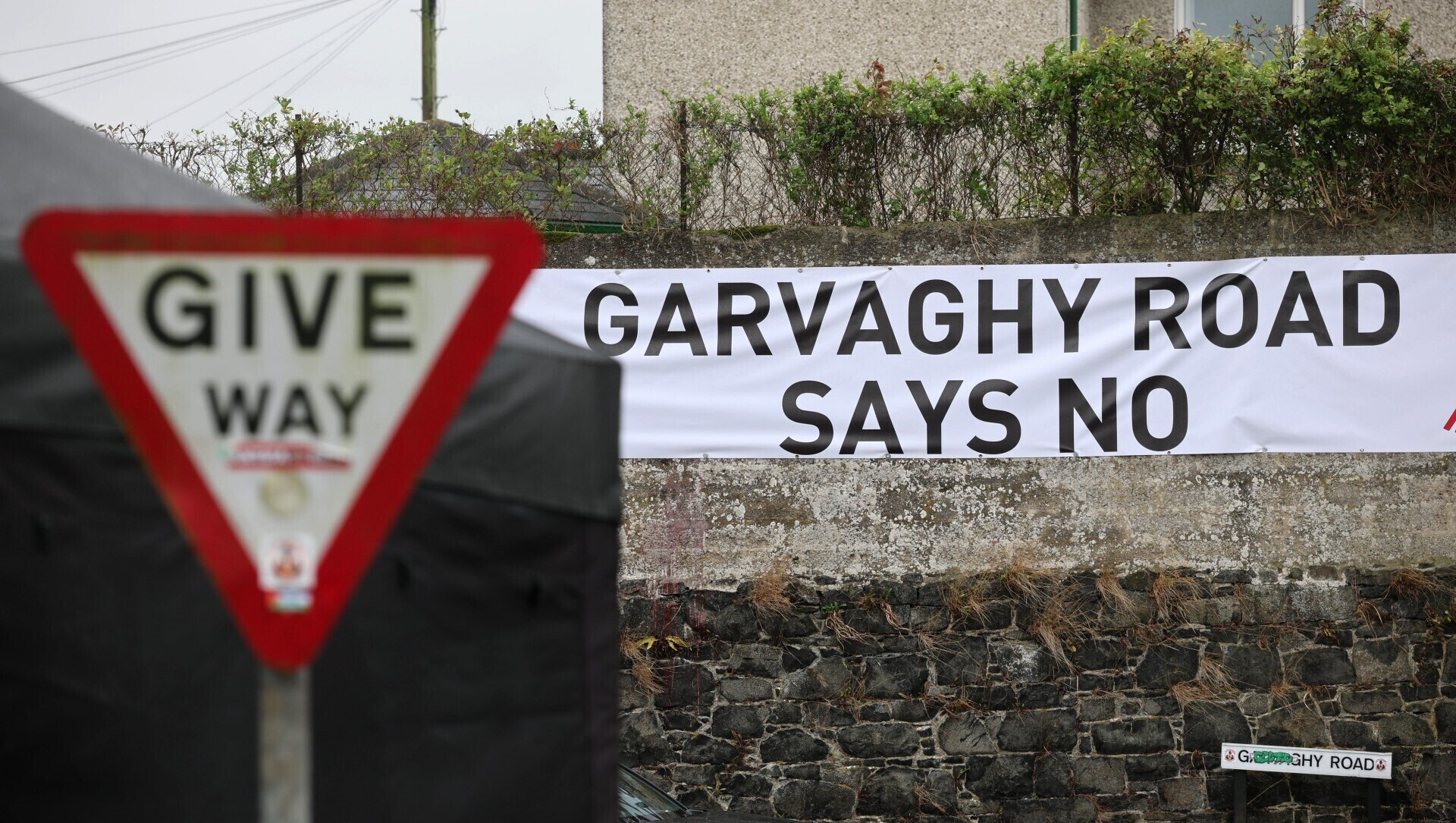
A banner is displayed on Garvaghy Road, following a weekend of tension at Drumcree in Portadown. File picture: Liam McBurney/PA
A political row over the British PM's assertion that a border poll is off the table and not up for discussion, one week.
Controversy over the US president's off the cuff endorsement of a united Ireland, the next.
And then, after 28 years of refusals, the Parades Commission's unexpected green light for a 'highly contentious' Orange Order parade on the Garvaghy Road.
All very interesting, if somewhat tiresome, for a cynical Ulster man in exile.
Assembly elections on the horizon next Spring, anyone?
Are the northern flocks being herded along traditional paths as the political shepherds get increasingly spooked at ever changing grazing grounds? Who was it that suggested the established political machine will always triumph as long as it remains a united minority against a divided majority.
For the record, it was the American historian and philosopher Will Durant.
I would have been happy to leave my assessment of recent events in the North with that typically pithy and admittedly reductive cynicism if it wasn't for the fact that as they were unfolding I was, by chance, reading the late Jonathan Bardon's excellent book,
Bardon was a highly regarded teacher, historian and author who was born in Dublin in 1941 and died in Belfast (where he had lived since the late 1960s) just short of his 80th birthday in April 2020.
Read More
A shortened version of his definitive 800 page tome, provides a highly readable and eye opening account of 9,000 years of Ulster history. Covering early settlements, through the Viking and Norman invasions, The Gaelic Recovery, Tudor invasions, the plantations and the Penal Laws, the rise of the United Irishmen and Orangeism, the Act of Union, emigration and the Great Famine, the linen industry and shipbuilding, and the Home Rule Crisis and partition, the civil rights campaign, the turmoil of the Troubles and up to the signing of the Good Friday Agreement.
What makes Bardon's history particularly engaging is that he places these events within a social, political and economic context and attempts to shine a light on what life would have been like for ordinary Ulster folk on the ground, or perhaps more aptly, in the fields.
I was concluding the book as news of the latest Garvaghy Road controversy began to emerge and was struck by the importance that Bardon attached to the original Garvaghy Road protests — and the wider Parades disputes — that erupted in violence across the North between 1994 and 1998.
He references them in both the updated preface to the book (dealing with the relative peace that has followed the signing of the GFA) and chose to end his original account of modern Ulster history with a retelling of the disruption, disturbances and deaths that occurred in that period.
It was clear he felt they were, and would be, a valuable touch stone and yard stick for measuring 'progress' in the years that followed.
No doubt he would have been depressed (but ever hopeful and obdurate in true Ulster spirit) at recent events in the North.
Most telling in that regard is the way that Bardon ended his book.
In a concluding section, entitled , Bardon places the history of Ulster in the context of wider European ethno-political conflicts.
On one hand he pointed to similar and ongoing ethic political conflicts which arose following the end of the Cold War. In particular he cites conflicts between Armenians and Azeris, Moldovans and Transdniestrians, Serbs, Croats and Muslims and Russian and Chechens which were a result of 'atavistic urges' remarkably similar to those being experienced in the North.
He points also to how several European governments have resolved long standing ethnic tensions with new constitutional agreements and cited autonomy for South Tyrol in 1972, devolution in the Catalonian and the Basque territories following Franco's death, the creation of Jura in Switzerland in 1978, self government for Corsica in 1982, Belgium's evolution into a federal state by 1988 and special status for Transdniestria within Moldova in 1992 as examples.
Most striking for me, given the events of recent weeks, was Bardon's final entry.
Speaking directly to those who despair of ever finding a solution "capable of restoring calm and mutual respect to Ulster" he recounts the words of an adviser to Henry VIII in the late sixteenth century: "It is a proverbe of olde date, 'The pryde of Frances, the treason of Inglande and the warre of Irelande, shalle never have ende' ... without Godd sett in mennes brestes to fynde some newe remedye, that never was founde before."
One can only hope that when the noise abates around this latest 'political crisis' we can take some comfort in that fact that no one lost their life and it is just noise, rather than smoke and tear gas, that must clear on this occasion.
But perhaps with Bardon and King Henry's adviser in mind we should take most solace in the knowledge that as this issue recedes and everyone takes time to consider what was really at play here we will perhaps be one step closer to the development of a 'new remedy' in the hearts and minds of ordinary Ulster men, women and children.
The people who, in the years ahead, should and will ultimately decide how the next chapter of its long and ever evolving history will take shape.


CONNECT WITH US TODAY



Be the first to know the latest news and updates