What a cow contraption said about Irish attitudes to Africa
A century-old cartoon of a cow-powered football factory looks like harmless mission magazine whimsy, but it sat just pages away from far more blatant racism in Irish missionary print culture
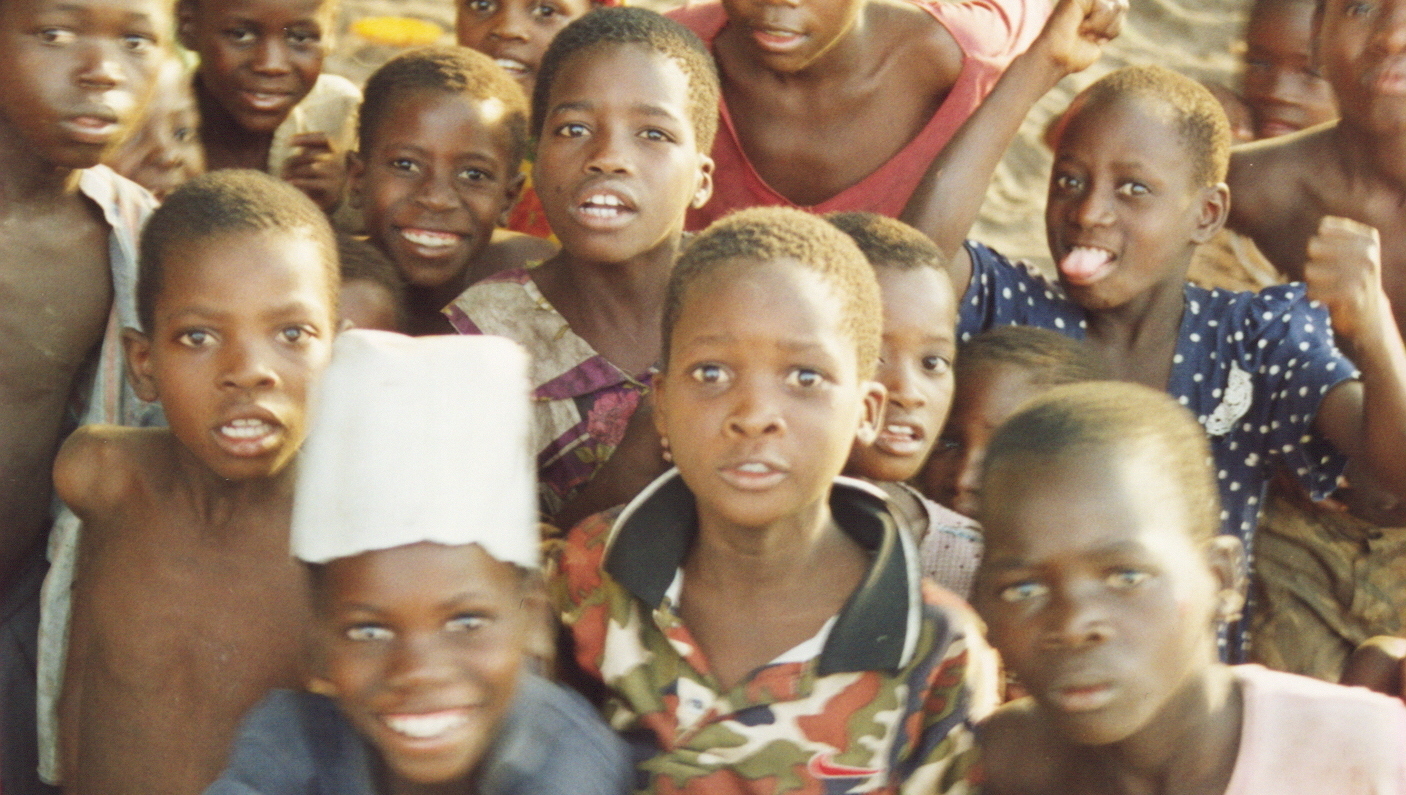
Mission print used humour not to mock African children outright, but to gently infantilise them. File picture: Tadhg O'Conaill

Mission print used humour not to mock African children outright, but to gently infantilise them. File picture: Tadhg O'Conaill

What did a cow contraption say about Irish attitudes to Africa? RTÉ’s recent documentary The Last Irish Missionaries went back over that history. 

The cartoon below is a smaller, odder footnote to the same story. Flick through an old Irish or British missionary magazine from the early 20th century and, alongside the earnest appeals for funds and reports from the field, you’ll sometimes stumble on something unexpected: A joke. 

One example reprinted in the African Missionary, a mission periodical, was borrowed from the illustrator W Heath Robinson, famous for drawings of absurdly over-engineered machines built to do the simplest of tasks. 

This one, titled “Footballs for African Boys”, shows a fictional production line involving cows, milk pails, hurdles, and flying men, all supposedly designed to toughen leather hides so that footballs sent to “mission schoolboys” in Africa might survive being kicked around barefoot.
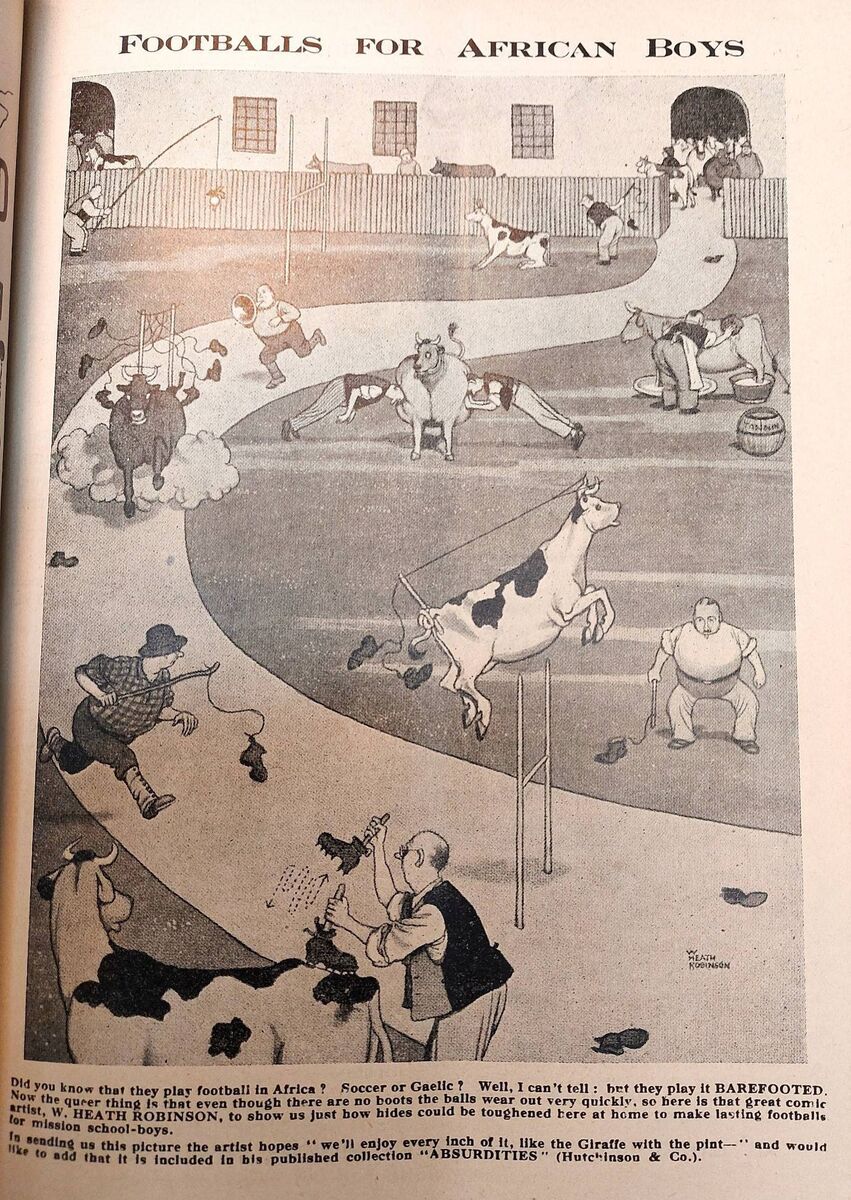

It’s funny. It’s also worth taking seriously, as the joke is doing real ideological work. African children play football barefoot, footballs wear out fast, so here’s an absurd contraption to solve the problem. But look closer, and the “problem” itself is telling.

It would be easy to dismiss a 100-year-old cartoon as a harmless curiosity. But images like this were part of how ordinary Irish and British readers came to understand Africa and its people not through meeting anyone, but through carefully chosen, often funny, second-hand glimpses.

It frames African children not as people with their own sporting culture and resourcefulness, but as a mildly amusing inconvenience for well-meaning adults back home to solve. 

This is a pattern that turns up repeatedly in mission print: Humour used not to mock African children outright, but to gently infantilise them. The joke doesn’t require cruelty, just affection without curiosity, a wink rather than a genuine question about who these children were.

That reading isn’t just an inference from one cartoon. In going through Irish missionary magazines of this period for my own research, I found that the mild teasing of a piece like “Footballs for African Boys” sat only a few pages from far blunter material. 

Articles regularly ran under headlines promising a look at “barbaric natives,” and described African culture and religion as “uncivilised,” “primitive” and “pagan”. 

On February 21, 1932, a lecture titled ‘Among the Cannibals’ drew a large crowd to Dublin’s Royal Theatre, where Monsignor Porter, prefect apostolic of Northern Nigeria, told the audience that dozens of Nigerian communities were of the “cannibalistic type” and that some warriors ate their enemies. 

Put bluntly, missionaries commonly described the people they were converting as belonging to “a class of savage and infantile people” in need of rescue. Accounts of similarly clichéd statements were featured regularly in missionary magazines from the 1920s to the 1950s. 

Next to that, a whimsical cartoon about a cow-powered football factory looks almost gentle. But it draws on the same well. The joke and the harsher language are two registers of one assumption: That Africans, young and old, existed mainly as something for Irish readers to look at and act on, rarely as people with a voice of their own.

Nigeria was the Irish missionaries’ most crucial mission in Africa at the height of its activity due to Ireland’s massive investment and Nigeria’s pride of place as the most populous black country. In respect of missionary motives, between 1885 and the 1940s, the missionary enterprise was replete with racist and superior stereotypes — the typical worldview of Europeans during this period. 

The Irish missionaries believed they had come to Nigeria on a civilising and humanitarian mission to a class of savage and infantile people who needed salvation from various evil practices and pagan religions. Missionary writings on the attitudes and policies of the missionaries portrayed white superiority.

Products of the time

However, the missionaries were products of their time.

The works of European administrators, anthropologists, archaeologists, ethnographers, explorers, soldiers, and traders in Africa influenced Irish missionaries during this period. Irish missionaries depicted Nigerians as “unintuitive”, “uncivilised”, and “uninventive”.

Nigerians were also deemed lazy, unambitious, docile, lacking critical thinking, and prone to revelry. Thus, to civilise, educate and enlighten Nigeria was a necessary task for Irish missionaries. Ogbu Kalu has termed this phenomenon the “Peter Pan syndrome”. 

This “Divine Intervention” model was a propagandist and romanticist strategy to raise morale from the home base. This approach was carefully designed for supporters in Ireland and to ensure a generous flow of donations (in cash and kind) to the missions so that this “civilising mission” might continue until Christianity reached the whole of Nigeria. 

It also chimed with Irish notions of a spiritual empire which both inspired serving missionaries and encouraged new vocations for the missions.

None of this cancels out the good the same Irish congregations did. They built hospitals, schools, and clinics that shaped healthcare and education, often at real personal sacrifice. 

The two things sat side by side: Real hospitals and schools, and a demeaning caricature of the people they served. Reading this history honestly means holding both, not letting one excuse the other.

James Akpu: 'The Irish missionaries believed they had come to Nigeria on a civilising and humanitarian mission to a class of savage and infantile people who needed salvation from various evil practices and pagan religions.'

Why reprint a well-known secular cartoonist rather than commission original mission artwork? Because mission magazines were competing for the same eyeballs as every other illustrated paper on the shelf. 

Slotting in a Heath Robinson piece complete with a caption crediting “that great comic artist” — let the magazine borrow his popularity to keep readers turning pages, and, not incidentally, keep them donating. Missionary publishing wasn’t just theology or charity. It was a business trying to hold its readers’ attention in a crowded market for magazines.

Here’s the strangest part: The cartoon itself has almost nothing to do with Africa. It’s a scene of Irish or English farm life: Cows, milkmaids, a man in a waistcoat with a mallet. The African context exists only in the caption underneath, tacked on to frame an otherwise unrelated domestic joke. 

The real world those children lived in, their games, their materials, their resourcefulness is nowhere in it. Africa is just a hook for a joke that could have been about anyone, anywhere. The caption does all the work of making it “about” mission children; the image itself erases them.

None of this was accidental. Mission magazines needed readers to keep caring and giving without becoming exhausted by moral appeals or worn down by starker descriptions of “savagery” and “cannibalism”. A joke like this gave readers a break.

Readers could feel warmly connected to the mission’s work in Africa without reckoning with the harder realities of colonial evangelism, cultural imposition, or the daily lives of the children being “helped”.

Why does this still matter? It would be easy to dismiss a 100-year-old cartoon as a harmless curiosity. But images like this were part of how ordinary Irish and British readers came to understand Africa and its people not through meeting anyone, but through carefully chosen, often funny, second-hand glimpses. 

Understanding how humour operated in this material helps us see missionary print culture not just as record-keeping, but as persuasion and reminds us that the gentlest-looking sources can carry the heaviest assumptions. That language didn’t last forever. 

After the Second Vatican Council in the 1960s and the conclusions of the 1974 Synod of Bishops in Rome, Irish missionary magazines dropped the explicitly racialised terms they had leaned on for decades, as attitudes shifted and African clergy and voices slowly gained more space in print. 

That doesn’t undo decades of caricature, but it’s a reminder that these were choices made in a particular moment not fixed or inevitable ways of seeing.

  • James Akpu is a research fellow in the School of History and Geography at DCU

x

More in this section

Revoiced

Newsletter

Had a busy week? Sign up for some of the best reads from the week gone by. Selected just for you.

Cookie Policy Privacy Policy Brand Safety FAQ Help Contact Us Terms and Conditions

© Examiner Echo Group Limited