Ireland's EU presidency must reclaim housing as a democratic project
Debate on housing and who has access to it is being rapidly filled by far-right extremists — Ireland can use this opportunity to shape an inclusive discourse, writes Valesca Lima
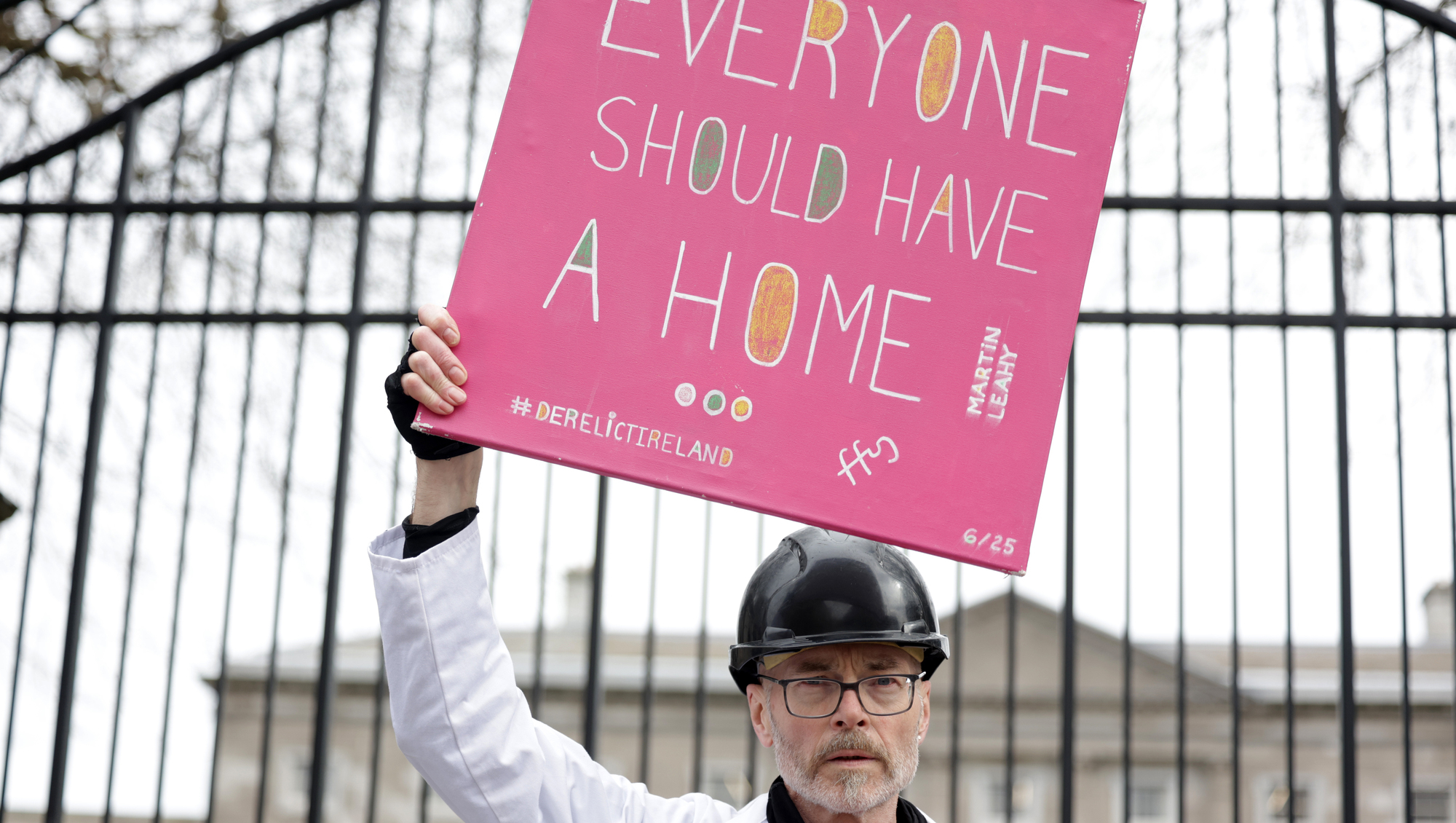
Frank O'Connor from Derelict Ireland outside Leinster House in March, as Cork-based singer/ songwriter Martin Leahy marked his 200th and final weekly Dáil housing crisis protest with his song 'Everyone Should Have A Home’. Picture: Leah Farrell/RollingNews.ie

Frank O'Connor from Derelict Ireland outside Leinster House in March, as Cork-based singer/ songwriter Martin Leahy marked his 200th and final weekly Dáil housing crisis protest with his song 'Everyone Should Have A Home’. Picture: Leah Farrell/RollingNews.ie

When Ireland assumed the EU presidency on July 1, it did so under the banner of ‘Ní neart go cur le chéile’— ‘strength in unity’. Yet, the reality across the EU is one of growing fragmentation, rooted in a structural and systemic housing crisis.

For the next six months, Ireland can steer the European affordable housing plan and shape the €2trn 2028–2034 EU budget. But doing so requires more than chairing meetings or pushing through the construction services act. 

It demands a fundamental break from the financialised groupthink that reduces housing to a tradable asset. We must recognise the housing crisis is no longer just an economic burden — it is the very fuel sustaining far-right extremism across the continent.

To lead effectively, Ireland must fundamentally alter the EU’s trajectory, shifting housing from a market obsession back to a vibrant democratic project.

Simplification does not always mean deregulation 

The Irish presidency’s programme treats housing as a competitiveness issue. Initiatives like the Affordable Housing Act and the Construction Services Act aim to unlock supply and streamline EU financial programmes. The stated ambition of the housing simplification package under preparation is a simplification agenda to accelerate permitting for critical infrastructure and housing.

This sounds pragmatic, but experience demands intense scepticism. Domestically, the last time politicians accepted the narrative of removing red tape to boost supply, we ended up with 32sq m studios, communal or cultural facilities in apartment schemes removed, and the outright removal of unit-mix restrictions — all in the name of reducing cost and allowing for flexibility, in addition to planning exemptions for modular sheds in back gardens with the added lack of tenancy rights and very lightly regulated standards. 

Simplifying planning and reducing administrative cost cannot become a convenient excuse to abandon basic living standards, leaving communities to pay the long-term social price.

If the EU affordable housing plan is to succeed, politicians must stop blindly trusting the market. Questioning housing quality is not an attack on business. While the Circular Economy Act and European Grids Package offer genuine opportunities to modernise infrastructure, they must be anchored in robust standards. Bowing to industry lobbies to promote competitiveness will not deliver sustainable homes; it will merely scale up the delivery of poor-quality, overpriced units.

Dr Valesca Lima: 'Any reduction in red tape or access to EU funding must be tied directly to delivering high-quality homes, rather than handing developers blank cheque to maximise yields while citizens face housing exclusion and homelessness.'

What concrete action can Ireland take? It must steer the forthcoming housing simplification package so it accelerates permitting only developments that meet strict, pan-European standards for liveability and sustainability. 

Any reduction in red tape or access to EU funding must be tied directly to delivering high-quality homes, rather than handing developers blank cheques to maximise yields while citizens face housing exclusion and homelessness.

Combatting homelessness 

Ireland must lead by example, shifting European policy toward aggressive affordability frameworks and robust tenant protections. Increasing homelessness is not a ‘normal’; it is a policy choice born of treating shelter as a financial instrument rather than a human right.

Member states, including Ireland, which opted out of Article 31 of the Revised European Social Charter on the right to housing, have shrugged off international criticisms regarding systemic failures to protect tenants. 

True affordability cannot be dictated by a volatile market. It requires structural mechanisms that guarantee security of tenure, predictable rents and shield citizens from abusive practices that undermine tenants’ rights and housing security. 

A critical component of this fight against homelessness is recognising the specific, intersecting vulnerabilities that drive people onto to it. 

For instance, we must explicitly recognise domestic, sexual, and gender-based violence within broader housing policies. Domestic abuse remains a common pathway into homelessness, yet systemic responses routinely treat emergency refuge as a temporary justice issue rather than a structural housing failure. 

By implementing housing-led solutions that pair immediate tenant protections with secure, permanent accommodation, the EU can begin to address the root causes of housing deprivation. Without binding European standards on tenant security and affordability, fighting housing exclusion remains a rhetorical exercise.

A concrete action here could be to transform the European Platform on Combatting Homelessness from a voluntary agreement into a binding framework. A firm directive along those lines would work towards standardising tenant security metrics across the bloc and penalising, perhaps financially, countries that use light-touch regulation to facilitate speculative property bubbles.

Reclaiming the democratic project from extremist groups 

Debate on housing and who has access to it is being rapidly filled by far-right extremists. The narratives then focus on housing fatalism and scarcity, blaming vulnerable groups, especially migrants and refugees, for a problem that has built up over decades of underinvestment, government inaction and encouragement of speculative housing practices. 

These negative discourses do not arise from nowhere: they take root in the fertile soil of democratic anxiety, increasing wealth inequality, social exclusion and the despair of the many locked out of secure housing.

Ireland can use this presidency to shape an inclusive discourse that actively fights off these extremist ideas. But to do so, citizens cannot simply be treated as consumers expressing market preferences in a competitive housing space; they must be drawn back into a cohesive political project. 

By ensuring cohesion policy commitments and affordable housing are treated as fundamental rights across the EU, Ireland can demonstrate that democratic institutions are still capable of acting collectively to solve structural crises.

If the Irish presidency spends the next six months aggressively promoting housing that European households actually need — affordable, secure, and integrated with vital social infrastructure — it can prove that ‘Ní neart go cur le chéile’ is more than a slogan. It is a viable blueprint for a safer, more equal, and democratic Europe, which could be a very positive influence on other regions in the world.

  • Dr Valesca Lima is assistant professor at Dublin City University, researching housing policy and governance
x

More in this section

Revoiced

Newsletter

Had a busy week? Sign up for some of the best reads from the week gone by. Selected just for you.

Cookie Policy Privacy Policy Brand Safety FAQ Help Contact Us Terms and Conditions

© Examiner Echo Group Limited