New ‘inclusive special’ classes aims to provide more flexibility to support students
Despite concern’s from Ireland’s autism charity, the new educational model has potential, provided it works in tandem with the current autism class model
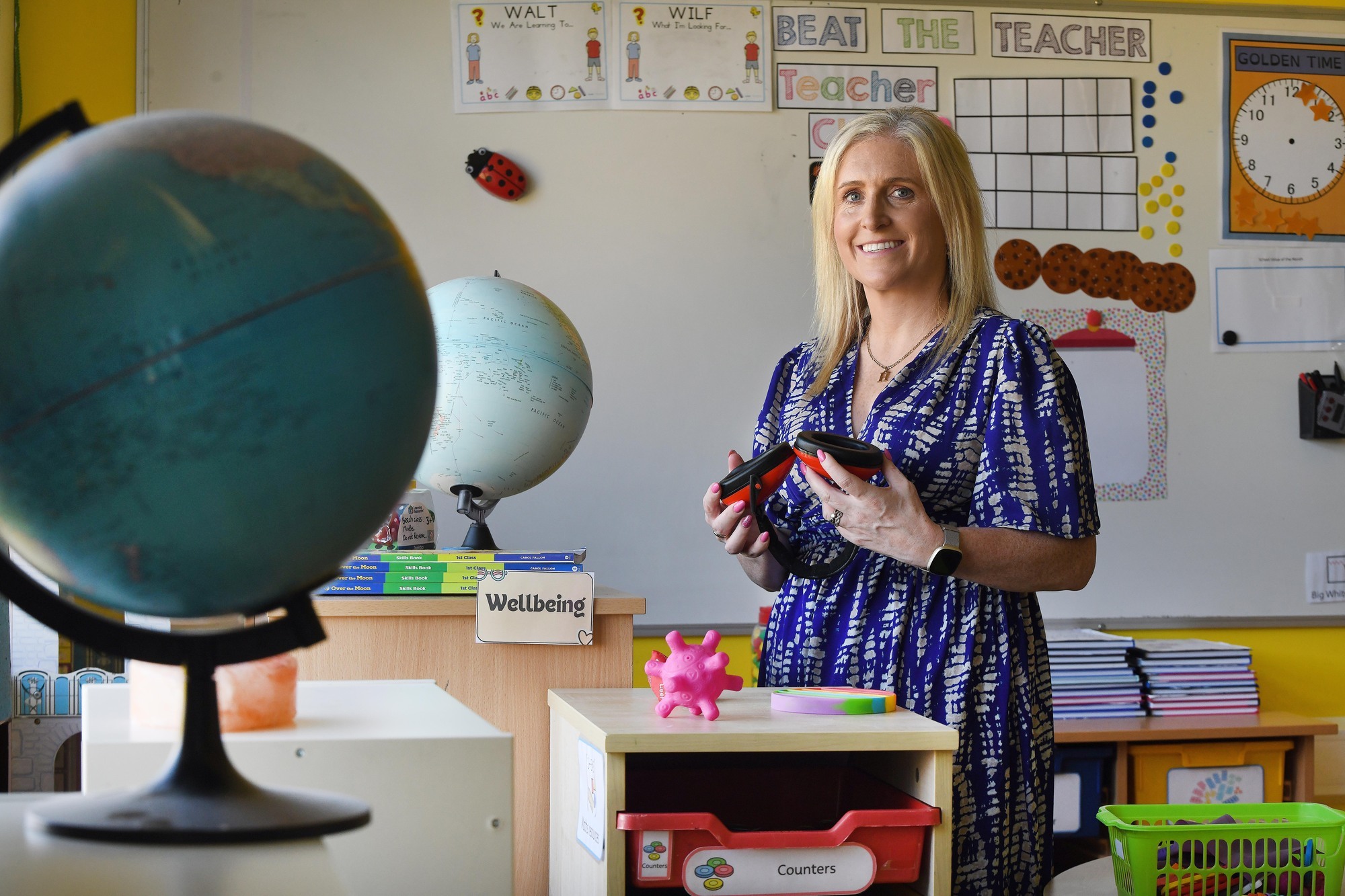
Powerstown Educate Together National School principal Helena Trench says ‘some children will need special classes, some children will need special schools, and we have to realise there is parental choice too as to where a child goes to school’. Picture: Moya Nolan

Powerstown Educate Together National School principal Helena Trench says ‘some children will need special classes, some children will need special schools, and we have to realise there is parental choice too as to where a child goes to school’. Picture: Moya Nolan

As many school principals will know, children’s development doesn’t tend to just follow the same straight line.

It can make navigating the rigid system of available supports for children with special educational needs difficult for schools trying to contend with those changing needs.

Powerstown Educate Together National School (Powerstown ETNS), a mainstream primary school in Dublin 15, has looked at ways to bridge supports.

Principal Helena Trench explained: “It’s very hard to predict what a child’s educational pathway is going to be because it just isn’t linear, and it differs depending on each child. 

“I could make assumptions of a five-year-old but I could be very wrong because that child’s presentation could change a huge amount by the time the child is eight or 10.

“When a child has autism or any specific learning needs, their needs vary over time. It’s not linear, and it’s not the same for everybody.”

She says children can have an amazing, really positive experience, and then puberty can come and it can become very difficult.

“There could be a family issue, or they could have a falling out with their peers,” Ms Trench said.

“They might find it very hard to navigate all of that, and that can cause dysregulation.

“Support has to be fluid to make sure you are meeting the needs of children where they are at so we can cater for them.”

This year, more than half of Powerstown ETNS students accessed support during the school day for special educational needs.

Each of the school’s Special Education Teachers (SETs) worked with between 18 to 24 children. It also has eight special classes, the majority of which are for autistic students.

For September, more than a tenth of the school’s incoming junior infant intake has a recommendation to attend a special class.

The need for more special education places in Dublin 15 is well documented: A taskforce established by the Department of Education predicts that up to 1,225 students in the area may require a special class or special school place in the coming years.

This would require the establishment of approximately 80 new special classes in mainstream schools, and the creation of 48 new special school places.

Heavy demand for special school places in Dublin 15

“Demand in Dublin 15 has always been heavy,” Ms Trench said. 

“But if I look at my school and look at my demographics, and the addresses of children applying, their addresses are my catchment area. They are siblings of children in my school.

“They are children who can walk to school, or who can throw a stone from their back garden. I’m looking at the kids who are directly in my locality.

“For me, I’m always going to prioritise the needs of children in our locality. I think my colleagues in Dublin 15 are doing the same.

“There’s been a huge increase in autism classes in Dublin 15 over the last six years. Everyone is trying to make sure everyone is properly catered for in their local schools as best they can.”

Demand isn’t just heavy in Dublin 15. Across the education system, there continues to be increasing need for special educational school places. 

From September, more than 34,000 students are expected to attend special classes and special schools, an increase of 86% since 2020 according to the Department of Education.

For the 2026/27 school year, there will be more than 4,300 special classes attached to mainstream schools open nationwide, more than double the 1,836 open in 2020. 

Almost 70 ‘inclusive special’ classes

Among these 4,300 classes will be almost 70 ‘inclusive special’ classes, a new type of provision for students.

Initially announced earlier in the year to begin in just five schools, the announcement of a new type of educational provision prompted more questions than answers. 

AsIAm, Ireland’s national autism charity, pointed to the name ‘special inclusive’ class and highlighted how all autism classes should be inclusive.

It and Inclusion Ireland called for a pause on the roll out, after its announcement came without any consultation with children, families and their representative organisations.

Last week, AsIAm told the Irish Examiner it continues to have concerns the move forms part of a broader push within the education system to “move away from rights-based approaches to access to autism classes and autism specific supports”.

The Department of Education told this newspaper it intends for these new classes to “provide greater flexibility for schools to support students whose needs may be best met through a combination of mainstream participation and specialist support throughout the school day”.

“Inclusive special classes are not intended to replace special classes. Rather, they represent an additional model of provision which builds on inclusive practices already operating successfully in schools.”

Approximately 5,895 students who require a special educational school place for the 2026/27 year are already enrolled in school. 

The Department of Education said it anticipates that some inclusive special class places may support students already attending schools “while also creating additional capacity to meet future demand”.

Potential of inclusive special classes model 

For Helena Trench, the model has potential, provided it works in tandem with the current autism class model. 

Some children in mainstream who have an autism diagnosis need more support than what current SET allocations can provide, Ms Trench said, adding that a new model could be “a good stepping stone towards that”.

Its something her school has experience with, to great effect. Three years ago, Powerstown ETNS introduced an ‘inclusion teacher’ after it saw how its students, who were ready and happy to transition from their autism class into mainstream, often struggled with the move.

“They all would have had the autism class recommendation, and we felt they were ready to leave the class, and parents felt they were ready too, and the children themselves wanted to.

“Before we had the inclusion teacher, we tried it and the children really, really struggled. We felt we had to do something more to support that transition.”

A lot of this comes down to numbers, and back to the rigid support structures schools have to navigate.

Special classes at mainstream are capped at a ratio of six children to one teacher, and usually two SNAs. 

If a child is attending a mainstream class, this ratio is often upwards of 25 children to one class teacher. 

SNAs are not allocated to individual students, rather they are a ‘whole-school resource’.

“When a child comes into school, and a child enrols in an autism class, its really, really important that child gets every opportunity to be included with their mainstream peers as much as possible,” Ms Trench said. 

Transition from autism class to mainstream

“When you are enrolled in an autism class, it doesn’t mean that you are enrolled in an autism class for eight years.

“If the opportunity arises, and the child is ready, and the child wants to, they should be given the opportunity to transition out of the autism class into the mainstream.”

In Powerstown ETNS, the inclusion teacher acts a ‘bridge’ essentially during and after this transition, working with six children. 

The inclusion teacher also works to help support students with complex needs in mainstream, providing a minimum of one hour of specialised teaching, both in-class and through targeted access to special class spaces.

“When you are in the autism class, parents get to know the staff so well that are working with you, because your child is one of six,” Ms Trench said.

“When your child is one of 30 children in a class, that relationship isn’t as connected as it would be in the autism class because you are dealing with 30 children at the same time.

“Having this bridging role, to be the main connection, to support parents and communicate with parents, and to be the safe person for the child in the school.

“If a child is having a tough time, or a tough morning, because the inclusion teacher has six children, they have the flexibility to meet the child where they are at.”

Parents fear the loss of supports

A big fear parents have about a transition to mainstream is the loss of support when compared to an autism class.

“A child is never not going to have autism, they are always going to have autism needs, so how can a school appropriately meet their child’s needs with the SET allocation,” she said.

The school also has facilities like a sensory room and an occupational therapy room. All of its teachers are trained in trauma informed practice.

“That support mechanism is there where children can be supported in the mainstream, they can be supported in the inclusion teacher’s room, and they also have access to the autism [class] area so they have the opportunity to keep those friendships.

“That’s something parents told us. When a child leaves an autism class, they’ve spent a lot of time in the autism class.

“They’ve made really, really good friendships with their peers in the class, its important that they maintain those friendships.

“For us as a school, something we’ve always been very transparent about with the parents is that, some parents want an autism class for their child, and some children definitely benefit really well from an autism class, and it works really well for them.

“Some parents don’t want an autism class for their child but they know their child isn’t coping in mainstream, and they want to see what else we can do to support them.

“Some children don’t want to go into an autism class, but they are struggling with their regulation and their autism needs and know they need extra support.”

No special classes in around 500 schools

There are still questions unanswered about the roll out of special inclusive classes. 

They come at a time when approximately 500 medium and large primary and post-primary schools do not yet have a special class. 

The Irish Examiner asked the Department of Education what happens if a child’s placement in a such a class isn’t working, do they need to seek a place in the school’s autism class, join its waiting list, or enrol elsewhere if none is available?

A spokesperson said: “Where a different form of provision is required, the NCSE will continue,  the model has potential, provided it works in tandem with the current autism class model, to work with families to identify the most appropriate educational setting.”

The Irish Examiner asked if classes will be capped, or will more be sanctioned for the 2026 school year. 

It said: “There is no predetermined end point to the expansion of special education provision.”

For September, 11 ‘special inclusive’ classes are set to open in Cork, with the majority in post-primary schools. A further 19 are to open in Dublin, eight in Kildare, and six in Wexford.

Simon Lewis, principal of Carlow Educate Together National School is one of three schools in Carlow set to open these classes. He had sought to open another autism class, the school’s third, but it wasn’t sanctioned.

Concerns about aspects of ‘special inclusive’ classes model

He has concerns about aspects of the model. “It’s a complete emergency measure. There are a lot of children in mainstream who aren’t able to regulate but there are no special class places [across the system].

“It gets a child out of their mainstream classroom into a smaller setting and provides teaching and SNA resources they wouldn’t get otherwise,” he said.

Schools “really badly” need extra staff to look after the needs of children with highly complex needs in mainstream classes, he added. 

“There’s no way of getting those resources, and this is the only avenue open to us.

“I suppose it had a bad start with the name it was given, but that’s certainly the reason why I, and lots of other principals, are opening these classes, because we needed the resources.”

Given the Powerstown’s experience with inclusion teachers, Helena Trench said flexibility is key.

“Some children will need special classes, some children will need special schools, and we have to realise there is parental choice too as to where a child goes to school.

“Enhanced support gives the child the opportunity to succeed at primary level in a mainstream setting before they might need to go to a special school.

“Sometimes it might work, and sometimes it might not be enough.

“It’s a model that can really work, but I do think its important to realise the inclusion teacher model isn’t the same as an autism class model.

“When you are in an autism class, you are in a specific class, you have facilities, you have six children, two SNAs,” Ms Trench said.

“If you look at the inclusion class model, I really feel like it needs to be that bridging piece, and that fluid piece to make sure children are getting the right support at the right time, but that they are called two different things so that they can be presented and work as two different things in the education system.”

More in this section

Revoiced

Newsletter

Had a busy week? Sign up for some of the best reads from the week gone by. Selected just for you.

Cookie Policy Privacy Policy Brand Safety FAQ Help Contact Us Terms and Conditions

© Examiner Echo Group Limited