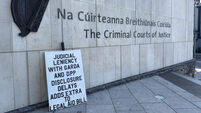
Mick Clifford: Jim O'Callaghan's crusade against legal aid will damage access to justice

Right now, the minister for justice Jim O'Callaghan gets to look tough and determined to save money. Wouldn’t it be interesting if he were to ever actually tackle proper reform in the civil law system where the real scandal of access to justice and legal fees resides? File picture
Lawyers like evidence. In criminal trials it is all that matters. Irrespective of how well an argument can be made, a jury impressed, a judge wooed. Without the evidence, the case is sunk.
Jim O’Callaghan is a lawyer, but, as he told the Oireachtas justice committee recently, he never practiced criminal law. The big bobs, he was told as a newly minted lawyer, were in civil law.
On Monday, he was asked about his ongoing row with solicitors on the criminal legal aid panel. New reforms to the free legal aid system has solicitors being paid a single fee per case irrespective of how many appearances are required in the case.
Jim is not for turning. On one level it is admirable to observe a politician sticking to his guns in a matter on which he believes he is right. Except, there’s a problem with the evidence.
He told reporters on Monday that the new way of paying solicitors is designed to cut down on adjournments and delays in the system. “This is not about me blaming solicitors. This is about recognising that a system needs to be improved,” he said.
He said he was struck by a case that had recently been in the media. “A man from Kerry who had been charged with a very minor offence from the day of the All-Ireland final in 2023, and his case hadn't been determined by July 2026, some three years later.
"Like that is unacceptable, that somebody who faces a minor offence can find themselves not having their case determined within a period of three years.”
He was then asked whose fault it was that the case had dragged on.
“This is not about me blaming solicitors," he said. "This is about recognising that the system needs to be improved. And a system which has a payment structure, which encourages adjournments because you get paid more through an adjournment, is going to encourage situations like that.”
The minister hasn’t a clue why that case took three years, yet he cited it as an example of what can happen when solicitors are paid per adjournment. In reality, all the evidence is that most adjournments are due to faults by the State.
Yet he claims that cases like this take years because solicitors are encouraged to drag it out because they will get paid more. That’s not evidence. That’s spin.
O’Callaghan’s ostensible objective to speed up the process for citizens — and defendants — is admirable, but why is he going after the soft target?
Last week, in the course of hearing cases, district court judge Desmond Zaidan told Naas court that three quarters of all adjournments before him are the fault of the State. He cited “failing to get (DPP’s) directions, garda not in court, waiting nine months for forensic analysis in a drug case.”
“The other one that stares at me, the State initiate (proceedings) by charge sheet, put it back for disclosure or directions, then the State seeks a further adjournment to add a summons, so the defendant is being prosecuted by two systems,” he said, according to the court report.
“There's a central computer that serves summonses, not to suit the court lists, just spits them out. It’s just not right,” he said.
Yet, according to the minister, the main barrier to efficiency is solicitors somehow calling for adjournments in order to rack up a few bob — €59.85 per appearance — presumably even when that is contrary to their client’s interest.
The minister’s main exhibit for the prosecution is a report compiled by his department. This examined 350,000 cases over two years and came to the conclusion that the criminal legal aid system encouraged delays and adjournments. No detailed breakdown was given.
There was nothing, for instance, on whether the number of adjournments are attributable to issues around addiction or mental health, the kind of things that feature prominently in all manner of petty crime. There was nothing apparently about the myriad failures and shoddy work of State agencies in the system that add, according to judge Zaidan and plenty of others, hugely to delays.
No, the problem is defence solicitors unable to conduct themselves with integrity because the system “encourages” adjournments. Where precisely is the evidence?
If the minister is so concerned about alleged conflicts of interest, perhaps he should look closer to home. The report he cites was compiled by a department that oversees or funds all the agencies on the opposite side of the defence in criminal courts, the very agencies that contribute to most of the delays.
Yet somehow the main problem is the criminal legal aid system. Through such a lens the great reform of the system begins to look more like deflection than any attempt at evidence-based policy making.
Solicitors are well able to take care of themselves. Precious few of them will go hungry. What is really at issue in this so-called reform is the quality of defence representation that may emerge.
This is not something that bothers most people, at least not until they or one of their loved ones might find themselves as a defendant. But it does matter for anybody who believes in a full right to a fair trial.
If, as the minister asserts, some solicitors are “encouraged” to needlessly seek adjournments under the old system, surely there will be some who will encourage the swiftest resolution possible under this one, irrespective of whether that coincides with a client’s best interests.
What of the cases where mental health and addiction issues complicate everything, and by extension lead to delays? Will these now be disposed of much quicker to the detriment of an afflicted defendant?
In effect, solicitors are being told that irrespective of State failings or the needs of a client, they will have to work for nothing once a case drags beyond a certain point.
While the minister is all at sea in evidential terms, he’s on much firmer ground in the politics of this conflict. The public are rightly sceptical of any branch of the legal business crying foul over not being paid properly.
Equally, in the current environment there is precious little sympathy for those who find themselves before the criminal courts.
As such, the minister picked his target well, even if the reforms ultimately result in the erosion of rights for defendants and deflection from a State that doesn’t work efficiently in the interests of all citizens. The long-term fall-out from that will, in the future, be safely beyond the next election.
Right now, the minister for justice gets to look tough and determined to save money. Wouldn’t it be interesting if he were to ever actually tackle proper reform in the civil law system where the real scandal of access to justice and legal fees resides?
That would require taking on very powerful interests and using up political capital in the name of the public good. Far easier, it would seem, to go after soft targets armed with a cavalier attitude to the rights of those who come before the criminal courts.

CONNECT WITH US TODAY



Be the first to know the latest news and updates