Will Iran become a constant warzone like Southern Lebanon?
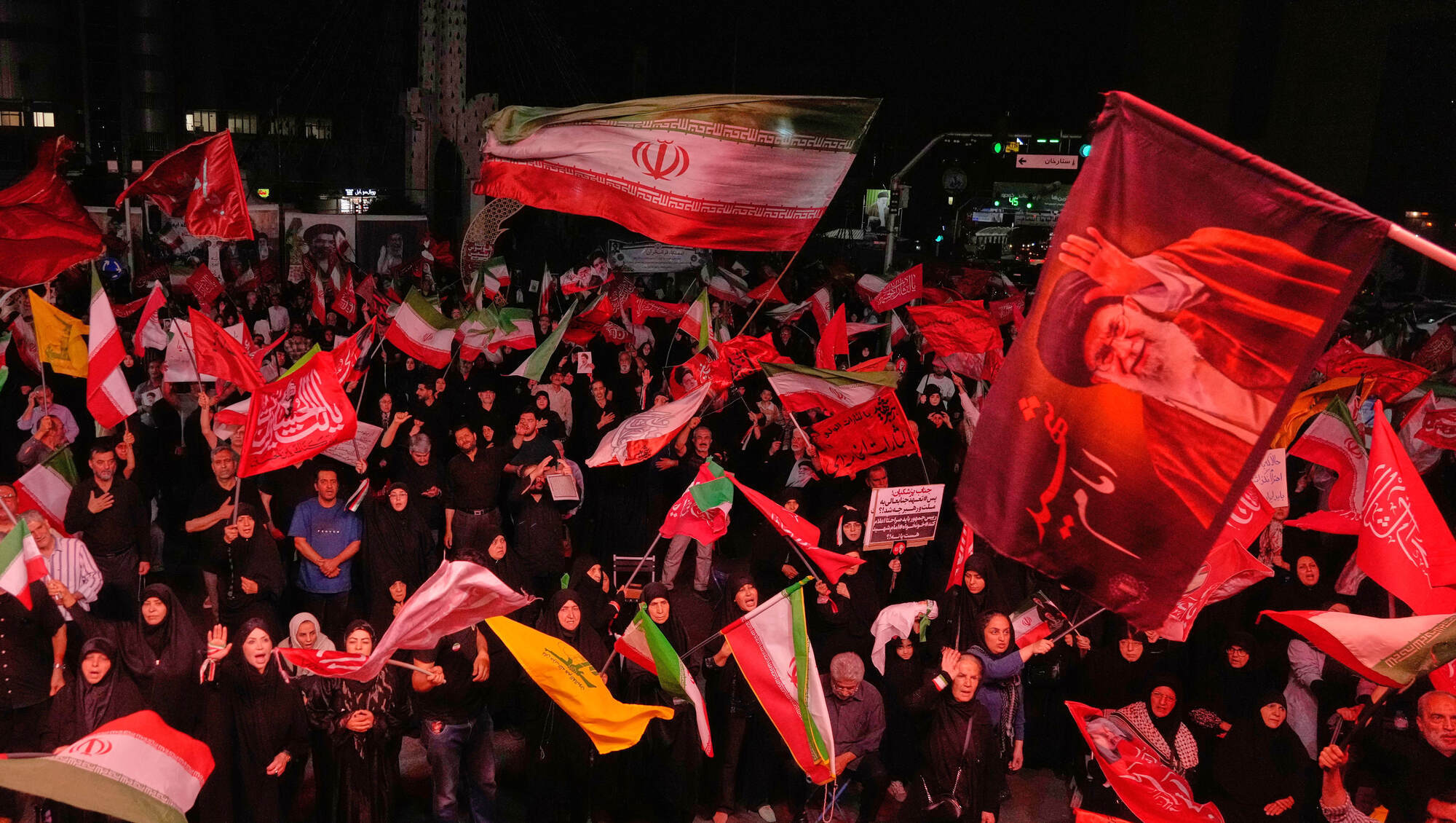
Pro-government demonstrators wave Iranian and religious flags in a gathering commemorating the late Iranian Supreme Leader Ayatollah Ali Khamenei in Tehran on Saturday. Picture: AP/Vahid Salemi
Trump finally announced this "Schrödinger's ceasefire" has come to an end. As a friend aptly put it, they should have called it a "less-fire" rather than a ceasefire.
Throughout this entire time, the clashes persisted — especially in the south of Iran. And is Iran just Tehran, such that because they didn't bomb Tehran, we should say there was no war?
No. During this period, they were still hitting Iran, from Kish Island to Bandar Abbas, Bushehr, and Kharg.
Last month, after months of quiet, they bombed the outskirts of Karaj again. It was the middle of the night, and we were all asleep. At first, I thought it was the sound of the wind slamming something against the door; by the second explosion, I suddenly realised they were striking. The sounds were deep, resembling the sound of bunker-busters.
For about 20 minutes afterward, there was absolutely no news, not even on local news channels. It was to the point that I was gradually beginning to doubt myself, wondering if it really hadn't been the sound of explosions. I told my brother: "Did everything really become normalised this quickly? Are explosions in the city no longer breaking news this fast?"
I don't dare open videos of the bombings of southern Iran; I've heard from many people that, like me, when they hear the sound of an explosion, they are thrown right back into that same black hell of endless traumas and fears, the fear of surviving under the rubble while all your loved ones have died; the fear of displacement and homelessness. It’s as if those sounds are the key that unlocks Pandora’s box.
During this period, news of negotiations, memorandum of understanding (MoU), and agreements was hotter than ever. I think regardless of all differing political views, the word "negotiations" has become a kind of trauma for every Iranian.
Read More
A word that has been constantly repeated for over 20 years, with various and numerous rounds, with multiple mediators, direct and indirect, and always extended for the next round. It is as if it is not supposed to yield any achievement or result; as if they negotiate for the sake of negotiating.
A group of people and political parties like Paydari (if "political party" in its conventional sense applies in Iran) were opposed to any kind of agreement with America from the very beginning. Their opposition is much older than this war or last year's 12-day war.
I remember well that after the JCPOA (the 2015 Iranian Nuclear Deal, also known as the Joint Comprehensive Plan of Action) was approved, many people took to the streets and celebrated.
In those days, the JCPOA meant freedom from a dead-end and economic openness after decades for many. However, this group of extremist supporters of the regime blamed the people for their trust in America and believed the JCPOA was an absolute loss.
Until before last year's war, I believed their extremism was groundless and that surely if we signed a good agreement with America, America would also abide by it.
When the first war started, I saw with my own eyes the change of opinion in many people. My own opinion changed as well. It was as if absolutely no trust was left in the West, especially America. We were furious they had started a war in the middle of negotiations, and it felt as though the word "enemy" had found a new meaning for us.
Except for the monarchists, who were overjoyed with all their hearts at the start of the war and saw it as the way to overthrow and throw out the Islamic Republic, the rest of us, even opponents of the regime, seriously thought about our relationship with America, being Iranian, possessing power, and fighting, and we changed our views. The second war drew this line even sharper and made many of us more patriotic and more anti-Western.
When the news of signing the MOU came out, it seemed that except for a small group of reformists who considered this understanding a true victory, other groups were neither happy nor optimistic.
Some, like the Paydari and extremist supporters of the regime, many of whom had spent over 100 nights in street rallies, believed this understanding was not to Iran's benefit and that Israel and America will start the war again; therefore, now that we have the opportunity, we must completely hit American bases in the region's countries and also deliver a heavy blow to Israel to set our minds at ease.
Many of them talk about how a MOU under these conditions is treason to the country. At Khamenei's funeral, everyone raised red flags as a sign of revenge and seeking blood, and they had written on large banners: "We will kill Trump."
Almost every night during the ceasefire, we prepared ourselves to wake up again to the sound of massive explosions. Although in our hearts we wished this time would be different, we knew we had to be prepared for the reigniting of the war.
There was yet another group, monarchists, who, similar to the first group, are upset about the agreement, but they also have differences with them. They said America was supposed to help us and support Israel to strike the Islamic Republic, but now it has backed down.
Some of them were cursing Trump, accusing America, and waiting for Netanyahu to attack and finish the job. Others were saying Trump is smarter than that and has a secret plan. When the news of the bombings came a few days ago, it was as if they were holding a wedding; joy surged in their tone and eyes.
These days, I think about how, under these current conditions, we will probably become like southern Lebanon and be forced to cope with war. I don't even know if coping with war makes any sense.
These days, the future is shrouded in a cloud of ambiguity, and living in ambiguity is the hardest thing in the world. For now, the only solution is this living day-by-day.
- M is a young woman living in Karaj, near Tehran. Her identity has been verified by the
CONNECT WITH US TODAY



Be the first to know the latest news and updates