Abdallah Aljazzar: Why Gaza cannot be erased from the Mediterranean narrative
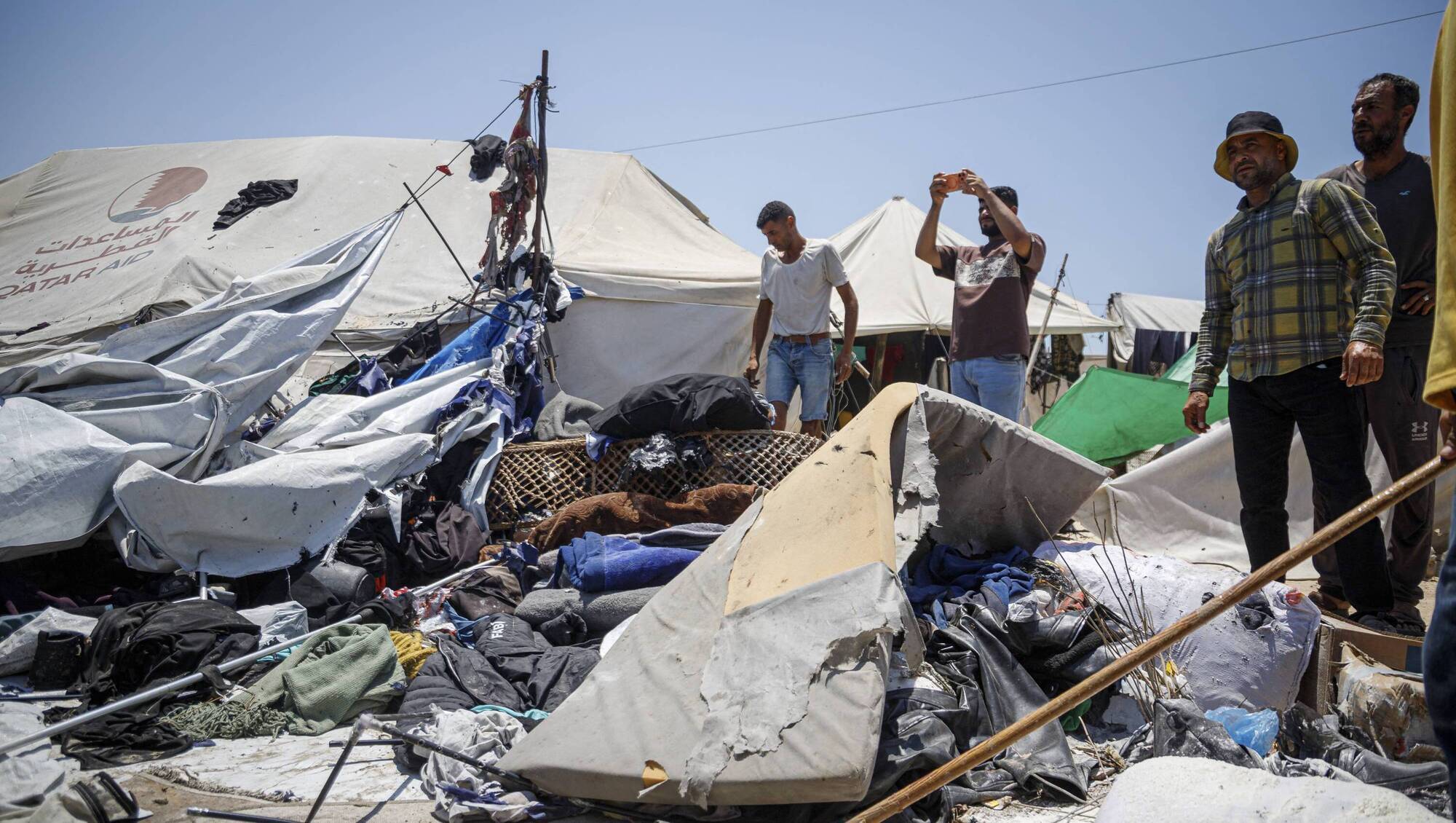
Palestinian men gather around a destroyed tent and scattered belongings in Gaza after an Israeli drone strike targeted a tent sheltering displaced people, killing one Palestinian and injuring several others. Picture: Mohammed M Skaik/Getty Images
I have just arrived home to Maynooth from my first conference in Malta, where I was presenting my academic paper . The conference was called Rewriting the Mediterranean.
Malta gave me my travel visa, but my name was spelt wrong. Can you believe that? How do you travel when your visa has the wrong person? Did the clerk get infected by my confusion as a Gazan survivor in Ireland, travelling back to the Mediterranean? Gazans usually can’t travel, locked in a prison so when the airport security looks at my visa, will they lock me up for being someone else? I give myself my own identity check.
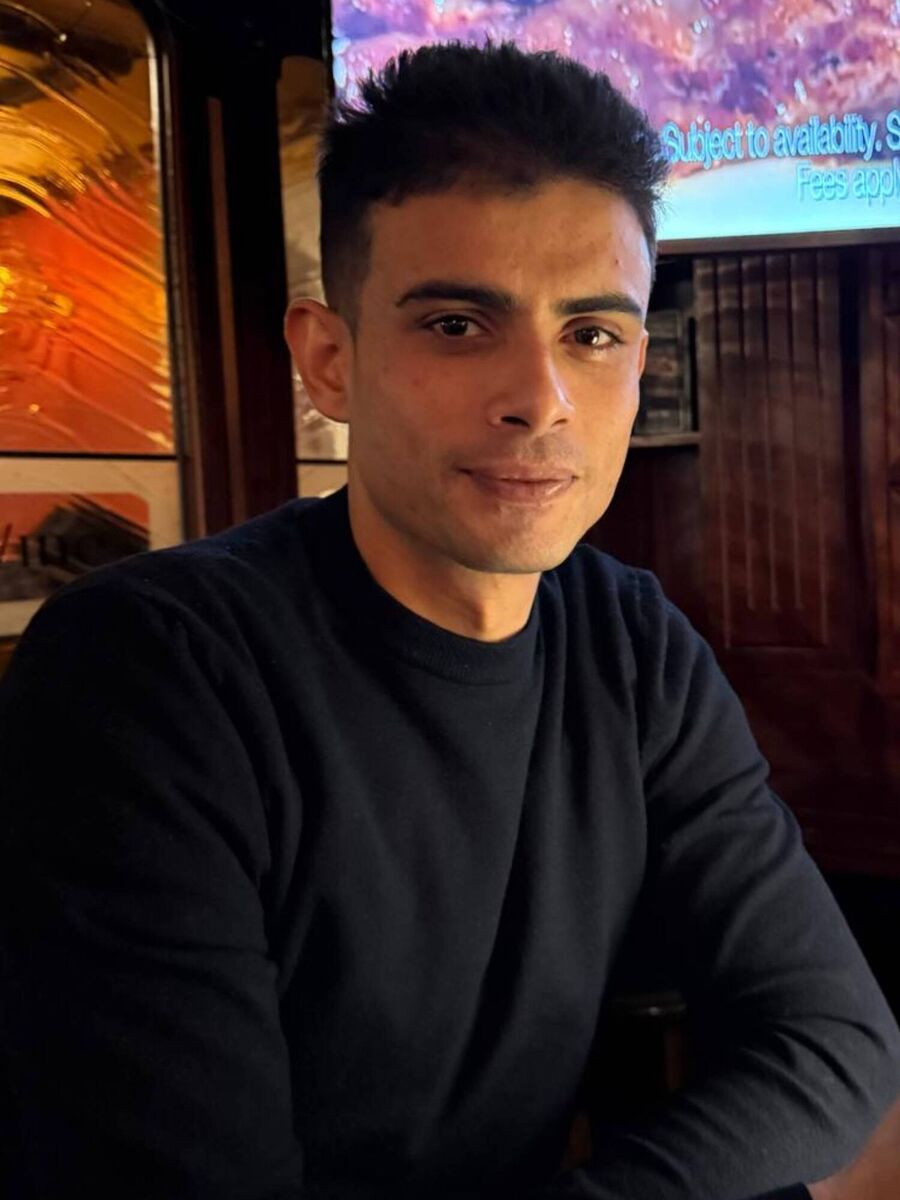
Who is Abdallah Aljazzar? Honestly, I don’t know. Abdallah, genocide survivor? Abdallah, oldest son? Abdallah, MA scholar, project manager, and We Are Not Numbers writer.
The visa’s version of me is the product of the embassy officer’s misspelling. Who else has the power to turn me so casually into something I am not?
I arrive in Malta after explaining to the airport officials that I am legit. I am doing an Erasmus programme — Rewriting the Mediterranean.
Read More
They are impressed. Twenty-eight classmates join me from all over, and we mingle in the hotel and at meals. We begin by attending a lecture on what it means to translate and translocate Mediterranean texts. You thought this was a tourist trip. No, this is serious stuff. We are in the cradle of civilization, they tell us. This is where the ancient world began. The Greeks invented drama and democracy. We are supposed to soak up both.
The teacher wants us to understand the Greek idea of theatre.
We listen, but I am confused. First, the professor's accent is too hard for me. Second, why should I care about Antigone?
The conference feels like theatre for professors so they can be heroes. And our role is to play the part of listeners. I get restless. I have to get out for a smoke because I am not sure if I have enough patience to perform my role.
When I sneak back in, I feel everyone is looking at me.
When you survive a genocide that comes years after war and siege, your life already has enough drama. Who needs theatre?
But then, the world broadcasts the pictures of dead babies and collapsed towers so that the gaze of the world turns our trauma into spectacle. Even the Israelis on far distant hills hire camper chairs to watch us die.
My performance was to write, to try and have my voice heard, and to claim an identity as a human being.
If you are going to watch my genocide in three acts, don’t expect me to be quiet. It got readers through a programme for Gazan writers, We Are Not Numbers, but nothing else.
My act one happens in Rafah. It calls for Israeli bombing and our evacuation.
The hero is my brother Nour. If Greek tragedy needs an Achilles’ heel, Nour can audition. He was as loyal as he was stubborn. “What shall we do? He asked me. The obvious answer was “Run for your life,” but like a Greek hero, he was hard-headed. “You go; I will stay in Rafah.”
The Greek chorus would have chanted, “No!” but you had to know my brother. “I will join you tomorrow — I don’t want the IDF to take our house.”
Nour stayed. We left. My goodbye was maybe the final scene, because he did not join us.
Tomorrow dawned from the smoke haze of the bombing, and peering into the distance for that lone figure, we thought, “That is Nour,“ or “Is that Nour?” but they were all ghosts, apparitions of our fading hopes.
Nour never came back. The play went on without him. With the hero gone, I became more and more the audience to the drama of my lost brother, who, like the ghost in , walks in and out of my dreams in Dublin.
I am supposed to give a paper at this conference. It is on Edward Said’s essay, . What I found kind of funny was that I submitted it late and was not given permission to narrate.
But listening to these lectures, I found myself imagining a paper on the theatre of Nour and the epic cycle of genocide. Like these lectures, it would have to sound totally bloodless and theoretical, laced with words like “performative” and “transform".
I would ask what space Nour was creating by his heroic resistance to Israel, and then, what space did he create in his absence? This would lead to a new imaginary — the rewriting of what was lost. Brilliant. How academia can make even genocide boring is something else.
At the break, my phone rings. I look at the old screensaver and it is Nour looking at me. My performance space collapses into tears. I go hide. I can’t perform genocide. Nor can I script Nour in prison, tortured, or gone forever.
In Greek tragedy, the lecturer said, they choose to look at death on the stage. But that is not the same as looking at death in the face. Heroes can rise and fall as the curtain rises, but what is the theatre of the bombs falling and Nour disappearing? What catharsis is there for the wound in my soul?
I head for the water, the same Mediterranean as we Gazans are wont to do, even when it is not safe. I realize that rewriting the Mediterranean is not happening for me.
This same sea washes Gazan shores, but Gaza does not exist in this academic world.
If this is the cradle of civilisation, don’t they care that Iran, ancient Persia, is being bombed even now by those who bomb Gaza? How could they not know that the term “Mediterranean” was shift-deleted ages ago because it erases the Levant?
The Middle East — the one dominating the globe right now, for the Mediterranean was the Near East. No one ever asks, “East of what?” or “How near? Some 1,900km away, Gaza is erased by Israeli bombs while here in Malta, the professors finish the job.
Gaza and Palestine are Mediterranean, but they will not be rewritten here.
The hero's journey is the modern translation of Greek drama, but the Gazan tragedy has refugees, not heroes.
Yet, this seminar is part of what got me out of Gaza — out of hell to study in Ireland and it is coming to an end.
Academia might lack relevance, but for me, it has been a haven.
If conferences like this one on rewriting the Mediterranean don’t know I exist, or know that Gazan shores are Mediterranean shores, then maybe I have to give myself permission to narrate.
I need to tell them, I am coming back here next year for a conference. It will be called Rewriting Gaza and it will involve rewriting Gaza back into the Mediterranean story.
If they claim they have no texts to study, the book can provide the texts, and my essay, this essay in the , will be the one everyone has to read as prologue.
Abdallah Aljazzar is a humanitarian and engagement project officer who is studying for a master's degree in literature of engagement at Maynooth University

CONNECT WITH US TODAY



Be the first to know the latest news and updates