Marion McKeone: By getting him fired, Trump has unwittingly cemented Stephen Colbert’s stature as a cultural icon
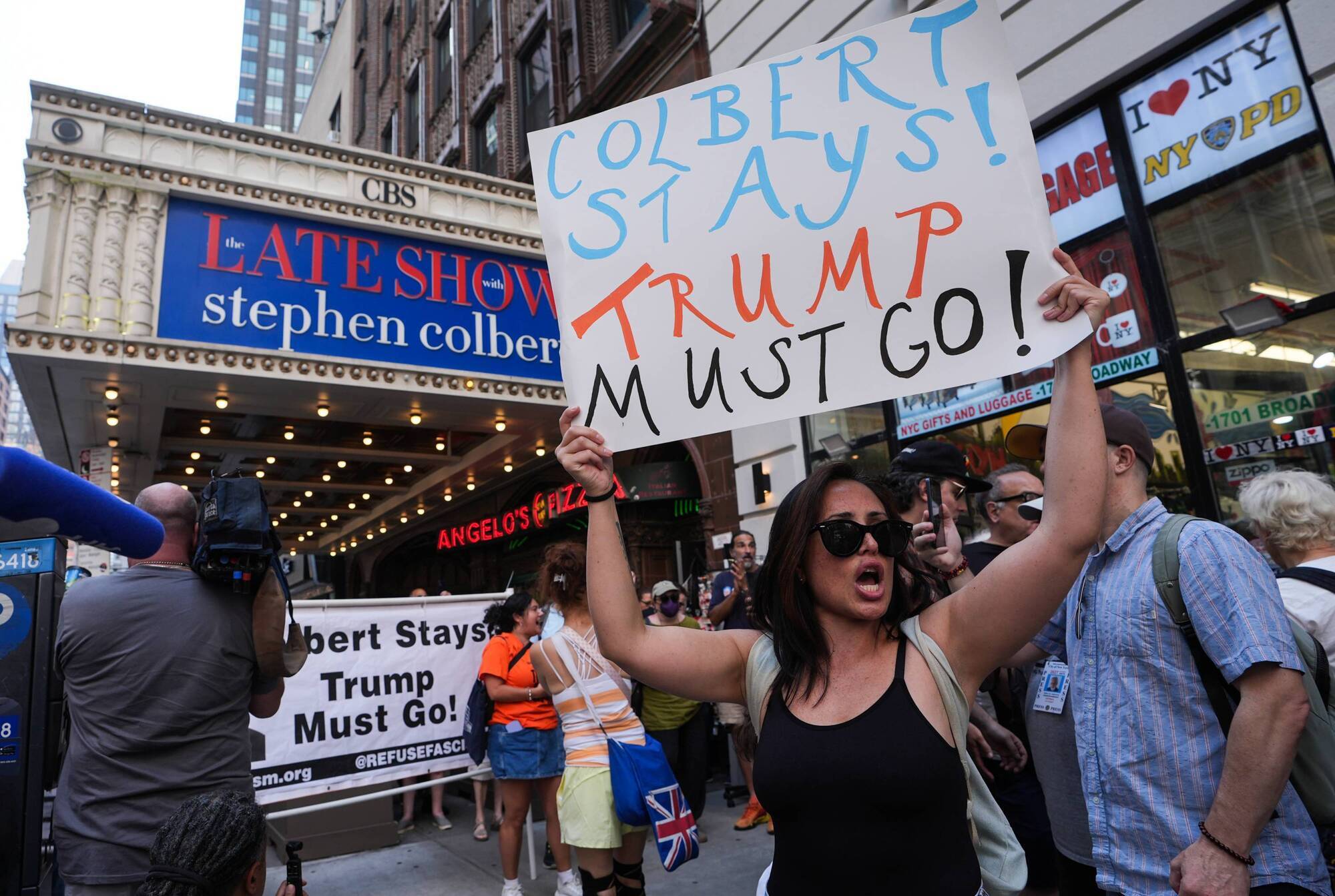
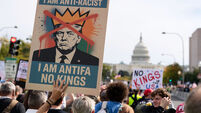
Anti-Trump protesters outside the Ed Sullivan Theater, home of The Late Show with Stephen Colbert, to protest CBS's reported decision to fire the longtime host. Picture: Lokman Vural Elibol/Anadolu via Getty Images
“Thank You Stephen. And f**k you Trump and CBS.”
The message, etched in giant chalk lettering outside the Ed Sullivan theatre on the final night of Stephen Colbert’s was about as New York as it gets.
A janitor with a bucket and pail was quickly dispatched to remove the offending words. But CBS hasn’t found it quite as easy to erase the public fury over its decision to scrub Stephen Colbert from its airwaves.
The damburst of outrage, both online and onstage, has left no doubt about the magnitude of Colbert’s star power — and CBS’s own-goal in caving to US president Donald Trump’s repeated demands to bring down the curtain on a show that lampooned him on a nightly basis.
Over the past month, former presidents, Hollywood A-listers, music legends, cultural icons and fellow satirists, friends and rivals lined up to praise Colbert and bury CBS and Trump.
“You’re the first guy in America who has lost his show because we got a president who can’t take a joke,” Bruce Springsteen declared during his final guest appearance on Wednesday night.
Springsteen’s rebuke, all the more powerful for its clarity and brevity, was amplified by a searing rendition of , the song he wrote to protest the fatal shootings of protesters Renee Good and Alex Pretti by ICE officers.
Other guests went for a more anarchic approach. In a nod to an old tradition, David Letterman, the show’s creator and host for two decades, hurled furniture off the roof of the Ed Sullivan theatre. The last word went to Letterman, which he directed at Colbert’s CBS bosses.
“In the words of the great Ed Murrow, good night and good luck, motherfuckers.”
His farewell was punctuated by Colbert, who sent a large iced cake with Congratulations! Emblazoned across it in blue — presented to him by the network’s executives — hurtling 13 floors downward to splatter across a strategically placed CBS logo.
The longest wake in showbiz history ended on Thursday night, with the final airing of the show that Colbert has helmed for 11 years.
As a gesture of respect, Jimmy Kimmel and Jimmy Fallon, who host rival late night shows on the ABC and NBC networks, went dark to ensure Colbert had the biggest possible audience. “Tune into CBS for the last time — don’t ever watch it again — but watch tomorrow night to wish Stephen and our friends at the a fond farewell,” Kimmel told his audience on Wednesday night.
Colbert has always seemed more comfortable with self-deprecation than appreciation and on his final night, the audience was stacked with longtime friends, rivals and colleagues who doubled as hecklers. Paul Rudd nonchalantly munched on a banana while his old buddy Tim Meadows, ostensibly offended he didn’t make the cut as one of Colbert’s final guests, yelled "Screw you, Colbert! You know what? You got what you deserve!”.
There is a symmetry of sorts to the beginning and end of Colbert television career, which spans almost three decades. His reputation as America’s foremost satirist was birthed in the US media’s failure to hold the Bush administration to account over its trampling of individual rights in the aftermath of the 9/11 attacks and the false pretext for its 2003 invasion of Iraq.
Back in the early 2000s, Colbert was a sidekick on Jon Stewart's groundbreaking , which relentlessly mocked an incompetent Bush administration and a supine White House media. His on-air persona — a Fox News blowhard who revels in his own ignorance and bigotry — was so outsized it demanded its own spin-off show. Few spin-off’s match their source, but transcended it. Overnight, Colbert’s brilliantly subversive creation — a mash up of Bill O’Reilly and Pete Hegseth — became must-see viewing.
The buzz around Colbert prompted the White House Press Correspondents Association to invite him to provide the presidential roast at their 2006 annual dinner, a traditionally genteel affair intended to showcase the cosy illusion the media can clash swords with the White House by day and clink glasses with each other by night.
Colbert’s performance was something else entirely. From the cheapest of seats at the foreign correspondents' table, I watched as he delivered the most subversive performance of his career.
Standing 3ft from Bush, he served up not so much a roast as a napalm-marinated skewering of the US president, before turning his fire on the White House press corps with a witheringly funny indictment of their timidity. As a comic performance, it was a tour de force, brilliant, eviscerating and wholly unexpected. It’s difficult to overstate the ‘what the hell just happened?’ sense of disbelief that followed.
To Bush’s credit, he gamely stood up and shook Colbert’s hand as he departed the podium. The White House press corps were far less forgiving. Stunned and angered by what could reasonably be described as the definition of speaking truth to power, they decided to censor Colbert instead. Even the chose to scrub any mention of his comments from its report on the event.
But the buzz around Colbert’s performance made it too big to ignore; millions of Americans tracked it down on CSPAN and it became a defining moment in American culture.
Colbert made the leap from Comedy Central star to Letterman’s replacement on CBS, around the same time as Trump transitioned from reality TV star to US president.
Read More
After initially foundering in the soft ball tradition of the late-night format, Colbert went for broke, harnessing his improv and mimicry skills in service of his talent for satire. His opening monologues morphed into scathingly funny takedowns of the Trump administration’s Rogues Gallery. No one was spared — especially not Trump’s son Eric, whom Colbert took especial delight in portraying as a gormless moron.
occupied the coveted number one spot in the ratings for over a decade, drawing up to 2.5 million traditional viewers each night. Over at ABC, Jimmy Kimmel’s ‘f**k you’ energy, perfectly suited to Trump takedowns, landed him the second most watched slot, while Jimmy Fallon’s benign humour caused his ratings on NBC to plummet.
But more importantly in today’s atomised media landscape, Colbert was attracting tens of millions more viewers on YouTube, TikTok, Instagram and X.
The narrative behind Colbert’s cancellation goes something like this: Last July, Paramount which owns CBS, agreed to pay Trump $16m to settle a baseless legal action stemming from a interview with Kamala Harris. Colbert excoriated his CBS bosses on air that night for caving over a case Trump had no chance of winning and pronounced the settlement "a big fat bribe". Trump had repeatedly criticised Colbert and demanded his firing. Now CBS’s parent company Paramount needed the approval of Brendan Carr, the Federal Communications Commissioner and Trump lackey, for an $8bn merger that was in the pipeline.
Three days later, Colbert’s show was cancelled. By firing Colbert, CBS had shown itself willing to shapeshift into the sort of media outlet that Trump desired.
The merger was approved and Larry Ellison, longtime Trump donor and friend of Israeli prime minister Benjamin Netanyahu, bought Paramount for his son David who immediately appointed Bari Weiss, a 35-year-old former columnist and avid defender of Trump and Netanyahu as editor-In-chief at CBS News.
Weiss lost no time in smothering CBS’s other golden geese — its flagship evening news programme and show. Reports considered likely to offend the Trump administration were dropped in favour of puff pieces, soft soap interviews and glowing profiles of Trump cabinet members.
That Trump and his acolytes, who were so vociferous in their condemnation of cancel culture, have ushered in a chilling Orwellian era is the supreme irony. It’s unsurprising Trump, Vance and Hegseth, who relentlessly scorned the snowflake sensibilities of Democrats, have proven so thin-skinned when it comes to any form of criticism.
The difference is the lengths to which they are willing to go to silence perceived threats: defunding universities, attacking law firms, censoring media outlets and crushing dissenters from within their own ranks.
Just as Trump’s attempts to have Kimmel removed from ABC backfired, triggering in a surge in his popularity and ratings, he has unwittingly cemented Colbert’s stature as a cultural icon while freeing him from the shackles of a moribund vehicle.
Broadcast television and the late night shows it spawned are circling the drain. But as the billions of views Kimmel and Colbert draw on YouTube and other social media outlets illustrate, there is an enormous thirst for their brand of political satire, one that Trump’s authoritarian tendencies have not sated.

CONNECT WITH US TODAY



Be the first to know the latest news and updates