Rents and house prices up in Limerick and Cork as Munster cities become investor playgrounds
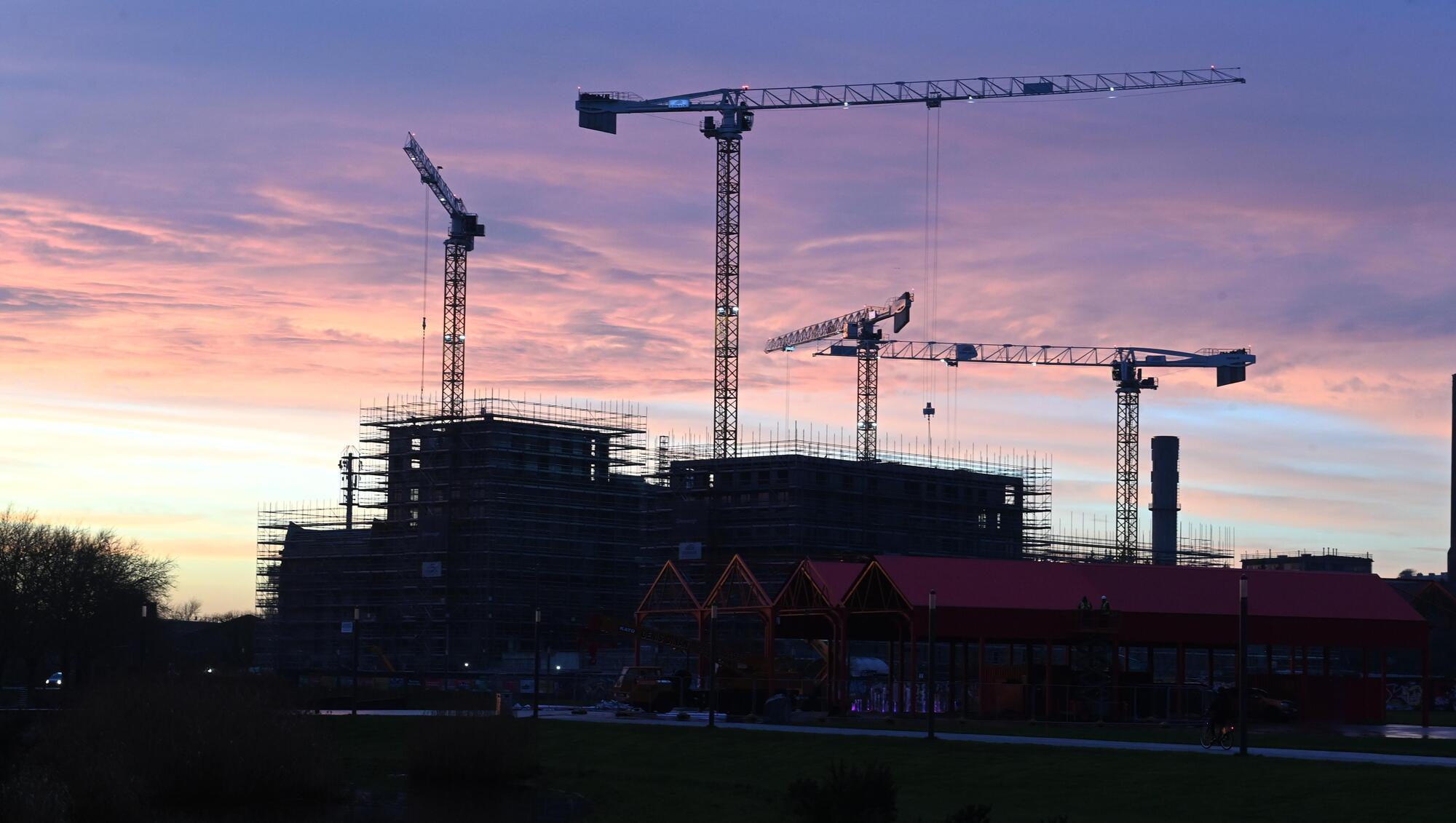
The setting sun silhouettes the tower cranes and apartments under construction by Glenveagh Homes in the docklands in Cork City; in the city, out of almost 1,500 new homes, just 11 new apartments and 19 new houses were sold on the open market last year. Picture: Larry Cummins
Munster has many of the same housing issues as Dublin; a lot of media coverage of the never-ending saga that is our (latest) housing crisis tends to focus on Dublin and the east of the country.
However, the effects of the housing crisis are national, and particularly in our large urban areas and their hinterlands, such as Cork and Limerick cities.
Munster is well-represented politically, having 26 government TDs (not including the Healy-Raes) and being the seat of Taoiseach Micheál Martin. But it’s not having it any easier when it comes to housing problems.
Two new reports on rents were published in the last fortnight. This week’s Daft report, which captured one month of the impact of new rent rules — which allows rents to jump to market rates for new tenancies — showed Cork City asking rents at €2,126 and €2,187 in Limerick City.
Market rents in the first quarter of 2026 were 13% higher in Cork, and up 10% in Limerick and 8% in Waterford.
Read More
The Residential Tenancies Board report showed that in Cork City to March this year some 739 tenancies were terminated.
That’s the equivalent of every household in Cappoquin, County Waterford, being told to leave their homes.
The new rules which arguably have caused the massive increase in evictions and rent surges mirror recommendations made by a minority group on the previous government’s Housing Commission, which felt that ‘rents [should] revert to market after the end of a tenancy’, as they now do.
That minority report was authored by economists Ronan Lyons and Dermot O’Leary and Cork housebuilder Michael O’Flynn.
When the new rules were introduced, the minster James Browne said he could not say when rents would fall.
On the social housing front, local authorities across Munster directly built 518 new houses. They acquired another 292 from the market, bringing their total to 810 new council houses.
As would be expected, Cork City Council built the most at 133, the second-highest direct build output in the country.
Approved Housing Bodies delivered another 1,555 new social houses, this time mostly acquiring them from the private sector.
The social housing waiting list across the province is almost 14,000 households, many of whom will wait an average of eight to 10 years for a house.
More positively, in the last decade the number of new houses built across the six counties has gone up by 400% to 7,466 new dwellings in 2025.
The increased supply of new houses hasn’t brought down the price though (hint: it never does).
Indeed, the price being paid for new homes has increased significantly. I
n 2015, the buyer of a new house in Cork city or county could expect to pay an average of €181,000; this is now €427,000.
In Limerick city or county, this was €175,250 and is now €440,000.
In Kerry, house buyers paid an average of €104,000 10 years ago; now they’re paying €520,000.
Cork City is moving the way of Dublin with increasingly less new housing available for sale each year.
In Dublin City in 2025, data show just 58 new houses and 150 new apartments were sold to ordinary buyers last year, from a total output of 4,521.
Following the trend of handing over our city centres to investors rather than families, in Cork City, out of almost 1,500 new homes, just 11 new apartments and 19 new houses were sold on the open market last year.
That is about 2% of all the new homes built in the city.
Large investors and the State are buying up an increasing amount of new housing supply each year to be used for income or as social housing.
If you’re wondering why your children are finding it hard to find somewhere to buy, this is it.
The type of housing being built feeds into this.
Whereas the number of single houses (or one-off houses) has increased in the last decade by 78%, the number of apartments — the vast majority of which never appear for sale — has jumped by over 300%.
There is no dysfunctional market in Dublin, just as there is none in Cork City or Limerick City. The market is behaving just as would be expected given the incentives on offer to it.
If building housing for rent (which is nearly always apartments) is more profitable than building housing for sale, then that is what will happen.
In the Government’s head, rising rents can only be cured by a greater supply of more rental properties, which they then incentivise by allowing rents to rise continuously.
More rental properties are built — but never enough to bring down rents — and less therefore appears for ordinary households to buy.
It never seems to occur to them that if they built more social houses or if there were more new houses for sale, then there would be less demand for the rental sector in the first place.
Dereliction is a scourge in Munster as it is in the capital city.
Anti-dereliction activists and Cork City residents, Frank O’Connor and Jude Sherry identified more than 700 vacant and derelict buildings within 2km of the city centre and compared this to Cork City Council’s own Derelict Sites Register that listed just 95 properties. It now lists 170 properties.
Kerry County Council just removed all sites from its register and wiped out €655,000 in potential fines due to ‘various inaccuracies in its files’.
Vacancy and dereliction is an outcome of different factors but is often the result of it being more valuable to leave a property empty as prices rise around it than to use it as housing or even sell it (when you might get a higher price next year).
Tourism also affects Munster as it does Dublin where we have the topsy-turvey situation of tourists living in apartments while homeless families live in hotel rooms.
Right now in Cork City, from Ballincollig to Glanmire there are twice as many homes for rent on AirBnB as there are available to rent on Daft.
Tralee has 11 properties to rent on Daft compared to 50 on AirBnB.
Although the capital gets most of the attention, the same issues that plague Dubliners, are also at play around the country.
Large urban areas like Limerick and Cork are particularly vulnerable to being turned into playgrounds for investors at the expense of locals.
- Lorcan Sirr is senior lecturer in housing at the Technological University Dublin

CONNECT WITH US TODAY



Be the first to know the latest news and updates