Colin Doherty: Bertie Ahern is wrong - Irish healthcare relies on migrants
Nurses from India, doctors from Egypt, midwives from Spain, and therapists from Brazil are all economic migrants, but our system would collapse without them, writes Colin Doherty
Colin Doherty: Bertie Ahern is wrong - Irish healthcare relies on migrants

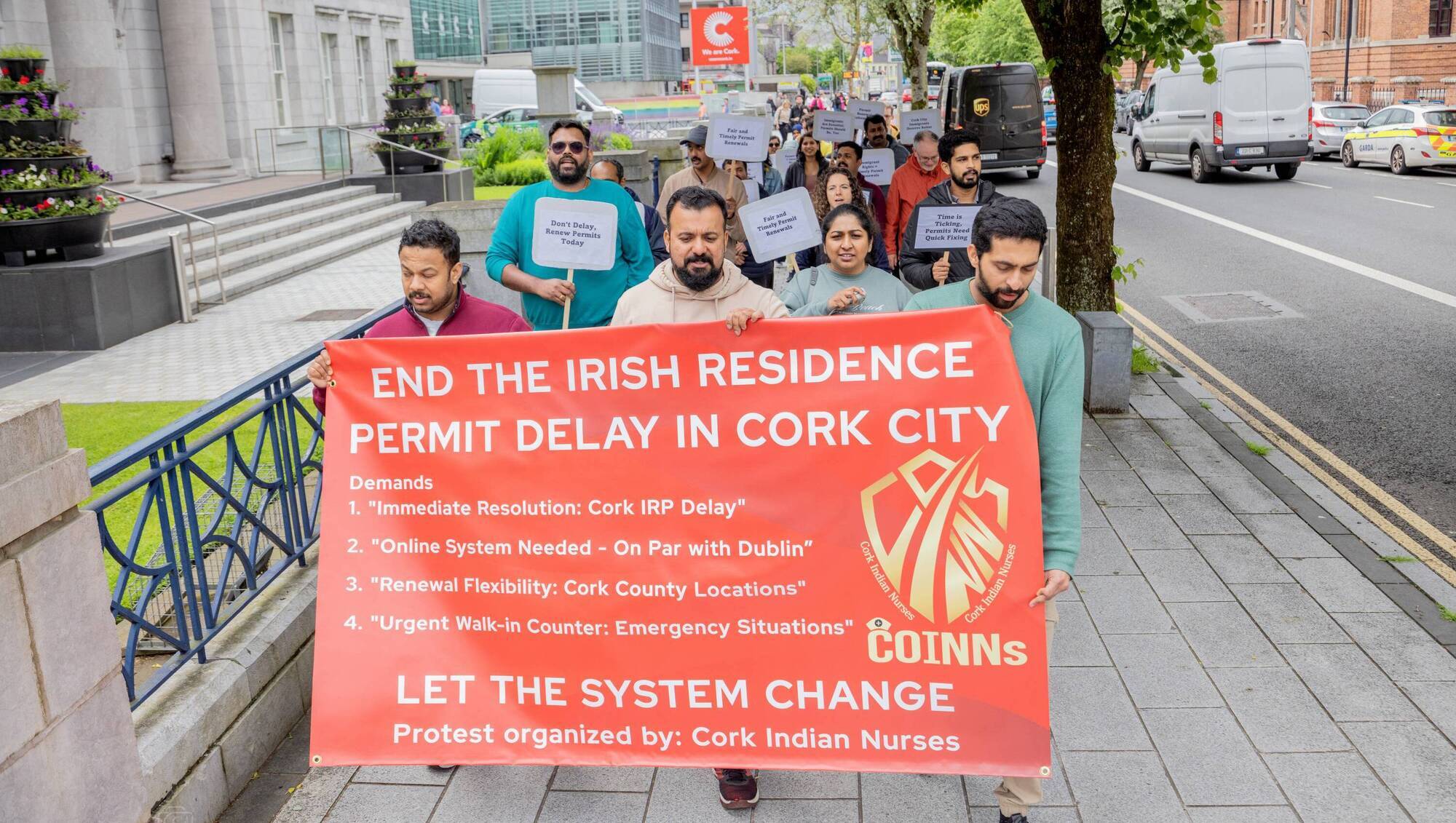
Cork Indian Nurses (COINNS) protesting delays to renewal of Irish residence permits. Picture: ElmayaReels

Former taoiseach Bertie Ahern’s comments about "too many" immigrants from outside Europe were unpleasant. They were also deeply damaging to our healthcare system.

As a practicing doctor, medical academic, and occasional patient, I see everyday that the system is completely dependent on healthcare workers from every part of the world. Whether in our largest teaching hospitals or smallest rural facilities, foreign-born healthcare workers are not an exception — they are the backbone of day-to-day care.

These people do not need to come here. There is a global shortage of talent and therefore plenty of other countries trying to attract doctors and nurses to meet the almost limitless demand for care. 

You have to ask yourself: Why would any self-respecting nurse or doctor come to a country where the former head of government happily criticises them when they could go almost anywhere?

It is time to be honest about who keeps our health service functioning. The nurse from India, the ophthalmologist from Egypt, the midwife from Spain, and the occupational therapist from Brazil are all economic migrants; precisely the category of worker many voters now say should be restricted or turned away.

I understand migration from personal experience. In 1998, I left Ireland to train at Harvard. Two of my children were born in Boston. I left because opportunity drew me there, and like many migrants, I was eventually drawn home again. Migration is rarely permanent or simple. It is fluid, cyclical, and driven by opportunity and welcome.

Many foreign-trained healthcare professionals arrive here to train and work before returning home or moving onward to other countries. Their contribution is enormous but, by its nature, temporary. Every departure creates a vacancy that must be filled.

This is not a moral argument; it is a workforce reality. Those proposing strict limits on migration must explain how they intend to replace these workers. So far, they have not.

Ireland's reliance

The scale of Ireland’s reliance is striking. Close to one third of our healthcare workforce is foreign-born. More than half of nurses and roughly two out of every five doctors trained abroad. 

In 2024 alone, Ireland issued about 12,000 work visas for healthcare roles in a system employing about 105,000 people. 

The annual churn required simply to stand still is vast. Without continued international recruitment, staffing levels would collapse quickly.

If migration slows — whether through political rhetoric, administrative barriers, or a cultural shift that makes workers feel unwelcome — the consequences will be immediate and severe. 

Our health service will not simply become strained; it will fail in critical areas. Waiting lists will lengthen. Emergency departments will overflow. Ultimately, patients will suffer and lives will be lost.

Healthcare professionals are highly mobile. They can and do move to countries such as Australia, the UK, and Canada — often with relative ease. Reputation matters enormously. Word spreads quickly within global professional networks about which countries value, support, and respect their staff. A hostile or uncertain environment is not theoretical — it is a recruitment deterrent.

Some argue Ireland should simply train enough domestic staff to remove this dependence. In principle, that is a sensible and desirable ambition. In practice, it is currently unrealistic.

Colin Doherty, head of Trinity’s school of medicine, centre front, with young doctors from Trinity College Dublin at the university’s traditional Stethoscope Ceremony for third year students. Students from left to right: Merve Saharan, Natalie Uhi Kei Ung, Sofia Aisya, Eoin O’Kelly, Sean Onovo, and Jqu Kycia.

Training an equivalent Irish workforce would cost the State an estimated €3-4bn annually. This is not an ideological position but simple arithmetic. As head of the School of Medicine at Trinity College Dublin, I can also confirm that the infrastructure, teaching capacity, and clinical training placements required to scale up at that level do not presently exist in this country — even with substantial funding.

If we fail to maintain a culture of welcome, calmly, factually, and unapologetically, foreign-born healthcare workers will leave or choose not to come.  

The consequences will not be felt by politicians or commentators. They will be borne by elderly patients waiting for hip replacements, by families sitting in overcrowded emergency departments and by vulnerable individuals dependent on timely care.

Europe has already run this experiment. In 2015, Hungary’s leadership declared that migrant labour was unnecessary. 

A decade later, Hungary is actively recruiting foreign workers after large numbers of its own young people emigrated. Poland, by contrast, has remained outward-looking and economically dynamic, benefiting from a more open labour market.

Lessons learned

The lesson again is not ideological, it is practical. Modern healthcare systems do not function in isolation from global workforce flows.

None of this suggests Ireland’s current model is flawless. We are overly reliant on foreign healthcare workers, and global shocks including political instability, economic disruption, climate pressures, or future pandemics could rapidly expose this vulnerability.

Government must invest far more seriously in training, retaining, and supporting domestic healthcare staff.

There are also legitimate ethical concerns about recruiting clinicians from regions that already face severe workforce shortages. These are complex issues that demand thoughtful international cooperation and long-term planning.

But while those debates continue and long-term solutions evolve, one immediate reality remains unavoidable: Our healthcare system depends on foreign-born workers. I do not see this as as political slogan but simply an operational one.

So perhaps we should begin with something simple and human. The next time you meet a foreign-born healthcare worker, offer thanks, respect, and friendship. Because without them, our health service would not merely struggle; it would quite literally fall apart.

  • Colin Doherty is a neurologist based in St James’s Hospital and head of the School of Medicine at Trinity College Dublin

More in this section

Revoiced

Newsletter

Had a busy week? Sign up for some of the best reads from the week gone by. Selected just for you.

Cookie Policy Privacy Policy Brand Safety FAQ Help Contact Us Terms and Conditions

© Examiner Echo Group Limited