Sharp contrast in supports for adult and teenage asylum seekers worth examining
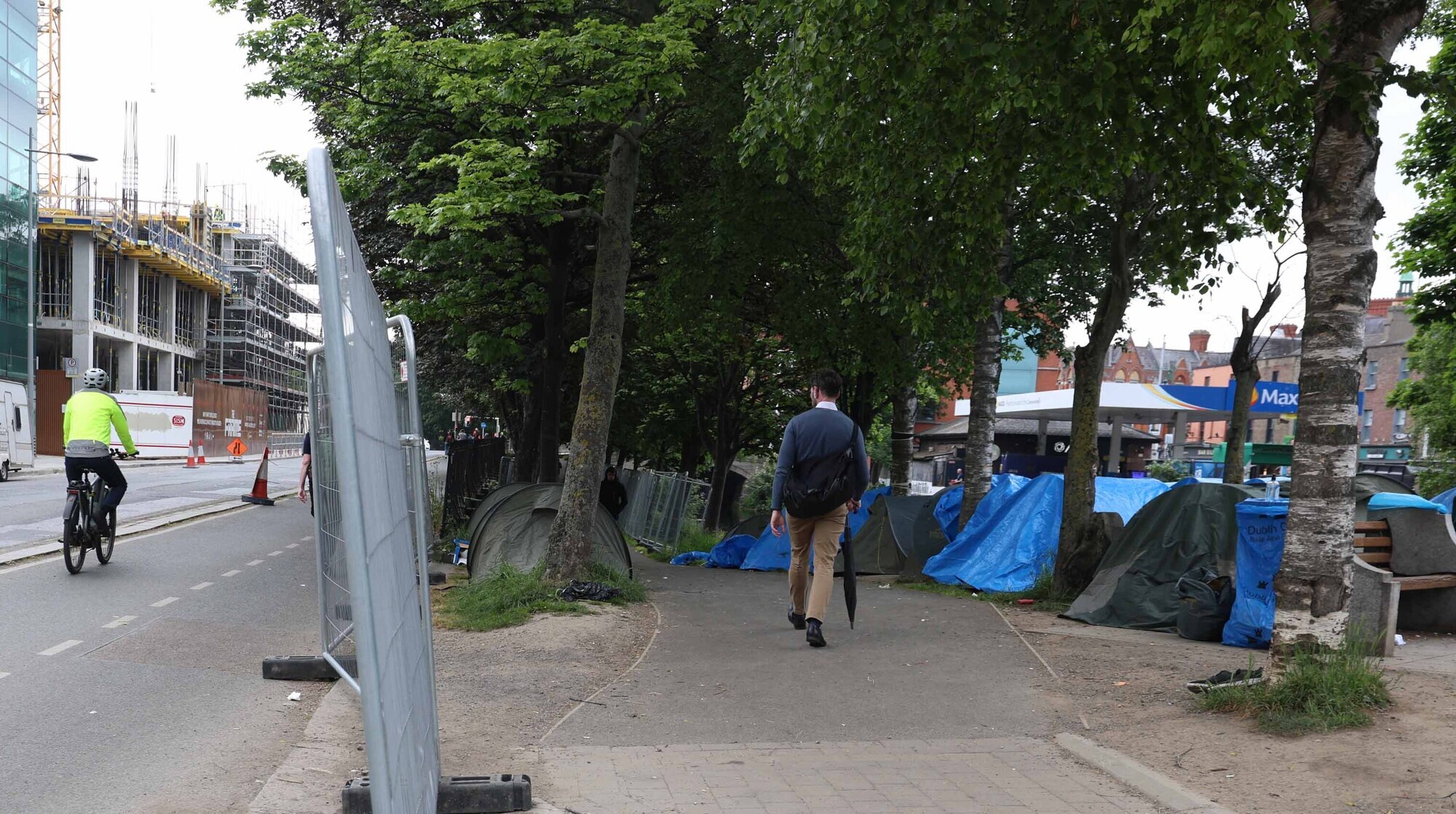
As an adult male, an international protection applicant is not considered vulnerable. He may spend a period of at least a few days living on the street, given the State’s failure to accommodate adult men at the point of arrival. Photo: Leah Farrell / © RollingNews.ie
Last week, Tusla released data indicating that 293 international protection applicants who said that they were children were subsequently deemed to be adults.
This prompted discussions about age assessment of unaccompanied minors, within both the Committee on Public Accounts and within the media, with the focus primarily being on the potential risks posed to children if adults are placed with them. These are valid concerns.
Read More
However, there is a danger of over-simplification of a complex situation. Indeed, one TD stated that it was a “disgrace” that people are “gaming the system” by pretending to be children and suggested they should be “sent straight back on a plane”.
Such simplistic sentiments risk the ‘story’ being used as fodder for those who harbour anti-refugee sentiment.
Two key questions require more nuanced understanding: (1) Does ‘deemed to be an adult’ mean, definitively, that a young person is an adult? (2) Why might a person claim to be an age they are not?
Research which I conducted with Professor Prospera Tedam and Dr Joanne Kelleher, on behalf of EPIC (Empowering People in Care), highlighted how social workers disliked conducting age assessments.
One participant stated that “we all hate doing them” and that “it is not an exact science”.
Age determination is certainly very difficult. For example, if I think of white Irish students I teach at UCD, I would be hard pressed to know how old they are. If you add differences in ethnicity, language and culture, it becomes even more challenging.
Many unaccompanied minors are impacted both physically and psychologically by experiences of persecution and precarity and come from cultures where children bear more responsibility at a younger age.
All of these factors can make it very difficult to determine age. Both psychosocial approaches used in Ireland and many other countries and more medical approaches used elsewhere have been shown to be inaccurate.
Therefore, while the coverage suggests a clear fact — that people claimed to be children but were not – the reality is much more nuanced.

There is significant room for error in both directions — a young person might be thought to be a child when they are not; equally a young person might be deemed to be an adult when they are in fact a child.
Both situations pose risks, although the latter is rarely discussed. Indeed, in our research, NGO workers gave examples of unaccompanied children living in IPAS accommodation because their age had not been believed.
This leads us to the second question: if we accept that at least some of those who claimed to be children were indeed over the age of 18, why might they have claimed to be younger?
While there is no simple answer, many of the reasons point to structural failings within Ireland’s international protection system.
Let’s take an example. ‘Noah’ arrives in Ireland, alone, at age 17, having fled war in his country of origin. His vulnerability as a child is recognised and he is accommodated by Tusla.
Even if this accommodation is in a Special Emergency Arrangement (which have been heavily criticised), he will have access to some psycho-social supports, including support with integration and with his international protection application.
If granted international protection, he will be able to apply for his parents and minor siblings — who are at grave risk where they live — to be reunified with him.
However, if Noah happens to arrive on his 18th birthday, his situation would be entirely different. As an adult male, he is not considered vulnerable. He may spend a period of at least a few days living on the street, given the State’s failure to accommodate adult men at the point of arrival.
When eventually accommodated, he will probably live in an emergency IPAS centre, which could be a tented facility. Most likely, he will have no support to help him deal with the challenges he faces: conflict-related trauma, worry about his family, navigating a totally different cultural context and managing complex legal processes.
If, eventually, he secures international protection, his parents and siblings will not be able to join him. His family will continue to be in danger. As a result of restrictive family reunification laws (soon to become even stricter), Noah — at just 18 — will be completely powerless to protect them.
So, if, upon arrival, Noah decided to give his age as 17 instead of 18, does this amount to “gaming the system”? Or is this a normal human response when one is desperate to ensure the safety of one’s family?
Determining age is nuanced, complex and contested. The international protection system is rigid and inflexible. The two don’t marry well. The sharp contrast between provision for adults and provision for those who arrive unaccompanied and under the age of 18 is problematic on multiple levels.
Therefore, rather than simplistically stating that young people are “gaming the system”, perhaps those in power should consider the inhumanity of the system in the first place?
- Muireann Ní Raghallaigh is associate professor at the School of Social Policy, Social Work and Social Justice, UCD

CONNECT WITH US TODAY



Be the first to know the latest news and updates