Sabastian Sawe's story is incredible — and it's not about his shoes
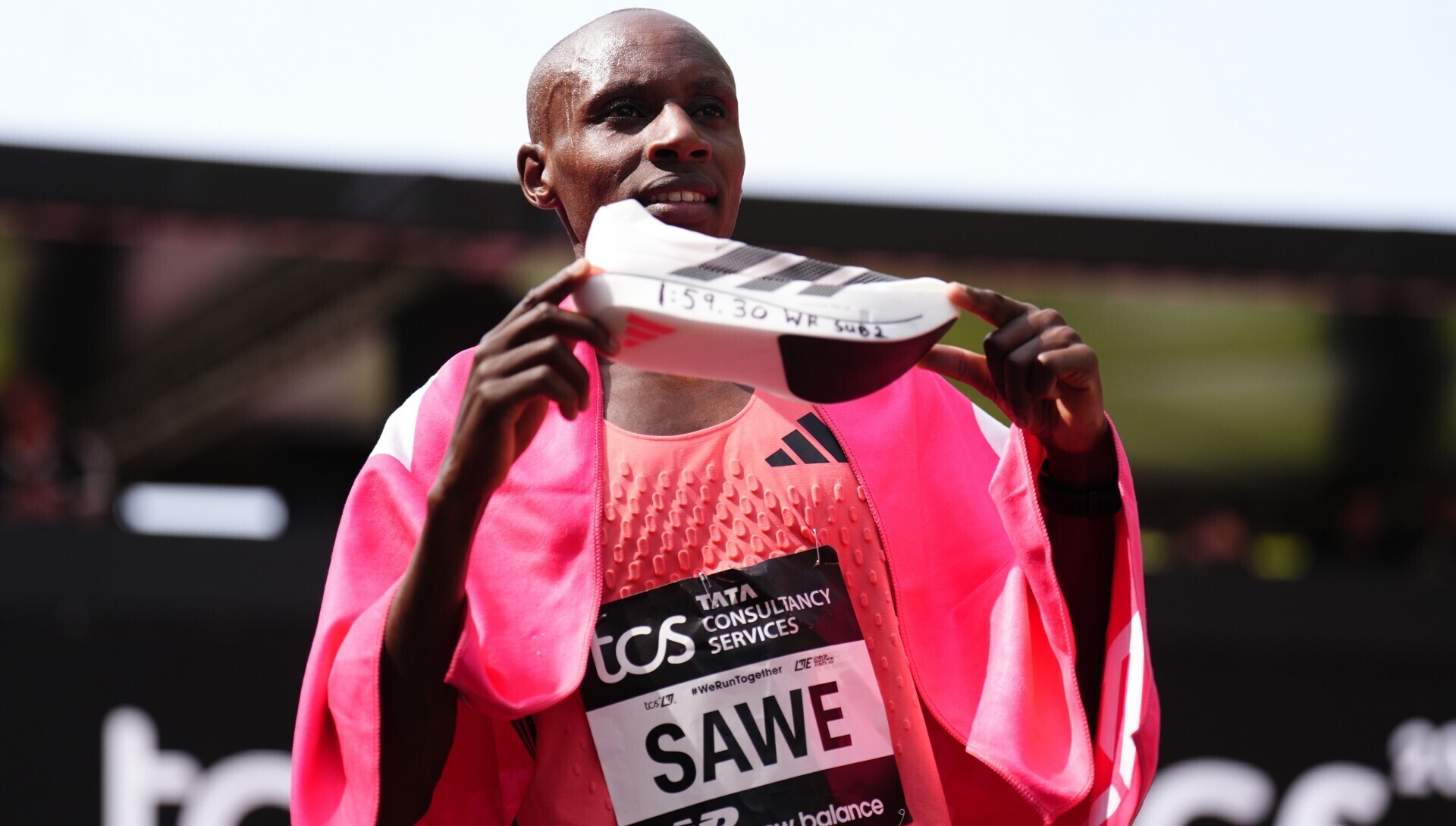
If a picture paints a thousand words, the photo of a black and white Adidas shoe, with Sawe's 1:59.30 time scrawled in sharpie on the side of the sole might compete for first place. Photo: John Walton/PA
Every runner has a why, a message they carry.
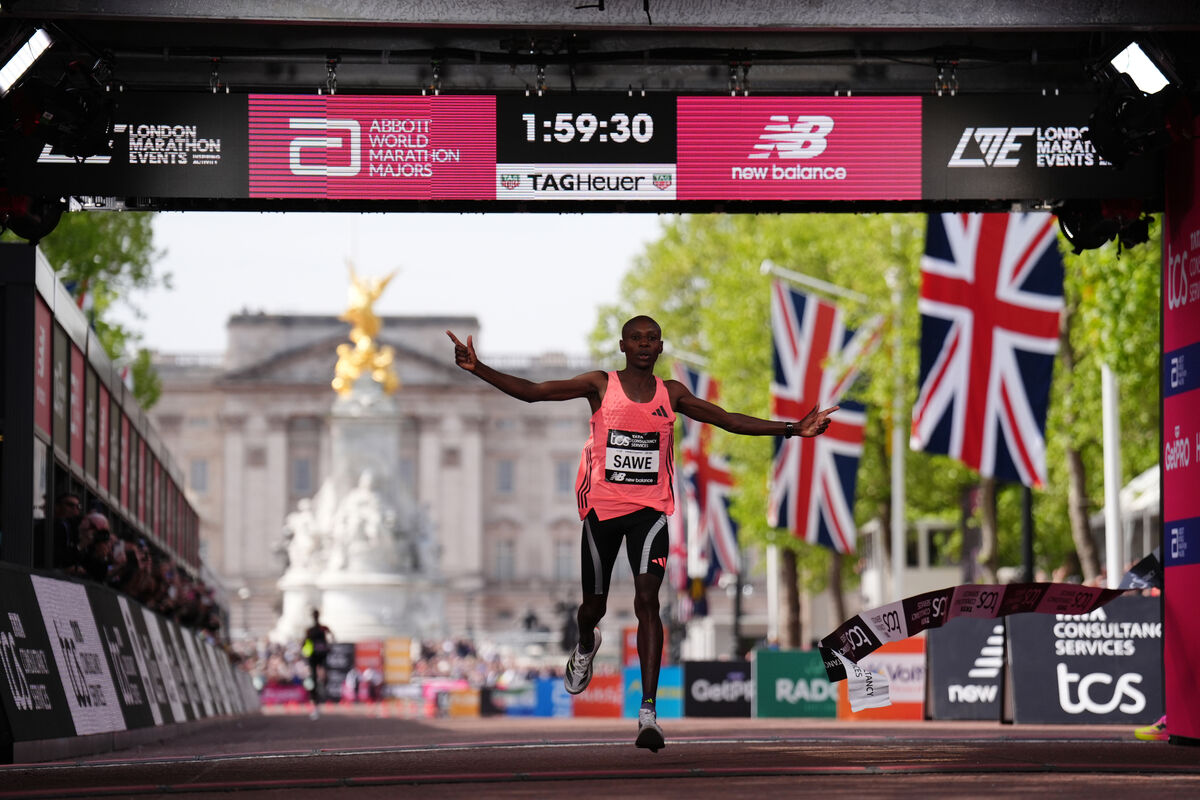
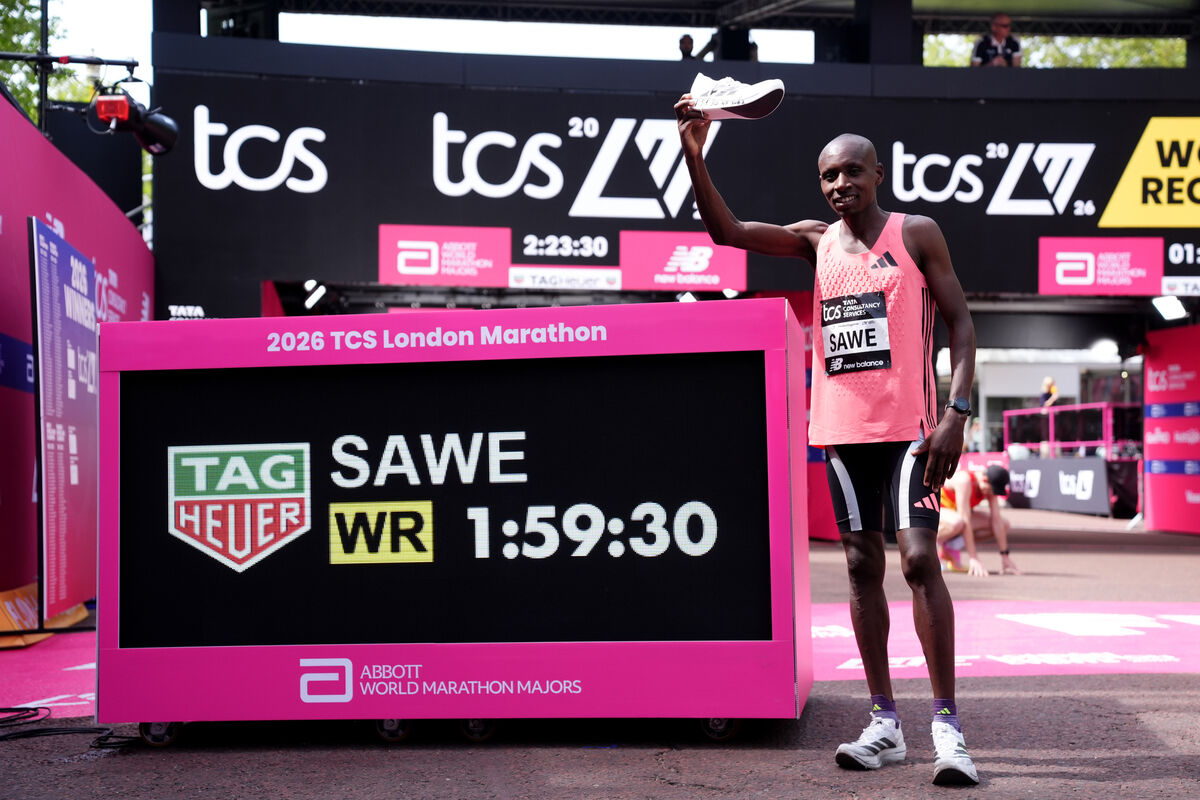
So, when 31-year-old Kenyan Sabastian Sawe crossed the finish line of the 2026 London Marathon in exactly 1 hour 59 minutes and 30 seconds last week — making history as the first human to finish an official 42-km marathon race in under two hours, what message reverberated around the world?
If a picture paints a thousand words, the photo of a black and white Adidas shoe, with Sawe's 1:59.30 time scrawled in sharpie on the side of the sole might compete for first place. In some photos the shoe is in sharp foreground focus, its holder in the background. In others, it is fingertips we see holding this shoe, or else, just the shoe and its time itself.
And in the era of short-form viral video content, perhaps the post-race message to reverberate the most was that of the shoe's foamy sole being pushed down over and over again as the trainer was turned around in angles of 45 degrees for a very simple, but very Instagram-friendly, shoot.
That several-second long video had amassed 25 million views in the hours after the world record was made.
But it's not just images and videos that form messages in 2026, words still do so too.
In the hours and days after Sabastian Sawe showed the world what the human body is capable of, here are some of the headlines reverberating around the world: 'The Adidas shoe that cracked the 2-Hour marathon,' and 'Adidas' lightest shoes ever were behind the first sub-2-hour marathon.'
Also in the words of social media captions we have 'History' and 'Maker' framing the image of just the Adidas shoe. Another social media descriptor reads 'A shared dream'.
Sabastian Sawe was born in Kenya in 1995, to a long line of runners, resistors and holders of dreams.
According to magazine, who profiled Sawe in September 2025, his father Simion is a maize farmer belonging to the Nandi. The Nandi hold a special place in Kenyan history, it was this group of people who staged a more than decade-long resistance against British colonial rule, from 1890–1906.
Sawe's resilience runs deep, according to the same profile, his grandfather, Musa Sitenei, who was once a farm labourer, "cleared scrubland, bush by bush, until he owned 150 acres of maize fields, leaving a legacy of self-reliance".
This man, who engendered self-reliance, died before Sawe was born, but his wife Esther, Sawe's grandmother, also known as Koko, would go on to rear the athlete.
Sawe had started primary school in Cheukta, but his parents moved to Nandi county for farming. However, he wanted to go back to Cheukta and to his grandmother, so he and his sister returned to be raised by her.
But it's not just resilience that runs in his blood, but sporting success times three. His own mother Emily, was a sprinter, winning primary school gold in 1991, but according to , an early pregnancy ended any further progress.
According to the ínewspaper, his other grandmother, Vivian Kimaru, competed at the Olympics. “I competed in Munich’s 1972 Olympic Games in 1500m and 800m and reached the semi-final," she said last week.
Sawe's uncle, and lifelong supporter, Abraham Chepkirwok ran the 800m in the 2008 Olympics in China, representing Uganda. So what happens when a legacy and lineage like this lines up in a boy born into the world of 1995?
In 1991, American exercise physiologist Michael Joyner published a study claiming that a sub-two-hour marathon was possible in an elite athlete. Joyner predicted a time of 1:57:58. Some people predicted it would happen in 2026, some 2028 and others in 2032.
While a sub-two-hour marathon distance was delivered by fellow Kenyan Eliud Kipchoge in 2019, in 1:59:40, it was not an official race, but a challenge with rotating pacers.
So how does Sawe spend his years leading up the London Marathon of 2026?
In his early 20s, he took a bus to the town of Iten, the famous Kenyan running hub that sits at 2,400m in elevation. He stayed here from approximately 2017 to 2020, but without signs of breaking through, is it time to give up, come home and get a job like the rest of his family?
Sawe resisted and trained harder, but ruptured a tendon, then covid hit, and as the world closed down, so too did races, and opportunities to prove himself.
His Olympian uncle intervened, and through old sporting friendships, connected him in with 2Running Club, based in Nandi County — founded by Italian coach Claudio Berardelli. Here, Sawe had to earn his stripes, as a newcomer, which he did.
But the setbacks continued, as does Sawe's resilience. He was due to pace a teammate in the 2020 Valencia Marathon, but a positive covid test put an end to that opportunity.
Then in January 2022, Sawe got another chance — again as a pacemaker, for the first 10km of the Seville Half Marathon (21.1km). But another setback occurred, news of his grandmother Koko's ill health.
Sawe decided to travel and complete his job as pacemaker, but as the BBC reported, he ran so fast, that he ended up dropping "everybody within the first 10km and carried on to claim victory in a course record time".
Having never competed on the road, the race shock went on to earn him headlines of "the pacer who forgot to stop".
He returned home to bury his beloved grandmother.
From here the races and records continued, although London was just his fourth marathon. And Sawe navigated this while being a husband and a father.
When he touched down on home soil in Eldoret last week, the described him as "locking eyes" with his wife Lydia as soon as he exited the military plane. Due to intense training he apparently only saw his wife, and three children, twice a month, just one of the many sacrifices clocked up along his history-making way.
This record is 130 years in the making, since the first official marathon debuted at the first modern Olympic Games in 1896, an event inspired by the Greek legend Pheidippides — a messenger.
The myth goes that he ran 25-26 miles from the battlefield of Marathon to Athens in 490 BC to deliver the message of Greek victory over the Persians. The history of running is the history of messenger, and in modern times most runners, whether they'll admit it or not, run with a message, a person to remember, a milestone to mark.
On April 26, 2026, Sabastian Sawe passed a milestone in human endurance, running one kilometre in 169.9 seconds (or two minutes 49.9 seconds) 42 times in a row, or the equivalent of running the 100m in 16.9 seconds, 420 times in a row.
Jamaican Usain Bolt still holds the world record for the 100 metre sprint for 9.58 seconds, a record no one has been able to surpass since 2009.
What Sawe achieved is moonshot stuff. After the race he said: "I can run faster".
But unlike Roger Bannister's 1954 three-minute-59.4-seconds mile, we live in the era of the internet, swimming in a constant stream of messaging to buy this, eat like this or think like that.
So what message will we take away from this history-defining moment? Will we make it about a pair of shoes that sell for €500 a pop?
Or, will we look into the humanity and history of the man who ran the race, look into his steely heart and tremendous mind, and mine it for wisdom to find out how he stayed the course, not only on race day, but when all the odds were stacked against him and his family, throughout generations?
CONNECT WITH US TODAY



Be the first to know the latest news and updates