Ciara Reilly: Power shift behind SNA U-turn exposes Government's weakness
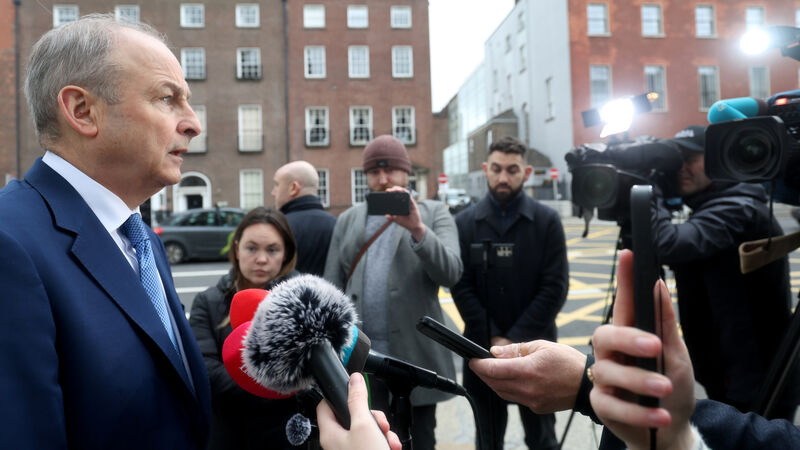
Taoiseach Micheál Martin outside Government Buildings. Circular rewrites alone will not fix disability and education policy. A bit of old-fashioned political leadership might. File photo: Leah Farrell / © RollingNews.ie
It became clear early last week that the Government’s neck-breaking U-turn on Special Needs Assistant (SNA) allocations was always going to happen.
The past week amounted to a brutal reading of the riot act. Spare a thought for your local Fianna Fáil or Fine Gael TD. There were emergency meetings, Ministers being dragged into rooms, and otherwise politically anodyne principals suddenly mobilising entire school communities.
And the timing? A complete howler. Slap bang in the middle of mid-term. Every parent in the country was on the phone and across social media. Every teacher and school leader was on every forum they could find, trying to make sense of what was unfolding.
A week is a long time in politics? Try a wet three-day mid-term for the empowered parent who perceives this as them being told their child is no longer a priority.
Read More
The backlash was too loud, too empowered, and too grounded in that most reliable of political kryptonite: cut anywhere else, just not my local school.
Call it NIMBYism if you like, but when it comes to certain children and certain classrooms, people organise fast. Not my child. Not his support. Not in our school. Not in my classroom.
So came the climbdown.
While ministers now present this as responsiveness, what we actually witnessed was a stark moment of political vulnerability laid bare. This was not decisive leadership. It was a retreat of epic proportions, leaving the department, the two ministers, and the wider Government looking exposed and ill-prepared.
It may well be the most revealing episode of this administration’s lifespan so far, showing just how fragile its decision-making becomes when it meets organised resistance.
Almost four years out from the next election, they have already lost the dressing room on following through on something even mildly unpopular — something that could have signalled an ambitious rewrite of special education policy and how we support our most vulnerable children.
The original plan to remove or redeploy SNAs based on a narrow recalibration of care needs could, in theory, have formed part of a broader structural shift.
That kind of reform might have been workable if other supports around the child had been strengthened at the same time: smaller class sizes, improved pupil-teacher ratios, a reset of the chaotic Special Education Teacher allocation system, and a clear alternative model of in-class support.
With thoughtful communication and meaningful investment in replacement structures, it could have been a difficult but coherent change.
Instead, schools were told they would lose SNAs without any corresponding increase in teaching posts, without clarity on alternative supports, and without a joined-up plan for children with additional needs. The system buckled under its own logic.
So the Government pressed pause, not just because the policy was flawed, but because the optics were. That exposes the first uncomfortable truth.
This Government cannot follow through when confronted with informed opposition. Its authority in this space is shallow.
It underestimated both the professional knowledge within schools and the capacity of parents and educators to mobilise quickly. Once the political temperature rose, any coherence evaporated.
The second truth is even starker. Policymakers remain fundamentally off the mark when it comes to special education and, more broadly, disability.
This controversy represents the “Kanturk moment” of this cycle, playing out in microcosms across the country in the 194 schools that were told they faced reductions.
It revealed how disconnected central decision-making has become from parents’ lived experiences and from what families believe their children who need something different now require in order to thrive.
Not one parent directly affected bought the line that there were “no cutbacks to SNAs”. Nationally, that might have been technically true, but tell that to a school losing up to five pairs of boots on the ground.
There was no parallel plan for smaller class sizes. No increase in teaching posts. No floating support model. No clarity on replacement structures. Just subtraction, with the implicit assumption that schools would absorb the impact, as they always do, until they cannot.
This brings us to the third and perhaps most revealing element of this saga: the Government’s growing reliance on quangos and subordinate agencies to carry out politically difficult decisions. In this case, the National Council for Special Education was tasked with implementing a directive that originated elsewhere.
They applied the criteria provided. Many of us have been keen to clarify that they merely did what they were asked to do. They communicated outcomes. And when the backlash landed, they were left politically exposed.
A weakened NCSE does not serve the people, like my daughter, who need it to be strong. I sincerely hope they take the opportunity to defend themselves now that next steps have been outlined.
This strategy of distancing ministers from consequences by outsourcing delivery may work in quieter policy areas. It does not work in education. Parents, teachers, and advocates understand the system.
They know where decisions originate. They know the difference between implementation and authorship. And they will not accept agencies being used as political buffers.
The NCSE did not design this reform alone. They executed it. Their abandonment in the aftermath sends a clear message: when pressure mounts, accountability flows downward.
There is, however, a deeper lesson here, one that extends far beyond SNAs. This episode offers a glimpse of what disability and education advocacy could achieve if those most affected by cuts and policy failures were consistently resourced, organised, and heard.
The speed of this reversal should give everyone pause. It shows what is possible when communities mobilise with clarity and urgency.
Imagine if that same collective energy existed around special class access, therapy provision, waiting lists, inclusive class sizes, respite, transport, or transition supports. This was not just about SNAs. It was about power. And for a brief moment, that power shifted.
What has emerged now is not a solution but a holding pattern. Schools due additional SNAs will receive them. Schools facing losses will not, for now. Reviews are deferred to 2027. New circulars will be drafted. Workforce plans will be advanced. Redeployment schemes will be reconsidered.
In other words, time is being bought. Nothing has been structurally resolved. The system SNAs currently prop up remains intact. We still have overcrowded classrooms, insufficient teaching posts, and little to no child therapeutic support in the community.
This pause simply delays confrontation with the reality that Ireland needs more teachers, smaller classes, and embedded multidisciplinary support if inclusion is to mean anything beyond rhetoric.
Spending figures will continue to be cited. Headlines will reference record investment. But spending alone is not impact. Outcomes matter. Children’s experiences matter. Teachers’ capacity matters. And trust matters. Right now, trust is in short supply.
People are not just angry because a recalibration was proposed. They are angry because it was done without safeguards, without alternatives, and without honesty. They are angry because once again, the burden of systemic failure was placed on school leaders, teachers, and most importantly the families least able to carry it.
All of this illustrates something even more troubling.
For those of us who desperately need something ambitious, creative, and overarching for our children, spanning education, disability, and health, there is now little faith that this Government has the political acumen, internal support, or capacity to carry meaningful reform from proposal to actualisation.
The gap between announcement and delivery has become too wide. The pattern of retreat too familiar.
This U-turn does not mark the end of a crisis. I hope it marks the beginning of a reckoning. The question is whether Government will finally engage in genuine structural reform, or whether this will become another chapter in Ireland’s long history of postponing hard decisions in disability and education policy.
Circular rewrites alone will not fix this. A bit of old-fashioned political leadership might.
Any takers?
CONNECT WITH US TODAY



Be the first to know the latest news and updates