Defence spending: Push to increase spending aimed at FDI interests
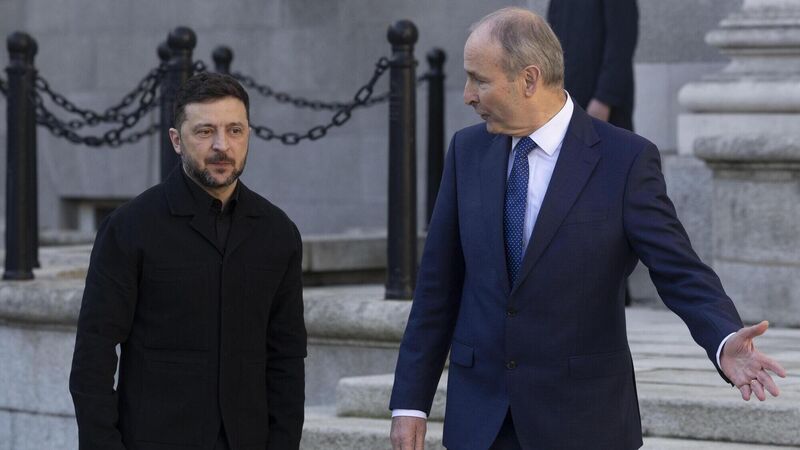
Ukrainian president Volodymyr Zelenskyy and Taoiseach Micheál Martin during Mr Zelenskyy's visit to Ireland in December. Picture: Sam Boal/Collins
In the last weeks of 2025, several major Irish lobby groups, consultancies, and think-tanks released reports making a business case for increased defence and security spending, including Ibec and a joint report from IIEA/Deloitte.
Why are business groups intervening in debates about Ireland’s defence and security policies? And why now?
At one level, some are simply tracking which way the wind is blowing and seeking opportunities for profitable investment as the State reorients its foreign and defence policies.
However, something more fundamental is at work here, relating to Ireland’s economic model and its geopolitical position between the US and the EU. The key factor is foreign direct investment (FDI).
It is clear the infrastructures that support Ireland’s FDI-led and tech-dominated industrial development model — subsea cables, data centres, gas pipelines, marine wind farms — have become a geostrategic concern for the US, UK, EU, and Nato.
They, of course, aren’t worried about the role of these infrastructures for the Irish economy, climate progress, or public services. Rather, these infrastructures matter because the flows of data, gas, electricity, and profit they facilitate support the corporate interests behind artificial intelligence (AI) and the security interests of powerful states in the midst of geopolitical and supply chain turbulence.
The Russian invasion of Ukraine and the shifting priorities and practices of US foreign policy have produced this turbulence, and states are scrambling to bolster their position in the face of these geostrategic headwinds.
This clamour has occurred in the context of the EU’s "twin transition" that requires the simultaneous digitalisation and decarbonisation of European economies and the rapid expansion of competitive AI capacity — all of which require transformations in how countries build-out infrastructure, source manufacturing, and secure resources.
Ireland is arguably a leader on this front, hosting most of the major US tech companies and providing a laboratory for green tech development. However, this concentration of infrastructure, coupled with Ireland’s geographic position, has led prominent commentators to characterise Ireland as "defenceless" in the face of security threats to these industrial interests.
This commentary is not limited to Irish organisations, such as Ibec and the IIEA. International pressure is being applied from a variety of sources, including British politicians. In the House of Lords, Paul Bew, former adviser to the Ulster Unionist Party and chairman of the Anglo-Israel Association, suggested the British public should be aware of "just how much Ireland benefits from Nato and the UK" while maintaining neutrality.
A steady stream of articles has appeared in the international media — , , — which charge Ireland with "freeloading" from Britain and the EU for its defence.
The core claim is that Ireland benefits economically from the presence of tech multinationals but doesn’t pay to defend the infrastructures that support them, with this cost falling to Britain and EU states.
In a country exceptionally dependent on FDI, where FDI has dictated economic decision-making for decades, this may appear like common sense. As we argue in a recent article and book, calls to secure infrastructures for FDI are a logical extension of Ireland’s dependent economic model, whereby the country’s prosperity is tied to the competitive advantages it gains by catering to multinational corporations.
However, this model appears under threat, and not just from increasing US protectionism and the Trump administration’s increasingly aggressive stance within the western hemisphere, as exemplified by last week’s attack on Venezuela.

Rather, in a militarising Europe, Ireland’s neutrality and low defence spending represent hurdles to the investment bonanza promised by initiatives such as ReARM Europe.
Seen in this context, the reasons for increasing defence spending become more obvious. This explains why so much of the domestic discussion focuses on the risk of reputational damage, rather than tangible security threats, if Ireland doesn’t engage in European militarisation.
The implicit message is that continued inward investment will be at risk if Ireland doesn’t get on board. This is what we call "militarising FDI". It is important to confront the assumptions of the dominant discourses, which naturalise these developments, because they entrench Ireland deeper into the militarism that threatens to destabilise the planet and destroy any meaningful chance of averting climate catastrophe.
After all, the planet’s militaries, especially those of the US and Nato, are among the world’s most significant emitters. In addition, the data centres that Ireland must now secure utilise 22% of the country’s electricity, and are widely acknowledged to obstruct our climate targets.
Ireland’s supposed defence vulnerabilities also represent economic opportunities for some, particularly to those in the defence-tech sector. Bobby Healy, founding director of the drone delivery business Manna, recently argued that the Irish tech sector should be examining the opportunities in defence technology, although he said Manna would not be pivoting 'From Burgers to Battle Plans,' as the headline ran.
In April, a article detailed how Irish tech firms are pivoting towards defence and security, seeing an opportunity to grow their businesses beyond Ireland’s previously restricted market for dual-use technologies.
Likewise, RTÉ noted the EU’s €800bn remilitarisation plans had given a "boost" to Irish tech firms moving into the sector.
In mid-December, it was reported the Government was seeking to remove barriers under the 1987 Science and Technology Act that prevent Enterprise Ireland from participating in contracts of "primarily military relevance". Simultaneously, justice minister Jim O’Callaghan plans to establish a new national security agency to provide the clearances for sensitive defence contracts.
Many commentators have talked about the growing influence of the "military-tech nexus", especially in the context of big tech’s increasing military applications, and we are seeing a growing convergence of Ireland’s tech industry and increased State spending on defence and security. This is an opportunity for the country’s small but fast growing defence-tech ecosystem.
The Government and media commentators often claim neutrality and defence spending are separate issues, but this fails to recognise the forces at play or is wilfully misleading. Policy changes in both areas are the result of enormous external pressure being placed on Ireland to step into line with the norms and interests of Euro-Atlantic security alliances. Ireland is particularly susceptible to these pressures because our dependency on FDI gives international powers huge economic leverage.
The Occupied Territories Bill offers a stark example of how Ireland’s economic dependency constrains our foreign policy. Despite the bill passing both houses of the Oireachtas in 2019, and mass public support, successive governments have avoided passing it into law. Why?
Because direct and explicit threats have been made by US politicians, including the US ambassadors to Ireland and Israel, that passing the law will have economic consequences. Gunboat diplomacy is not needed when FDI dependency is available.
Governments has to negotiate a complex set of domestic and international interests and pressures, that enable and constrain policy. However, it appears democracy is consistently neglected and undermined in current foreign and defence policy debates.
Instead, the interests of the Irish public are conflated with the interests of FDI companies due to our economic dependency.
It is questionable whether maintaining this situation is the product of rational, let alone ethical, political leadership, but it certainly runs counter to the democratic will of the Irish public, as polling and widespread public protests in support of Palestine and neutrality consistently show.
The heated debates around neutrality and defence spending show the need for a more honest and open discussion about the stakes of Ireland’s FDI economy, both for our foreign policy and the health of our democracy.
- Dr Patrick Bresnihan is an associate professor in the Department of Geography at Maynooth University
- Patrick Brodie is a lecturer/assistant professor and Ad Astra Fellow in the UCD School of Information and Communication Studies
- Dr Rory Rowan is assistant professor of Geography at Trinity College Dublin
Read More