Clodagh Finn: Rename library after Trinity’s first female students
Clodagh Finn: Rename library after Trinity’s first female students

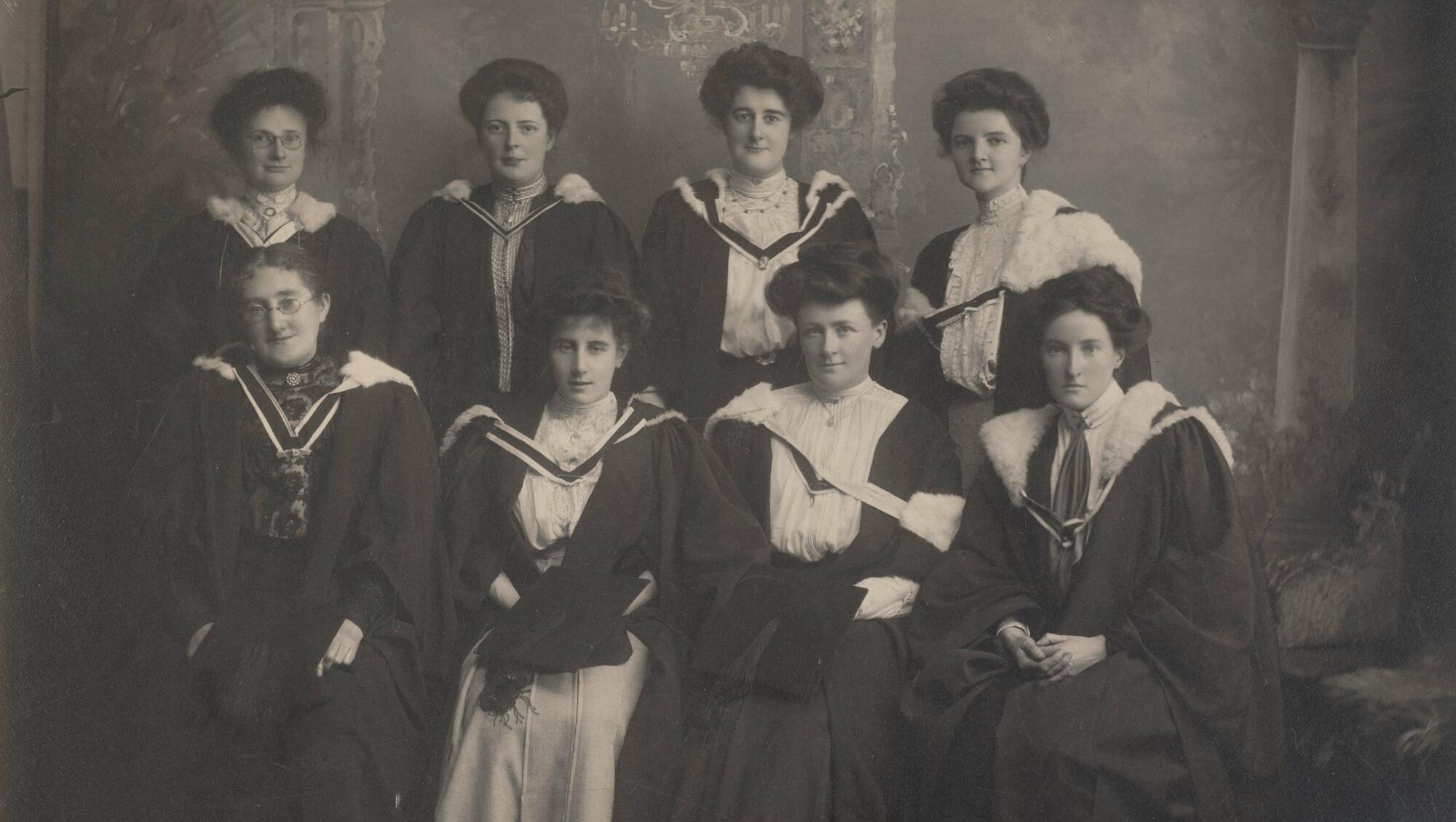
The first female graduates of Trinity College Dublin, in 1906, were: Back row, l-r: Lizzie Burkitt Craig (modern literature); Eileen Frances McCutchan (ethics and logic); Muriel Lora Bennett (modern literature); Bríghid Austin Stafford (modern literature), Front row, l-r: Anne Jane Sanderson (history and political science); Edith Marion O’Shaughnessy (modern literature); Eliza Beck Douglas (modern literature); Madeline Stuart Baker (medicine). Photo courtesy of the Board of Trinity College, The University of Dublin.

OH, the irony. George Salmon, mathematician, arch conservative and one-time provost of Trinity College Dublin, said that women would enter Ireland’s oldest university over his dead body.

And that is how it turned out. On the day he died, January 22, 1904, the first female student entered the hallowed institution... well, over his dead body.

When Isabel Marion Weir Johnston arrived in Dublin from Derry to sit exams — women were still not allowed to attend lectures — she wrote: “Dr Salmon had said that women would only enter TCD over his dead body, and when I arrived in Dublin in January 1904, I was informed that, as he had died that day, the examination had been put off until after the funeral.”

Dr Salmon, though, is rightly remembered for more than his conservative views on women, which were not unusual at the time.

HISTORY HUB

If you are interested in this article then no doubt you will enjoy exploring the various history collections and content in our history hub. Check it out HERE and happy reading
His statue, in the front square, honours his many achievements, from his distinguished school days in Cork, his entry to Trinity College at the age of 14, and his career as mathematician and theologian.

There is little on campus, however, to recall those early female students who had to fight prejudice, ignorance, and the suggestion that their very presence posed A Danger to Men, to quote the title of Susan M Parkes’s excellent book on the first decade of women being admitted to Trinity College.

Now that the Berkeley Library, just around the corner from Dr Salmon’s statue, has been ‘denamed’ because of the philosopher George Berkeley’s links to slavery, isn’t it high time that trailblazing women were honoured?

They opened the way for generations by chipping at the attitudes that kept women out of education

The people who opposed women in education doubted that the female mind was robust enough to stand up to the rigours of academic study. They also feared that women would distract male students — or, worse, trap one of the poor, unwitting darlings in “an imprudent marriage”. Little wonder that the first female students were chaperoned on campus and required to be off it by 6pm.

While we can’t prove that women didn’t distract male students — or vice versa — it is a matter of record that their brains were more than well-suited to the task of learning. More than half of the first 160 women won honours, in 1908, and, soon, they were winning medals in so-called male disciplines, such as experimental science.

What would Dr Salmon have thought when Sydney Elizabeth Auchinleck became the college’s first chemistry graduate in 1908? She had wanted to study engineering and she wrote a poem, taking the college’s Haughty Engineering School to task for not admitting her. She continued to write poetry, and, later, when she moved to Africa with her husband, studied car maintenance and worked part-time as a mechanic in Kenya.

If put to a vote — and let’s hope it will be — she would be a worthwhile candidate when it comes to renaming the library.

Weir Johnston also deserves a place on any list of potential candidates. She didn’t graduate, but her contemporaries recalled a woman with “remarkable personality, shown not so much in brilliance in examinations as in outstanding character, symptomatic of the new world of the 20th century”.

She was a talented organiser: Of dances, tennis tournaments, and student societies, at a time when women were barred from most of Trinity’s societies. Hard to believe now, but that didn’t change until the 1960s.

Any one of the first female graduates, in 1906, featured in the photograph to the right, should also be on the list. If there is a campaign, it would be good to see the stories of each of their lives fleshed out beyond this graduate picture.

We know much more about Alice Oldham, a long-time campaigner for women’s education and one of the first female lecturers at Alexandra College, Dublin, in 1889. She advocated for equality for women in education, saying they should be admitted to Trinity College.

Olive Purser, the first woman to be made a scholar at Trinity, should be on the list, too.

She was made lady registrar in 1918 and given an honorary doctorate in 1954 for her contribution to the welfare of female students.

And what of Elizabeth Maxwell, the first woman to join the college’s staff, when she was appointed lecturer in modern history in 1909? Thirty years later, she became the college’s first professor. We can’t ignore Ann Jellicoe, either. The committed educationalist founded Alexandra College in 1866, an institution that provided opportunities for thousands of women.

She also argued that the voice of women would not be fully heard in politics, literature, or in academic debate until they were admitted to Trinity College Dublin

On a lighter note, let’s include the ‘Forward Five’ — Barbara, Maureen, Joy, ‘Pic’, and Maura — who dressed as men and stormed the dining hall in 1931 to protest at women’s exclusion from it.

They were, alas, given short shrift by the housekeeper, Miss Jean Montgomery, as Parkes, fellow emeritus of Trinity College, recounts in her book.

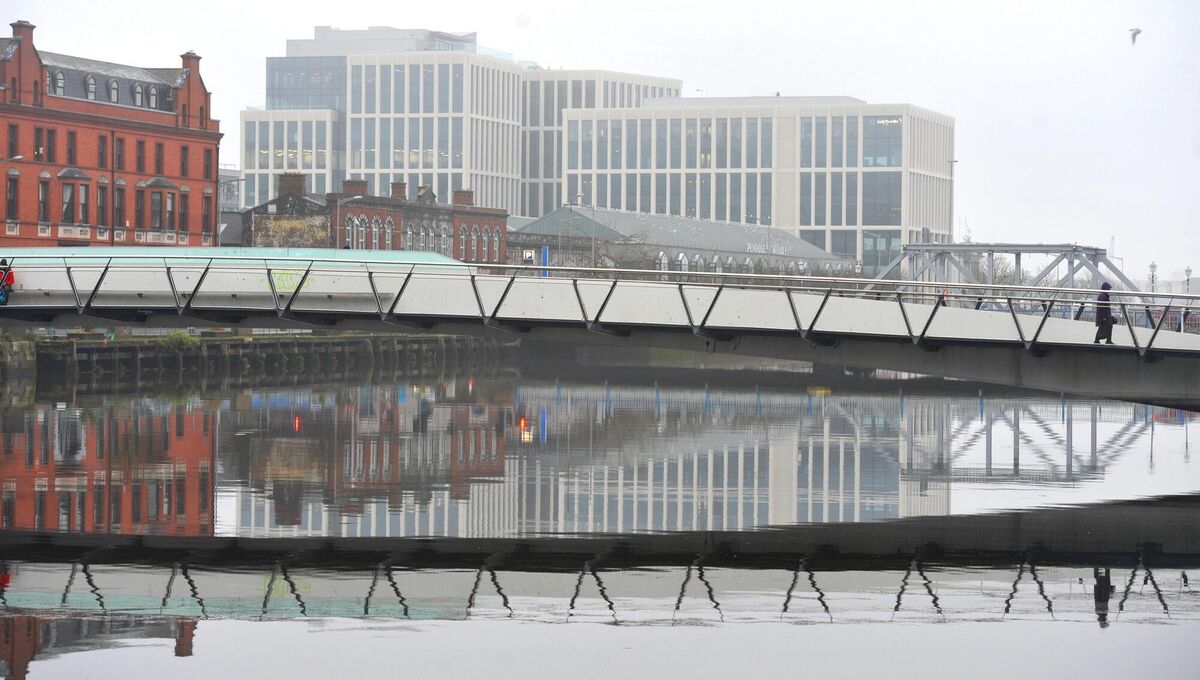
 The Mary Elmes Bridge over the River Lee, Cork City. 
 The Mary Elmes Bridge over the River Lee, Cork City. 

If Mary Elmes, exceptional Trinity scholar and wartime heroine, didn’t have a bridge in Cork named after her — we can’t be greedy — she should also be in the running. That’s not just because she saved countless lives during the Spanish Civil War and World War Two, or because she is not yet officially recognised by her former alma mater, but because she was interested in books and libraries.

She combed the depleted bookshops of Paris in the early 1940s so that those interned in camps in southwest France might have reading material. One of them, Catalan poet Agustí Bartra, was deeply moved when she gave him her own Spanish-English dictionary — with its inscription, ‘Marie Elmes, TCD, Dublin’ — while he was held behind barbed wire at Agde refugee camp.

“I will never forget it,” he wrote in a letter to her family later. “This dictionary, which has travelled with me during all my exile, is, for me, a luminous example of love. I wish she might know that the Catalan poet to whom she sent her dictionary still keeps it in his work.”

Now there’s a story that would grace any renaming ceremony.

Whatever happens, here’s hoping that we will hear of many worthy candidates for Trinity College to rename a library that, up to this week, carried the name of a man who once owned slaves.

If nothing else, the search for a new name will give us an opportunity to recall the many unheralded women who walked over poor Dr Salmon’s dead body to pave the way for the rest of us.

x

More in this section

Revoiced

Newsletter

Sign up to the best reads of the week from irishexaminer.com selected just for you.

Cookie Policy Privacy Policy Brand Safety FAQ Help Contact Us Terms and Conditions

© Examiner Echo Group Limited