Carl Bildt: Putin's gambit on Ukraine could lead Russia down a dangerous path

Russian president Vladimir Putin's government has been waging a multifaceted offensive since 2013 to prevent neighbouring states from making deals with the EU. Picture: Mikhail Tereshchenko/Sputnik/AP
In the autumn of 2013, Putin’s government launched a multifaceted offensive to prevent Ukraine, Moldova, and Armenia from signing free-trade agreements with the European Union. That set off a gradually deepening crisis that would profoundly alter Ukraine’s domestic politics, Russia’s position in Europe, and the future of Nato.
Less than a year later, Russia annexed Crimea, and embarked on a barely-disguised effort to dismantle the rest of Ukraine. The Kremlin then launched two more incursions into eastern Ukraine to save the separatist statelets that it had managed to set up there.
Since then, 14,000 people have died in this low-level “frozen” conflict. The EU and the United States regularly renew their sanctions on Russia, and the United Nations General Assembly regularly condemns Russia’s behaviour and reaffirms the sanctity of state borders. Not only did Putin fail to derail the EU-Ukraine free trade agreement, he also managed to transform Ukraine from a friendly neighbour into a country that regards Russia as dangerous and hostile.
Putin now faces the embarrassing prospect of being remembered as the Russian leader who lost Ukraine. He will have set his country back three centuries, to the time before Peter the Great. Even the collapse of the Soviet Union eventually may come to seem less important than Putin’s blunders over the past decade.
Nonetheless, Putin appears to have spent his Covid-19 isolation reading history. This summer, he produced a remarkable essay effectively calling for a greater Slavic empire.
Suggesting that power over Ukraine and Belarus ultimately lies within the Kremlin’s walls, he made clear that he intends to recover what his previous miscalculations lost.
The subsequent evolution of Putin’s thinking is unknown. But it is plausible that he spotted a weakness in the chaotic US exit from Afghanistan, and surmised that America is not keen on yet another foreign entanglement.
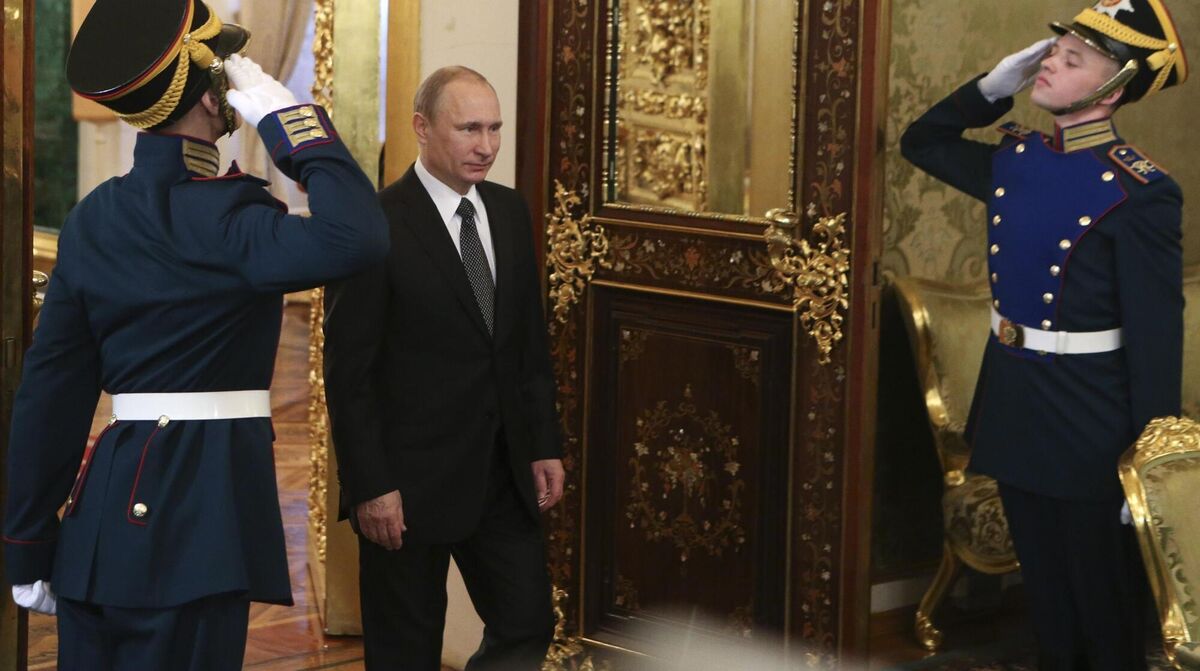
Whatever Putin’s reasoning, he has since abandoned further dialogue with Ukraine’s leaders, sent German and French mediators packing, and concentrated a massive number of tanks in the border region. His goal is to pressure the US to agree to a series of radical demands for restructuring European security; chief among these is that the US rescind its promise, first made in 2008, that Ukraine will some day be invited to join Nato.
Putin’s strategic intent in 2014 — to stop the agreement with the EU — ultimately failed. Now, his immediate focus is on regional security issues. Russian officials and state media have been issuing shrill warnings and spinning ominous tales about the US placing missiles in Ukraine to strike Moscow. There is talk of genocide against Ukraine’s Russian-speaking population, and of Ukraine’s imminent entry into Nato.
None of these claims bears the faintest resemblance to the truth. But opinion polls suggest that the propaganda has been effective.
In the meantime, Putin has tasked his diplomats with securing US and EU agreement to his maximalist formal demands for a new security order. The manoeuvre is eerily reminiscent of the infamous deal-making done at Yalta in 1945, when the Allied powers discussed how Germany and Europe would be carved up after the Second World War.
Yet while a further expansion of Nato is not in the cards, the Alliance will not accept an arrangement that denies any country the right to shape its own destiny. This issue is bigger than Ukraine.
Sauli Niinistö, the president of Finland — which shares a long border with Russia — has been vocal in pointing out that the option of applying for Nato membership is key to his country’s security. Though he has no intention of launching a membership bid, nor can he allow any outside power to limit his country’s sovereignty. Likewise, countries across Central and Eastern Europe fear that giving in to one Kremlin demand will only invite more.
Is a diplomatic resolution still possible? The path is narrow, and time might be running out. There are proposals to place limits on, and improve the transparency of, conventional forces in Europe.
However, Russia has rejected many such proposals in the past, and complex arms negotiations would take considerable time. Moreover, these diplomatic options would not satisfy Putin’s wish to create a Greater Russia, suggesting that the Kremlin will not rule out military options.
These come in many shapes and sizes.
A full-scale Russian invasion would undoubtedly lead to an open-ended conflict that, whatever the original intention, is bound to spill over Ukraine’s borders. If that happened, all options would be on the table for Nato. Severe sanctions and other measures would further squeeze Russia’s already dim economic prospects — even if it secures support from China.
More to the point, Nato would finally roar forward to Russia’s border by deepening its presence in its member states that border Russia.
Given this foreseeable outcome, an invasion would be folly in the extreme.
However, this scenario cannot be ruled out. The Kremlin record of profound mistakes in its policy toward Ukraine is long. And while many in Moscow already doubt the rationality of Putin’s aggressive revisionism, their voices carry no weight.
Another more imminent possibility is that the Kremlin will try to provoke Ukraine into doing something that would justify a smaller-scale invasion of the kind we saw in 2014. But the escalation risk would be severe, and even a small invasion would expose Russia to damaging consequences. Either way, the Kremlin is on a dangerous path.
It is not too late to prevent Putin’s script from becoming a tragedy. Let us hope that he has not been reading Chekhov, who famously advised against introducing a gun in the first act unless it will be used in the second.
- Carl Bildt was Sweden’s foreign minister from 2006 to 2014 and prime minister from 1991 to 1994.
- Project Syndicate
CONNECT WITH US TODAY



Be the first to know the latest news and updates