Budget 2022 failed to provide what was required to deliver Housing For All
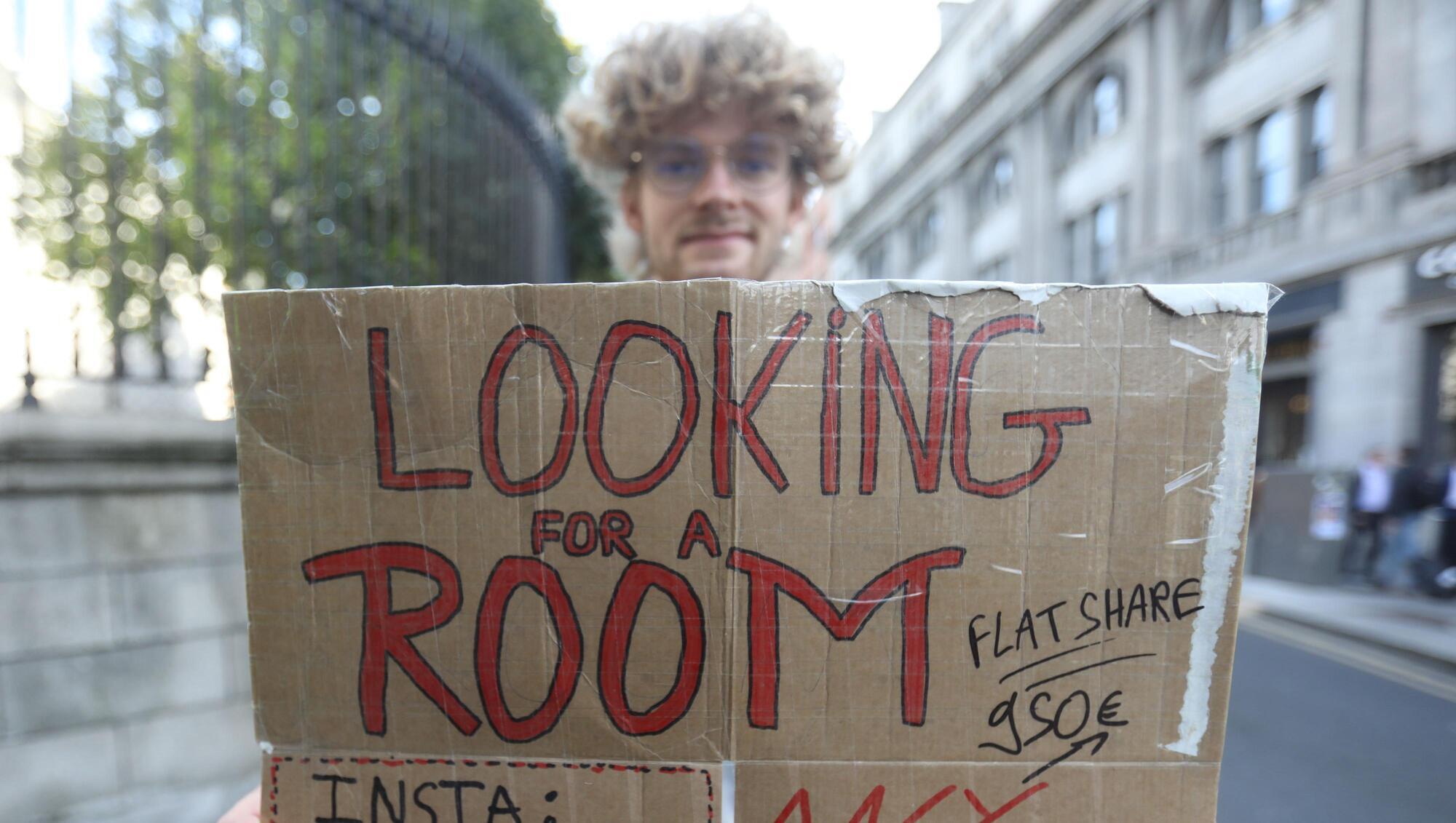
Student Joris Carbonare, 21, from France, pictured in Dublin holding a sign asking for help to find a room to live in. Picture: Leah Farrell / RollingNews.ie
The pandemic highlighted the real impact of Ireland’s housing crisis, and the benefit of implementing progressive housing policies. While we welcomed many of the initiatives in our review of Housing for All, the strategy still leaves those most in need of a secure, sustainable home behind.
Unfortunately, Budget 2022 did not deliver the policies and resources required to truly deliver Housing for All.

An increase in social housing stock is needed to sustain this sector and reduce house and rent prices into the future. The target of 90,000 social homes in Housing for All would address only three quarters of existing need, and does not take account of the 27,500 new households entering the system each year.

In Budget 2022, Government failed to commit to a target of 20% of all housing stock to be social housing, with an annual capital envelope of €3.3bn for social housing. The allocation of €1.7bn for a social housing build of 9,000 units and €224m for 4,100 affordable units in 2022 needs to be increased substantially.
There is still a continuing reliance on the private rental sector to provide social housing through housing assistance payments (HAP), the Rental Accommodation Scheme (RAS), and rent supplement.
We know that to ensure the sustainability of social lettings, the services and infrastructure communities require must be in place. Community health networks, social care supports, community policing, and safe spaces should be a priority.
Unfortunately, this regeneration of communities was not specifically resourced in Budget 2022.
The problem of long-term mortgage arrears was also ignored. Housing for All broadened the scope for the Mortgage to Rent scheme, aiming to deliver 1,000 solutions every year.
Budget 2022 included this option as part of a larger package, allocating €1.37bn for a variety of leasing schemes set to deliver 2,620 social units in total.
This is deeply flawed. A far better use of State resources would have been to develop an equity fund to acquire a stake in properties in mortgage distress, leaving families in place, at a cost of €1.25bn.
Budget 2022 continued to support demand-side subsidies by failing to remove the Help to Buy Scheme. Social Justice Ireland has advocated against Help to Buy since it was introduced in Budget 2017, as we believed then that it would artificially maintain high house prices.
Regrettably, this scheme is due to be extended through 2022.
The specific commitments made in the Housing for All Strategy to increase protections for tenants, increase inspections, investigate deposit protection schemes, and introduce long-term leases did not receive any mention in Budget 2022, meaning development of a functioning private rented sector is still a long way off.
Housing adequacy and security are equally important. Increased protections for tenants also goes a long way towards preventing households from entering homelessness.
In order to make deliver progress on housing targets, they must be based in reality.
In Budget 2022, Government missed the opportunity to reform our data collection system by aligning it to the ETHOS typology and ensuring sufficient supports to local authorities to implement this change.
Budget 2022 allocated €194m to homeless services and increased resources for emergency homeless accommodation. While the increased funding for emergency housing provision is welcome, it fails to tackle the problem of homelessness.

Housing for All contains a commitment to “working towards” eliminating homelessness by 2030. Increasing resources for emergency homeless accommodation won’t solve the problem. A commitment to actually ending homelessness, and an increase in funding to actively prevent it, would have been a far better use of resources.
Access to affordable land is key. Access to enough affordable land to deliver on the scale needed is the biggest challenge.
The zoned land tax introduced in Budget 2022 in order to increase the supply of land for building homes allows for the owner of land that falls eligible for the tax to get the zoning status amended, as well as having a two year lead-in time for land zoned pre January 2022, and three years for land zoned after this date and, as a result, is unlikely to generate the volume of sites really needed to address the ever more serious lack of housing across the country.