Eoin Daly: Working from home leaves parents in the lurch
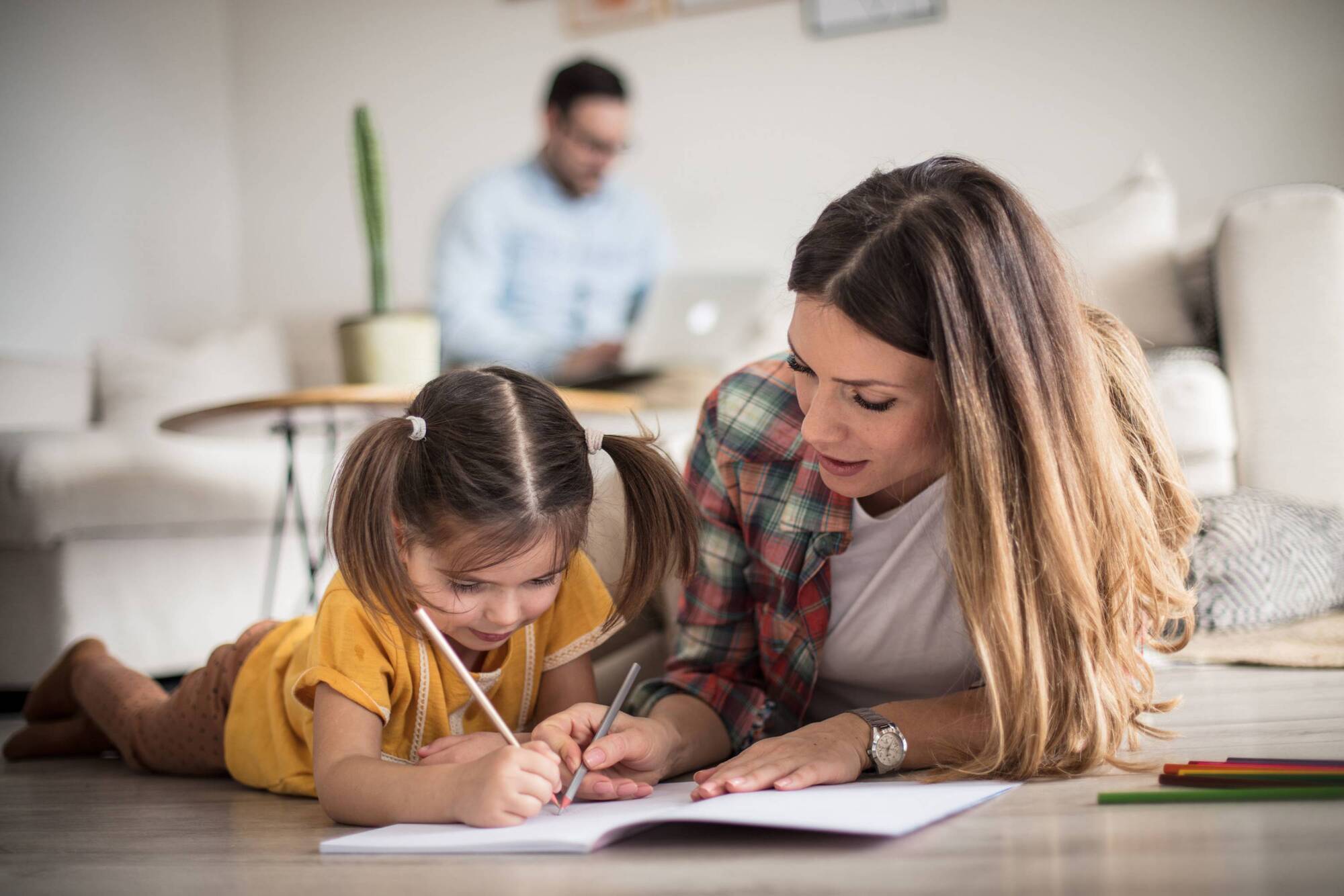
While there are challenges for all parents working from home, parents of babies and toddlers face a different, sharper dilemma. Picture: iStock/PA
When most people think of parents working from home, they probably imagine awkward arrangements with kids occupying themselves in the background while their parents spend the day on Zoom. The kids might work, half-supervised. on lessons sent from school, or even play together in a garden if they are lucky.
That's a difficult, far from ideal arrangement, but it's just about doable for limited periods during a national crisis. It might involve more screen time and snacks and so on — not great, but possible to cope with for a while.
That might be an accurate picture for many parents, but it is not the reality for a significant cohort — particularly parents of very young children. Remember, it’s not just the schools that have closed: Creches and childcare facilities can now only take children whose parents are frontline workers. This means a great many parents of one- to four-year-olds are now caring for very small, very dependent children while they work, or are supposed to be working.
And while there are challenges for all parents working from home, parents of babies and toddlers face a different, sharper dilemma, that is out of kilter with that stereotypical picture I mentioned above.
To put it bluntly, it is not really possible to ‘work’ in any sense — to do any other, paid, work — while having a very young child in your care, and especially with more than one at a time. You cannot really even muddle through with the kind of improvised arrangements, involving devices or TV, that people normally imagine.
All children are different, but as a general rule, very young children are uniquely dependent, and cannot be simply left to their own devices (no pun intended) for very long, if at all. Caring for them is in itself a full-time job.
Parents in this position have limited options. In two-parent families, one parent can work at a time. The other parent, or a single parent, could try and work by night — in the unlikely event that their work facilitates this. They might take unpaid leave if they can afford it — again, in the unlikely event their employer allows it. They might be one of the lucky few for whom a family member within their ‘bubble’ can step in.
Barring such lucky exceptions: Chaos. Seemingly, the State has not given very much thought as to what working parents in this position are, in fact, supposed to do.
It has effectively prohibited all but a limited category of workers from availing of childcare services, for an unknown period. And this is all because of a public health crisis that is itself a result of the State’s own decisions. And all of this is, of course, likely to disproportionately affect women, given persisting inequalities in the division of labour.
This is not an argument against the childcare closure — it if must be done, it must be done. Rather, I am arguing that the State cannot expect working parents to square the circle merely through improvisation and graft. Unlike last spring, there is now childcare for frontline workers, which is welcome. But there is little thought put in to, or even recognition of, the difficulties faced by other parents.
What, for example, are employers asked to do to facilitate parents in this position? What is the expectation on industry in sharing the burdens of this national effort?
Underlying this lack of thought, there is probably the old prejudice about childminding as not being real or serious work — as being simply a natural expression of feminine care, something that is simply taken for granted. Or some assume childcare is not really an occupation as such, but something requiring the presence, even the passive presence, of an adult.
Such attitudes are not all that unsurprising given how the childcare profession is undervalued at the best of times. It is a sector with highly qualified and capable workers but with problems of low pay, precariousness, and a lack of trade union representation. There has never been much ambition for a national early education and childcare system.
As for the children, I am sure other parents reading this will share a sense of wonder and gratitude at how early-years educators, as trained professionals, help their children thrive and learn to be social beings. Of course, children can thrive at home as well, but they lose out on social development in an extended lockdown. The value of playschools is partly that they offer the kind of social environment, for children, that previous generations probably had in the form of extended families and communities.
Read More
My wife and I are among the relatively lucky ones. Much of my work can be done in a flexible timeframe, at night after the children go to bed. In the spring lockdown, I worked mostly at night and weekends, having spent daytimes minding our one- and three-year-olds.
Being able to manage even this improvised, exhausting double-jobbing makes us relatively privileged: Other parents do not have the same flexibility. How they manage — having to work while being responsible for children who cannot even walk or sit up, or feed, or put themselves to sleep — is anyone’s guess.
In the long run, the pandemic may force us to rethink not only the way we work, but the way we reconcile work with parenting. There is no unique narrative: Every family is different. Many, myself included, will have enjoyed spending more time with children growing in their early years: The closest many of us get to seeing a miracle.
Many will also have been led to ask uncomfortable questions about the way we organise things, as a society, in ‘normal’ times. The uncomfortable truth for many with full-time jobs, and especially those with commutes, is getting to spend an hour or so at most, with children in the evenings, in the most precious years.
The irony of the pandemic, for many, is that it will have exhausted them with the dual demands of childcare and work, while making them question, at the same time, the ‘normal’ way of doing things.
The pandemic should provoke some fresh thinking about how, as a society, we reconcile the life of parenting and the demands of work.