‘I’m €200k worse off as I started teaching later’
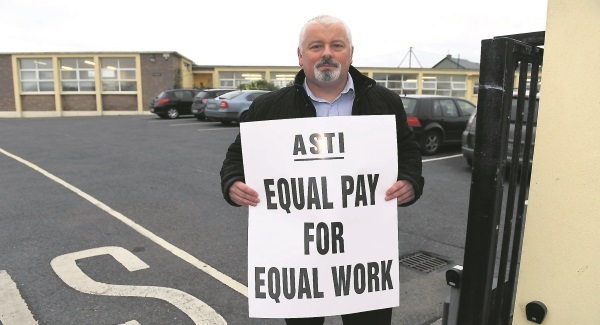
Jeremiah O’Brien was a late convert to teaching, beginning his first job three years ago. As a result, he earns around €7,000 less than he might have if he started his career sooner.
The Kerry man returned to college more than a decade ago to do an engineering degree, which he received in 2007 when he was in his early 30s. But with little work to be found, he changed tack and thought he could bring something to classrooms with his qualification and experience.
After completing a professional diploma in education (PDE) in 2011 and a distance learning module needed to teach maths, Jeremiah from Abbeydorney was fortunate that an opening came up at St Joseph’s Secondary School in nearby Ballybunion.
But because of the public sector pay policy for new entrants since 2011, and further changes which affected teachers disproportionately more, Jeremiah says there is a six-figure shortfall between what he will earn over the remainder of his teaching career and what he would be paid if he started teaching before 2011.
His current pay equates to €33,168 a year, but he understands that somebody who entered the profession before the pay cuts for new entrants took effect would be on more than €40,200 after the same level of service as he currently has.
“Over my 25-year teaching career, the difference would be around €200,000, the price of a house, effectively. I’ve thought about that a lot,” he said.
“When we were doing the PDE, there were just murmurs about pay being reduced for new teachers, but we didn’t get much information about it,” said Jeremiah.

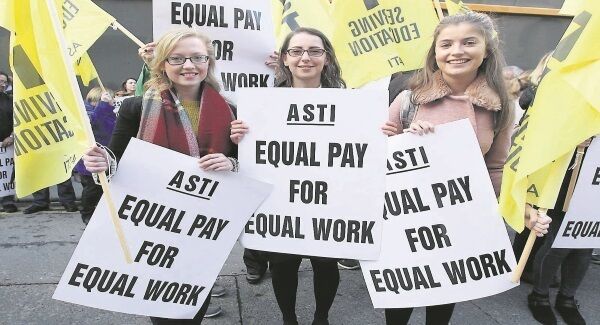
It is these pay gaps which led Association of Secondary Teachers Ireland (ASTI) members to vote by four-to-one in favour of industrial action to redress the imbalance in recent weeks. The first of seven strikes on the matter takes place today, with Jeremiah and counterparts around the country glad of the support of longer-serving colleagues on the issue.
As parents to six children aged from six months to 15, he and wife Sheila are anxious to have a home of their own.
But they only recently got mortgage approval after being turned down by most institutions they approached because of their income. The acceptance of the carer’s allowance which Sheila receives in respect of two of their children with autism got them over the line and they have only just started looking for a place.
With the prospect of some of the children heading to college in a few years, the significance of around €7,000 a year between his earnings and what he might be paid if he started teaching just a few years earlier is not lost on him.
“That would almost cover the cost of sending someone to study at college for a year,” he said.
There is an offer on the table to ASTI, whose leaders have been in talks with the Department of Education, that lower-paid members can see some of the gap bridged if they accept the deal agreed recently with the Teachers’ Union of Ireland (TUI) and Irish National Teachers’ Organisation (INTO).
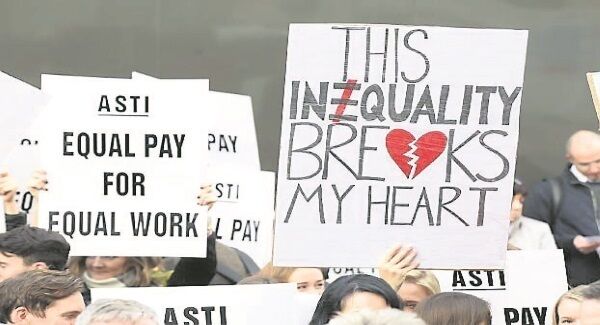
The Government says this deal would see increases of 15% to 22% for new entrants to teaching, depending on when they were recruited. It would see €4,600 added to the starting salary for the profession by 2018. For anyone recruited in the past year, their pay would rise to €37,723 by the start of 2018, from a starting salary of €31,009.
But the 22% rise claim is questioned, not just by ASTI, but also by those within the unions whose leaders agreed the package last month with the Department of Education.
Eddie Conlon of the TUI Grassroots group, which has called on members of that union not to pass ASTI pickets at close to 200 dual-union schools today, said the recent deal leaves a new entrant on the first point of the salary scale more than €4,500 behind their pre-2011 colleagues.
A teacher with a few more years’ experience, like Jeremiah in Ballybunion, would remain between €3,000 to €4,000 behind a longer-serving teacher with the same experience if ASTI signed up to the INTO/TUI deal, going on TUI Grassroots’ estimation.
But that difference could be bigger for Jeremiah as it is based on a member of the TUI or INTO who, unlike ASTI members, has had more than €800 added to their salary from this school year. This is the first installment of an increase that restores the amount previously paid to teachers for supervision and substitution work.
The Government has said the ASTI should accept this deal for now, with further pay restorations to be considered by the Public Service Pay Commission.
But Jeremiah believes teachers in his circumstances should not have to wait for any new pay deal.
“I think it should be a way to get this back way quicker and get equality back into schools. That’s why we are going on strike, to get the point across,” he said.
Although he has 22 weekly teaching hours this year, the most he is currently guaranteed for next year is 16 hours, covered by a contract of indefinite duration that he is grateful to have. On current rates, his pay would drop back closer to €25,000 if he had just 16 hours a week.
The apparent upturn in the economy has seen him tempted occasionally to look at the rising number of engineering jobs dropping into his inbox from the recruitment website with which he had an account.
But the family-friendly holidays and the job satisfaction of seeing students learn, make him determined to stick it out.
“I used to be one of those people who thought teachers have it handy, working 22 hours a week and three months holidays.
“But it wasn’t until I started working in a school that I realised how much work goes into those 22 hours of teaching,” he said.
Jeremiah maintains that he has not done a 22-hour week in three years, and it sometimes feels like four times that, spending evenings setting and marking exams, doing up slides and worksheets.
“It’s ironic that it’s at the beginning of our careers we spend more hours as we develop these preparations, and all now for less pay than other teachers,” he said.
CONNECT WITH US TODAY



Be the first to know the latest news and updates