Q&A: Studying the complex issues behind teacher action
What schools are affected?
It will certainly be an issue at all 375 voluntary secondary schools, those owned and run by, or on behalf of, religious orders. They account for just over half the country’s 735 second-level schools, with around 193,000 students, and their staff who are union members are affiliated to the Association of Secondary Teachers Ireland (ASTI).
Aren’t 500-plus schools actually going to be hit?
Yes, ASTI members also work at most of the 95 community and comprehensive schools, which have 58,000 students. The mix of ASTI and Teachers’ Union of Ireland (TUI) members in these schools varies widely, from 50:50 in some to just a handful of one union or the other at others. ASTI members also work in some of the other 250 vocational schools and community colleges run by the 16 education and training boards (ETBs).
How many people would each school need if ASTI members stop doing supervision and substitution?
That depends largely on local circumstances. While each teacher who previously volunteered for the work could be called on to do the equivalent of an hour a week across a 37-week school year, some of those hours might only be called on to cover substitution for short-notice absence, or to facilitate a colleague taking students to a match during, for example, last period of a day. When ASTI banned members doing supervision and substitution in a pay dispute in 2012, some schools relied on small numbers of people to do the work but others had large numbers doing a few hours each.
What was the outcome of that?
That eventually led to a deal agreed between Noel Dempsey — education minister at the time — and teacher unions on payment for supervision and substitution work, which was previously done for free in addition to contracted teaching hours. Before its removal during the recession-period cutbacks, the payment for those teachers who signed up to continue doing the work had reached around €1,600 a year.
So why the current dispute?
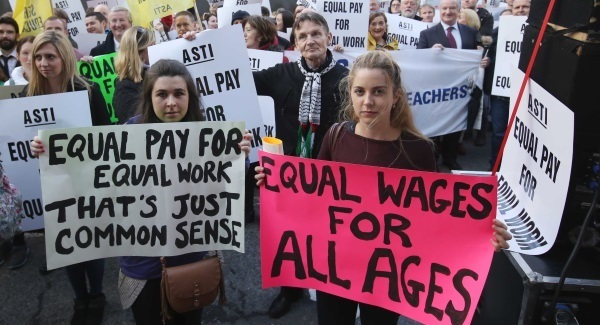
After rejecting the Lansdowne Road Agreement, the ASTI decided they were no longer obliged to work the extra 33 hours a year which unions agreed to under the previous Croke Park Agreement, used to hold parent-teacher meetings and staff meetings outside school hours. When the union issued a directive that members stop facilitating those arrangements from this September, the Department of Education initiated measures under Financial Emergency Measures in the Public Interest (FEMPI) law which meant money being restored under the LRA to teachers would not be given to ASTI members.
Does it mean TUI members are now being paid for supervision and substitution?
Not really. Although the €1,592 being added to salaries of TUI and Irish National Teachers’ Organisation (INTO) members from this school year (half is added since September, the rest from 2017) will be similar to what was previously paid for doing the work, it is not a direct remuneration for that work. It is this payment that is not now being paid to ASTI members, while the first portion of the extra pay, ironically, went into the fortnightly pay of TUI members on Thursday and INTO members last month.
Isn’t this confusing?
Extremely, and it makes the possible ways of resolving this mechanisms by which this can be resolved very difficult to envisage.
Can we expect Richard Bruton to come running to the negotiation table now the ASTI has announced detail of work stoppages and strikes?
Not really. He has said meeting all the union’s demands would cost more than €2bn a year and the money just isn’t there, but a portion has been set aside in his 2017 budget to include ASTI members in measures for other unions like creating new middle-management posts in schools, or partial restoration of pay reductions for teachers who began their careers from 2012 on.
The Government will be anxious to avoid any concession in a dispute with one of the very few unions remaining outside the LRA, which would risk unravelling the relative industrial peace in the rest of the public service.
It doesn’t look like we can expect resolution any time soon. Or does it?
Expect some school closures between now and Christmas before both sides are willing to sit down and, maybe through an outside individual or agency, start talking. As happened recently with Dublin Bus staff and LUAS drivers, these things all get settled eventually.
But not without either side being able to claim to have stood their ground and achieved something for their union members/taxpayers.

CONNECT WITH US TODAY



Be the first to know the latest news and updates