Previous healthcare decisions ‘contradictory’

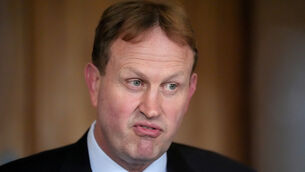
“If we want a better outcome, we need a long-term, settled plan. Without that we will not succeed,” he told a major health conference in Dublin yesterday.
“I hope that the next programme for government will create the conditions in which we can have an open, all-party, cross-society consensus about what we want our healthcare system to be like, not in five years or 10 years, but for the next 20.”
Mr O’Brien also said it would be impossible to make coherent decisions on healthcare without agreeing on what we wanted from all of it, not just the bits that the HSE was responsible for.
We have a quick guide on how to vote for first time voters this Friday on our Snapchat (irishexaminer) #GE16 pic.twitter.com/6KzsUJmKww
— Irish Examiner (@irishexaminer) February 24, 2016
During his opening address entitled ‘Delivering a Fair Healthcare System for All’ at the 12th National Health Summit, Mr O’Brien said one pressing issue was the age profile of GPs.
Describing GPs as the linchpin of the healthcare system, he said an agreed framework was needed to attract and retain the talent needed in general practise.
After reading the political parties’ manifestos, he believed a view was emerging about the need to discuss what people wanted the healthcare system to deliver.
However, he hoped the political parties that would come together to agree on a programme for government after the general election would do more than just put in place the bare necessities for a five-year term.
For more election news, analysis and general banter join us HERE
“We cannot change what has taken 90 years to put together in a five-year term. It is completely unrealistic. The life cycle of healthcare does not facilitate that.”
What was needed was a framework against which key policy funding and other priority decisions could be made in a sequential basis so that, step by step, a coherent healthcare system could be built for the population 20 years from now.
“In the absence of such an architecture it is no surprise that many of the decisions made in the last five, 10, 20 years have been incoherent, contradictory and incompatible with a strong outcome.”
Another speaker, chair of health systems at Dublin City University’s School of Nursing and Human Science, Professor Anthony Staines, said most of the manifestos of the political parties agreed on the following two issues.
The Irish healthcare system was unfair and needed to move to universal care, equally accessible to all (except for Fianna Fáil).
The system needed to focus more on primary care than at present.
Several parties (Fine Gael, Sinn Féin, and People Before profit) wanted to abolish the HSE, and, while he understood why, the price of abolition would be to halt change in healthcare for at least three years.
All party positions and priorities on major #GE16 issues right here #DoYourJob #Vote https://t.co/62Fkq0iXqC ^DH pic.twitter.com/QNUXoDo510
— Irish Examiner (@irishexaminer) February 24, 2016
He thought the balance between care in hospitals and care in general practice was wrong — too much was done in acute hospitals and far too little in general practice. If action was not taken the services would be stretched even further — the number of older people was rising steadily and so would the need for healthcare.
“Failure to meet this need will cause much unnecessary suffering and death,” Prof Staines warned. “We’ve tried building a hospital centred service and it has not worked well. To meet rising demand I think we will need to move to community based services and the heart of these is general practise.”
CONNECT WITH US TODAY



Be the first to know the latest news and updates