Fulfilling bailout terms will be an impossible task for Greece
On July 5, the beleaguered Greek government held a referendum on the final offer made by the creditors at the end of June.
The announcement of the referendum was greeted with rage in Brussels. It seems that the EU is a top-down organisation allergic to democracy.
In the run-up to the referendum on the bailout proposal, life in Athens remained fairly normal. The stories about panic on the streets, empty supermarket shelves, and so on were part of a terror campaign by Brussels intended to get people to vote yes. The reality was a lot less dramatic. The Greeks are a sociable people. The café terraces were full, people went to the beach. Of course there was concern and the banks were closed since June 29 due to the capping of liquidity assistance by the European Central Bank.
Of course, life in Greece can hardly be described as normal. Since the so-called bailouts began in 2010, the size of the economy has been reduced by a quarter, unemployment is over 25%, youth unemployment is over 50%. The bailout is in fact a pauperisation programme. But the people get on with things as best they can.
The referendum was conducted in a calm and orderly manner, resulting in an emphatic no vote of 61%.
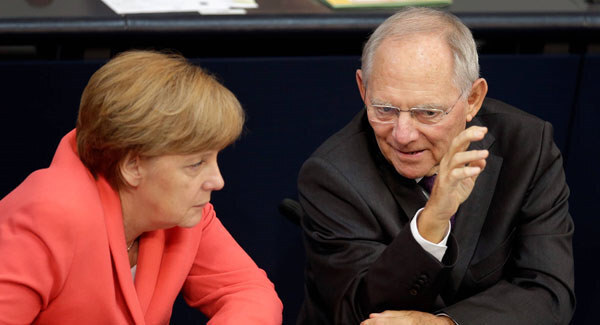
This was the high point. All was lost in less than a week. Syriza, the party of Alexis Tsipras, was elected in January to end austerity. They wished to do this and stay in the euro. Pretty soon it must have been obvious that the two objectives were incompatible due to the negative reaction of the group of euro finance ministers, the Eurogroup. The Eurgroup appears to be completely dominated by German finance minister Wolfgang Schauble, with the assistance of his ventriloquist dummy, the Dutch chair of the Eurogroup.
Greek proposals to the Eurogroup were rejected as inadequate or not just considered at all. The Greeks had to choose between rejection of austerity and the euro — they chose the euro. Within a few days of the referendum, they submitted proposals for an austerity programme which were savagely augmented by the Eurogroup. Once they knew that the Greeks were committed to staying in the euro at all costs, the creditors could hang, draw, and quarter them at their leisure, which they did.
A transition back to the drachma combined with a default would have been difficult but the government could have availed of the momentum of the referendum to go for it. The referendum was depicted by Brussels and the Greek yes voters as a choice for the euro or the drachma. The government could have gone along with this interpretation when it became clear the creditors were not prepared to be reasonable. It has emerged that former finance minister Yanis Varoufakis had contingency measures in this direction prepared. The Greeks could have walked out the gate of the euro concentration camp. However, the eurozone pundits and Varoufakis himself said it would be an utter disaster. I think their case is not proven.
Obviously the Greeks are responsible for their original debt predicament. But the bailouts have caused the deterioration since 2010 and the explosion of the national debt. This has been admitted by the IMF but never by the EU. As regards recent developments, the villain of the piece is obviously Germany. The Germans seem to wish for Greece to be treated like some kind of colony or protectorate. They ignore wider foreign policy considerations, including their historical responsibility in relation to Greece, in view of the numerous atrocities perpetrated during the Second World War and the loan that Greece was compelled to pay to finance the German war effort — never repaid.
I think one reason for the direction that German policy has taken is that chancellor Angela Merkel is in fact a weak leader; in spite of all the hype to the contrary, she follows rather than leads. She has left Schauble to make the running on this issue . He is a taxman and has the vision of a taxman. His life’s achievement is to balance the German budget oblivious to the fact that infrastructural investment is urgently needed in many areas.
It is unclear whether Schauble’s idea of a temporary exit for Greece from the eurozone is just a stick to beat the Greeks with or a proposal intended to be taken seriously. Whereas Greece has been obliged to adopt ainful legislation, the creditors are merely asked to agree to the opening of negotiations, so he will have ample opportunity to continue to insult the Greeks and pursue his idea of Grexit.
Merkel is a follower of opinion polls and knows Schauble’s line is very popular with the readers of the populist press. He is also a popular figure in her party, the CDU. Accordingly, she does not try seriously to restrain him.
As regards the bailout deal itself, it is in line with previous bailouts, only worse. It will lead to further deterioration of the Greek economy and Greek debt... the IMF has already stated that the programme does not add up without a restructuring of the Greek debt. We will be back again in crisis mode in a few months. It will not be possible for the Greeks to fulfill what is imposed on them. The asset-stripping fund is particularly objectionable, reminiscent of Soviet policy in the territories it occupied after the Second World War.
At the end of the day Greece is going to have to default in view of the unwillingness of the Germans and their allies to face up to the unsustainable nature of Greek debt. So Grexit will be back on the agenda.

CONNECT WITH US TODAY



Be the first to know the latest news and updates