Global alliances are needed to save the world from itself
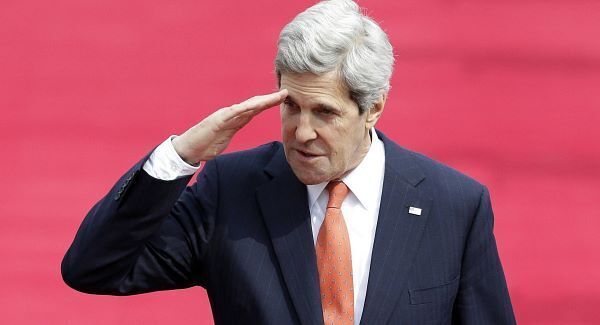
Just like after the Second World War, countries must co-operate, not ply their own path, writes US secretary of state John Kerry

Global alliances are needed to save the world from itself

I GREW up in the shadow of the Second World War, and at the dawn of the Cold War. My father’s work as a foreign service officer gave me an opportunity to see history up close in a searing way: I will never forget walking the beaches of Normandy with him and seeing the burned hulks of Higgins’ boats still on those shores, just a few years after so many young men went to their graves so the world could be free.

Likewise, I will never forget the eerie feeling of riding my bike through the Brandenburg Gate from West Berlin into the East, and seeing the contrast between people who were free and those trapped behind the Iron Curtain.

What strikes me now, all these years later, is that a generation of leaders won not only a war, but also the peace. They did it together. The US and our partners worked to create alliances that brought prosperity and stability to Western Europe, Japan, and South Korea. Old enemies became new allies, and together pioneered a new global economic system that made the world more prosperous.

In short, by building effective and indispensable international institutions and strategic partnerships, we did not just avoid another catastrophic world war,we ultimately ended the Cold War and lifted global living standards for hundreds of millions of people.

That is the remarkable story of the 20th century. The question now is what story will emerge from the 21st century.

Today, the world order faces new challenges. Russian aggression is rattling allies. Extremists who hijack religion threaten governments and people everywhere. Technology is accelerating a shift in the balance of power between governments and the governed that offers both opportunities for democratic accountability and obstacles to inclusive politics.

We have gone from a world where power resided in hierarchies to one where it inhabits networks. Statecraft has yet to adapt. The international institutions and partnerships that emerged in the postwar years demand both maintenance and modernisation.

In the face of all of this turbulence, some suggest that America should turn inward. That is nothing new. Some argued the same after the Second World War. They argued it again 25 years ago, after the fall of the Berlin Wall. They were wrong then — and they are wrong now.

The need for leadership has never been greater, and the US has never been more engaged with the world. Our role in Afghanistan’s first-ever peaceful, democratic transition reminds us all that, having invested so much blood and treasure in helping to give Afghans a chance to succeed in battle, the world has just as much responsibility to help its leaders succeed in governance.

We know that the destruction of 100% of Syria’s declared chemical weapons would not have happened without direct, hands-on diplomacy and perseverance, just as Syria’s immoral and horrifying civil war will not end without an equal commitment.

So, too, in Asia, where US President Barack Obama and Chinese President Xi Jinping just announced ambitious commitments to tackle climate change, we are reminded of what countries can accomplish together with real leadership — and of how much additional leadership is required to conclude a successful climate agreement in Paris next year.

The world has changed, and we are changing with it. Lines on the map no longer contain the gravest threats, and the players are no longer divided neatly into two camps.

In the 21st century, next door is everywhere. That is why the world needs coalition diplomacy. No country can defeat terrorism on its own. No country can solve the existential threat of climate change alone. No country can eradicate extreme poverty, combat potential pandemics, or improve nuclear security by itself.

None of us can live safer, richer lives by turning our back to the world. We must build on our history of working with allies by forming new coalitions — with governments, with civil society, and, yes, with everyday people.

A good example is the international effort to confront the Islamic State’s malign brutality in Iraq and Syria. Political, humanitarian, and intelligence tools from more than 60 countries are being used to support unified military action.

Success depends not on what one or even a handful of countries can do alone, but on what all of us are able to achieve by moving forward together against this common threat.

On an equally important front, the US is working with the UN to galvanise a global response to the danger posed by the ebola virus. I have personally talked with more than 50 foreign leaders, and we all agree that only by co-ordinating our actions can we stop the devastation in West Africa and halt ebola’s spread.

We are making progress on both issues, but much work remains. Bringing together countries with competing interests and varying resources is hard work. It demands intense diplomatic engagement and calls upon relationships that have been built and maintained over decades, as well as alliances with new partners.

• John Kerry, former senator of Massachusetts and chairman of the US senate foreign relations committee, is the US secretary of state. Copyright: Project Syndicate, 2014

More in this section

Revoiced

Newsletter

Had a busy week? Sign up for some of the best reads from the week gone by. Selected just for you.

Cookie Policy Privacy Policy Brand Safety FAQ Help Contact Us Terms and Conditions

© Examiner Echo Group Limited