Time to give youth its voice
I’VE just finished reading a brilliant book entitled The Bully Pulpit, written by an historian named Doris Kearns Goodwin. It details the development in the United States early in the 20th century of what’s known as the ‘reformist’, or ‘progressive’ movement.
This largely resulted from a convergence of ideas regarding social justice driven by the energy of the then president, Theodore Roosevelt, and the commitment of a group of campaigning journalist — working for McClure’s Magazine — foremost among whom was a woman named Ida Tarbell. This largely forgotten figure can quite justifiably be said to have invented ‘responsible investigative journalism’.
Why is that, and she, so important? I’ll try to explain.
My all-time favourite book is The Seven Pillars of Wisdom in which TE Lawrence, looking back in 1926 on the shattered dreams and broken promises that followed Allied victory in World War One, writes this: “The moral freshness of the world-to-be intoxicated us, we were wrought up in ideas to be fought for... but when we achieved and the new world dawned, the old men came out again and took our victory, to remake in the likeness of the former world they knew.”
That remains a significant reflection in that, if 20 years in politics has taught me any one thing, it’s that the grip of the ‘status quo’ continues to be ever present and, being primarily driven by fear, is always ready to be the enemy of progress.
In fact, you have to punch very hard indeed to achieve the traction needed to deliver real and lasting change because, whether we care to admit it or not, as human beings we are — and always have been — instinctively change resistant.
That’s troubling, because I believe the world is shifting on its axis and that, because of the impact of digital technologies, this is happening significantly faster than most people seem prepared to acknowledge, except perhaps the young.
The dangers inherent in our resistance to change were vividly brought home to me last year when I shared a platform with Larry Summers, the former US Treasury Secretary. During his speech he went to great lengths to make this point: “Change tends to take far longer than you expect, but when it does occur, it happens faster than you ever believed possible.”
In fact, despite recent encouraging signs in parts of the global economy, it’s the sheer pace of change that many are finding hardest to cope with.
American commentator Tom Friedman, in an article for The New York Times, chillingly but accurately argued that: “In the past, workers with average skills, doing an average job, could earn an average lifestyle.”
But, as he puts it, like it or not, today, “average’ is over”.
He went on to say that, “everyone needs to find their extra” — that special something that makes them stand out in whatever field of employment they happen to find themselves — today “average is officially over”, because the best jobs already require people to have a better education, and more of it, to ensure they themselves are well above average.
In one sense that’s a challenge to every young person — average just isn’t going to be good enough to allow you to live a fulfilling life — actually I’m not sure it ever was.
Where I think we would all agree is that, though the pace and scale of change can at times feel bewildering, the need to up our game has now become overwhelming.
Digital technology has fundamentally reshaped the way in which people of every age connect with, make sense of, and engage with society — and with each other. Rightly or wrongly — people expect an entirely new form of relationship with the world around them; and the speed, scale and ramifications of this change have been remarkable.
This, in turn, creates enormous opportunities — as well as challenges — for us in Europe, most especially in an era in which each member state needs to use every scrap of imagination and talent to help solve the massive structural problem of youth unemployment which, if unaddressed, could derail all of our efforts to get Europe on the road to permanent recovery.
However, we also need to move fast, because huge additional challenges remain to be tackled. For example, here in Ireland one in five of our citizens has never used the internet and, for any number of reasons, that simply has to change.
As Ireland’s Digital Champion you won’t be surprised to hear that I believe adequate and reliable broadband connectivity should be as ubiquitous as electricity and water — and should rapidly be established — not as a privilege for the geographically fortunate few, but as an unquestioned universal right.
Even the most determinedly disconnected can, through the medium of digital communications technology, become moderately capable and, given the chance, can go on to access new opportunities for learning, and, indeed, sharing that learning.
My own belief is that, when it comes to every form of education we simply can’t afford not to embrace the opportunities made possible by these developments; in fact I’d go further, we can scarcely afford to even imagine the social and geopolitical repercussions of anything other than brilliantly equipped 21st-century lecture halls and classrooms, and an equally brilliant, well-trained and committed generation to teach in them.
To settle for anything less is, without doubt, to risk short-changing an entire emerging generation.
After all, having raided their pensions, depleted their environment, and undermined their confidence in finding a worthwhile job, we cannot possibly allow them to drift into becoming unemployed second- or even third-class global citizens through our inability to invest in their future.
Among my concerns for those young people is that we will fail to exercise sufficient imagination and self-sacrifice to offer you the same opportunities that everyone of us enjoyed and, to a horrifying extent, squandered. That — to my mind — would border on criminality.
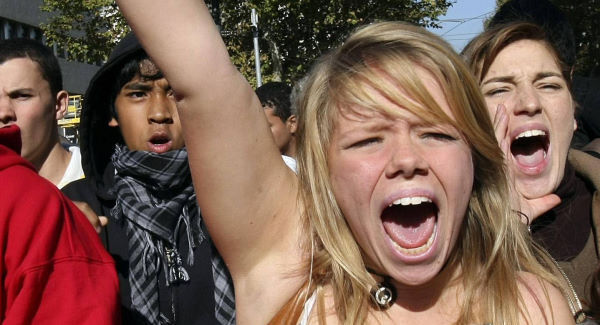
In fact it’s time for the young people most affected by our foolishness to start making their own voices heard.
I vividly remember, as a young activist, being reminded that “you’re either part of the solution, or you’re going to be part of the problem”.
I believed that then and, if anything, it is probably even more true today.
My own politics were essentially forged in the 1960s, an era of protest against nuclear proliferation, against the Vietnam War, and the destruction of our natural environment; and in support of the civil rights movement both in the US and in Europe.
To this day, my world view remains principally guided by the question ‘why’.
Why aren’t we treating each other in a better, and more considerate manner?
Why do we continue to judge others by standards more rigorous than those we expect of ourselves?
Why does the world appear to be again resorting to intimidation, imprisonment, and even capital punishment as a means of suppressing legitimate protest and dissent; after all, does any subsequent event suggest that those of us who opposed the Vietnam War somehow got it wrong?
Again, what’s the so-called hot-button ‘immigration crisis’ all about if not a contemporary re-run of conflicting notions of civil rights, and human dignity?
And last on that list, climate change, again a crisis that you can trace back at least 50 years, to the refusal of successive western governments to heed the warnings set out — as we now know so accurately — in Rachel Carson’s book The Silent Spring. It is a book that influenced and led to the formation of two generations of concerned environmentalists.
In the case of all four of those issues, I would argue that the protest movements of the 1960s have been entirely vindicated; surely it’s the judgments of those who, through lack of vision, or simple political expedience, have now been found grievously wanting.
And with what result?
With the result that we find ourselves navigating our way through an evolving, but frighteningly complex world.
What all this will come to mean to the daily lives of our children is not yet entirely clear, but what is certain is the overwhelming need for everyone of us, as I suggested earlier, to raise our own game — and to do so before it’s too late.
What’s also certain is that the type of sustainable civil society we so badly need is unlikely to come about by accident. To achieve it will require vision, commitment, courage and most of all, genuine leadership.
With the United States seemingly embarked on its own (and extremely dangerous) form of tribalism — along with of course electronic surveillance of not just its enemies, but its allies — we certainly find ourselves living in interesting times; a period during which, in business as much as in statesmanship, trust is at a massive premium.
A well-respected banker friend of mine suggested recently that the 2008 financial crisis ran out of control “the moment bankers ceased to trust each other — that their word ceased to be their bond”.
So, be it a trusted brand, a trusted handshake, or a trusted nation — this concept of trust has emerged, or re-emerged with an importance that, as I see it, we fail to respect and nurture at our peril.
I also happen to believe that, in rediscovering and valuing trust in our own daily lives, we are perfectly entitled to start demanding it of others. It’s with that in mind that I’d like to offer a few thoughts on an interest I’ve developed regarding the concept of a duty of care.
Anyone with even the most rudimentary legal training, is likely to be familiar with the story of the ‘Paisley snail’. On the evening of August 26, 1928, a woman named May Donoghue took the train from Glasgow to Paisley, seven miles east of the city. There, at the Wellmeadow Café, a friend bought her a Scots ice cream float, — a mix of ice cream and ginger beer. The ginger beer came in a brown opaque bottle labelled “D. Stevenson, Glen Lane, Paisley”. She drank some of the ice cream float, but, as the remaining ginger beer was poured into her tumbler, a decomposed snail floated to the surface of her glass. Three days later she was admitted to Glasgow Royal Infirmary and diagnosed with severe gastroenteritis — and shock. The case of ‘Donoghue versus Stevenson’ set what became a very important legal precedent.
Stevenson, the manufacturer of the ginger beer, was held to have a clear ‘duty of care’ towards May Donoghue, even though there was no contract between them, indeed she hadn’t even bought the drink that poisoned her. One of the judges, Lord Atkin, described it like this: “You must take care to avoid acts or omissions which you can reasonably foresee would be likely to injure your neighbour.”
Since that ‘Paisley snail’, and especially over the past decade or so, a great deal of thinking has developed around that notion of our duty of care — most especially as it relates to a number of aspects of civil society. Generally speaking, a duty of care arises where one individual, or group of individuals, undertakes an activity which has the potential to cause harm to another, either physically, mentally, or economically.
This has principally focused on obvious areas such as our empathetic response to children and young people, to our service personnel, and to the elderly and infirm; — it has seldom if ever extended to equally important arguments around the ‘fragility’ of our present systems of Government; to the notion that honesty, accuracy and impartiality are fundamental to the process of building and embedding an informed, participatory democracy, at a national, and at a local level.
Hasn’t the time come to develop this concept of a duty of care, and extend it to include a care for many of our shared, but increasingly endangered democratic values?
After all, the absence of a duty of care within many professions can all too easily amount to accusations of negligence — every school staff-room, every hospital maternity ward, knows precisely what the concept implies.
That being the case, can we really be comfortable with the thought that we are, in effect, being negligent in respect of the health of our own societies; and the values that necessarily underpin them?
Could anyone honestly suggest that, on the evidence, we in the developed western democracies have taken sufficient care to avoid behaving in ways which could reasonably have been foreseen to undermine, or even in some cases badly damage, our inherently fragile societies?
There will be those who’ll argue that this could lead to our becoming over-cautious, and even drift into a form of censorship — albeit self-censorship.
Personally I don’t buy that argument. It has to be possible to balance freedom of action and freedom of expression, with wider ethical and social responsibilities.
We should always remember that our notion of individual freedom is comparatively new in the history of western ideas and, for that reason, is often under-valued and, if abused, can quickly be undermined and discredited.
History teaches us that it’s a prize easily lost and, once lost, once surrendered, it is one that could prove extremely hard to reclaim.
Yet, from time to time over the past 30 years that ‘ethical underpinning’ has appeared to lose its appeal among sections of our polity, of business, and of the media — with visibly disastrous results.
Taken together these and similar contemporary developments threaten to squeeze the life out of active, informed debate and engagement.
Most of us surely accept some reasonably active role for the state in ensuring the maintenance, or even the enhancement, of that duty of care.
And the crucial word here is, I think, ‘reasonable’. Judges must ask, did the offender take reasonable care, and could they have reasonably foreseen the consequences?
Far from signifying overbearing state power, it’s that small common-sense test of ‘reasonableness’ that I’d like us to apply to all of those who set the tone and content of what becomes our democratic discourse.
Because democracy, in order to work, requires that ‘reasonable’ men and women take the time to understand and debate difficult and sometimes complex issues in an atmosphere which strives for the type of understanding that leads, if not always to agreement, then at least to a productive and workable compromise.
In the end, politics is about choices and, within those choices, priorities. It’s about reconciling conflicting preferences, wherever and whenever possible, based on facts.
But if the facts themselves are unreliable, or distorted, the resolutions are likely only to create further conflict.
In this respect, the media in particular have to decide, do they see their principal role as being to inflame or to inform?
Democracy, well led and well informed, can achieve great things. But as the Mayor of Newark succinctly put it: “Democracy is not a spectator sport.”
We all have to be prepared to participate, which brings us back to those preconditions I mentioned at the outset — we have to trust that those making decisions on our behalf are acting in the best interests, not of themselves, not simply of their party, or their constituency, but of the whole of the people.
And to be sure of that we need factually based options, clearly laid out; not simply those of the powerful and potentially manipulative, pursuing their own frequently narrow agendas; but accurate, unprejudiced information with which to form our own judgments.
I mentioned at the outset that I’d been reading a wonderful book — actually it would be more true to say two wonderful books — the other being Catastrophe by Max Hastings. This is set in 1914, and concerns the misunderstandings and catastrophic repercussions that led to the First World War.
When reading it, my mind went back 52 years, to October 1962, and what’s now known as the Cuban Missile Crisis — without doubt the most lethally dangerous few days of my entire life. I vividly remember my wife and I drawing the cot, in which slept our six-month-old daughter, tight up against our bed to ensure that whatever happened we’d all be together — it was that serious.
History records that US President Kennedy had, a year or so earlier, read — and been hugely impressed — by a book entitled The Guns of August, by the eminent American historian, Barbara Tuchman.
Kennedy concluded that the First World War could have been avoided but for the appalling lack of communication and ‘hard fact’ concerning the ambitions and anxieties of the combatant nations.
He was determined to ensure that whatever the eventual outcome of his stand-off with the Soviet Union, his actions would be based to the greatest extent possible on the mindset of his Russian counterpart.
There is every possibility that his determination to understand his enemy, and refusal to be drawn into an ideological and fear-based response, is what saved the world from a conflagration that would have taken an entire generation with it — living in ‘targeted London’ that would undoubtedly have included my tiny family and I.
That’s why I regard it as an article of faith that the intelligent and verifiable use of facts is fundamental to the health of any society.
Many of you have reached the conclusion that I’m simply some Utopian nutter — forever tilting at windmills.
However, I’d argue that much of what I’ve had to say is also being articulated by others, including senior figures in business, political and religious life. Sometimes there’s a difference in nuance or inflection, but there seems increasingly broad agreement that the future will be determined by our ability to rediscover trust — or maybe it’s faith; sufficient faith to conjure up Abraham Lincoln’s ‘better angels of our nature’ — so that collectively we might provide decent fulfilling lives for our children and, who knows, maybe the children’s children of all of the people on this fragile and increasingly overcrowded planet.
* David Puttnam is a film producer, campaigner, educator and a member of the House of Lords. This is an abridged version of a speech to students at the National Newspaper of Ireland Press Pass awards in Dublin. Press Pass is an initiative to encourage students to read and write more.
CONNECT WITH US TODAY



Be the first to know the latest news and updates