'When I’m asked to make speeches I point out I don’t talk for a living. I listen'

As Marian Finucane publishes a book of her Saturday radio interviews, she tells Sue Leonard about the background to the project, and why she crashed her car through electric gates for Roy Keane

'When I’m asked to make speeches I point out I don’t talk for a living. I listen'

ON THE day in 2010 that Marian Finucane was due to interview Roy Keane, she left home an hour early. But fate was against her. Her electric gates failed, and she couldn’t find her manual key.

She enlisted the help of a neighbour. They drove across fields, a bog, and a stream, to reach the back gate. But that gate, too, was locked. And she panicked. Then she rammed her car through the gate, and arrived at the designated hotel with 15 minutes to spare.

“The notion of being late for Roy Keane!” she says, having swept into the Merrion Hotel, her very presence filling the room. “It was just after that press conference when he’d snapped at someone whose phone rang. So I really wanted to be on time.”

It’s good to know that such a seasoned interviewer succumbs to nerves on occasion. Because I admit, I was apprehensive about meeting her. She famously hates being interviewed, and is reputed to lash anyone who asks her too personal a question.

I instinctively liked her though. Dressed head to toe in black, her eyes twinkling, she smiled warmly. We laughed our way through much of the allotted time, and though, occasionally, she stonewalled me on some questions, she was never sharp, and certainly not rude.

We were there to discuss Finucane’s first book: The Saturday Interviews, 2005-2011. It’s a great read, because the interview transcripts from her radio show are interspersed with Finucane’s thoughts and comments. We learn what the atmosphere was like in the studio, away from the microphone. How though, did she pick just 12 interviews? “That was the hardest job of the book. I would have liked 50; it would have been ridiculous, so then we looked at fields and areas, of business, banking, love, life and death. And we did it that way.”

The famous interview with Sean Fitzpatrick is here; recorded at the height of the bank crisis, in November 2008. Minister Mary Coughlan features too — unrepentant in March 2009. Ross Hamilton, son of Michael Cleary, talks of his strange upbringing, and we hear from the parents of a girl who suffered clerical abuse. It’s a mixture of the famous and the frail.

“That’s a nice way of putting it,” she says. Finucane seems equally at home with both those categories. Which kind of interview, though, feels most natural? She doesn’t exactly answer. “I’m very lucky that I have the opportunity to do both. I love that range. The studio is such an intimate space. It’s just you and them and if you are interested in them, the interview does it itself.

“When I’m asked to make speeches and stuff, I point out that I don’t talk for a living. I listen for a living.”

So she doesn’t always work out that inevitable difficult question in advance? “It’s a bit of both. My researchers give me the brief. We chat through it, amend it and I highlight questions in case I forget, but I rarely glance down at it. These things are organic in their own way.

“What you interview someone who has been bereaved, your role will be much more to listen. With the likes of Sean Fitzpatrick questions have to be asked. And with Michael O’Leary, it was exploring the dynamic.” Finucane laughs. “O’Leary was just like a coiled spring and he would not listen to me. You listen back and it sounds as if he’s answering the questions, but he was looking down at the desk and we were not engaged.”

How does she cope in that situation? “You try and think up a little surprise to make them engage with you. Because if people come in with a set series of things to say to you, the audience sense it in seconds. I often think politicians should read the listener comments, because they really do sense it.”

What’s her biggest dread in a live interview? “That I’ll have any of my facts wrong. Obviously I don’t want a libel.”

Generally Finucane feels that she reads her interviewees well. There are exceptions. She interviewed Pamela Izevbekhai at the end of 2008. The Nigerian was fighting for asylum for herself and her two daughters, claiming that should they return to their country, her daughters were in danger of undergoing female genital mutilation. She had, she claimed, already lost one daughter to the practice. Her story was to prove false and she was deported.

“Pamela has me puzzled. I had a nagging about her at the time. And I could not put a finger on it. Why would you live in terrible circumstances away from your country and your family for so long, unless there was a good reason for it?”

Finucane reinvestigated the case for the book. She got messages through to Izevbekhai, but she declined to comment. “I’m baffled by it. Some people who helped her are certain that everything she said was true. Others think, perhaps another child in the extended family died, and she was, genuinely, protecting her children. Maybe the whole thing was a scam? I really don’t know.”

One of the best interviews is with Dermot Bolger. The writer spoke to Finucane after the untimely death of his wife.

“Dermot had, possibly, been reluctant before he made the commitment. I felt the interview was cathartic for him; that it made Bernie real to him again. He brought in a beautiful photo of her. We put it on the table. It was heartbreaking, his loss. Celtic Tiger or no Celtic Tiger, it’s these big things that matter in life.”

MARIAN FINUCANE has become an institution. Yet she only got into broadcasting by chance.

“I was an architect. I was at an architectural party in Pembroke Road, and I met John O’Donoghue, who used to do Seven Days. We got chatting about politics, life, and the world, and he said RTÉ were doing auditions. He said, would I consider coming. I went, but made an awful hames of it. I was un-relaxed and so nervous. I didn’t get it, but it was like you switched on the lights. I thought, ‘I would love to do that’. So when an ad went in for continuity announcers, I thought I’d get my toe in and surely get a chance. I walked away from architecture.”

Finucane talks constantly about her luck. She credits Michael Littleton for the smoothness of her career. “I came into his ken when he was dragging Radio 1 into a vibrant station which was engaging with its listeners. I was a reporter, then I presented my own programme called Woman Today. We had great fun. We only learned afterwards that Littleton took such stick for it.”

Finucane had a short foray into print media. Then, back at RTÉ, after various projects, she started to present Liveline.

“It was an entirely new concept. Nobody rang a radio programme back then. When we started the audience didn’t understand the show. We had to read out what they had said. It took three to four years to become completely based on phone calls.”

She was on television too.

“I presented Crime Line for many years; and I had an interview programme one summer based loosely on Larry King Live. I liked that. I regretted they didn’t leave it on.”

She denies she’d have liked the Late Late job. But if she was offered another interview show, she’d certainly be interested. “But I don’t want to do a programme for the sake of it.” And that, surely, is the secret of her success.

Marian Finucane is a private person. She hates the red carpet, and likes to disappear once away from the microphone. Did she hate the press intrusion over the 2007 break-in to her home and earlier, when her eight-year-old daughter died of leukaemia in 1990?

“People were very respectful around the time of Sinead’s death. I only once felt hounded. Nuala [O’Faolain] told me she would ring the editor and threaten to brain him!”

* The Saturday Interviews 2005-2011 by Marian Finucane is published by Wolfhound at €12.99

Marian On...

* Good broadcasters:

“I admire Jon Snow. He asks every hard question that needs to be asked. He doesn’t pull his punches. You’re not going to get an easy ride, but he does it very respectfully. I liked Michael Parkinson’s style. Jeremy Paxman is good, but I call him the Rottweiler. Jon Snow is better.”

* Her height (5ft 10”):

“I was the same height at 13 as I am now. I started slouching and my dad said, ‘Don’t apologise for it’. He made me walk straight. I was self-conscious going to dances, but later, I forgot my height. I wore flat shoes the day I met my husband. He said, “For God’s sake wear high heels!” So I went out and got some.

* Her salary:

Reported as €513,270 in 2009. Is she worth it? ” “I don’t think anybody is worth it nowadays.”

The Late-Late Show:“I used to say, ‘When I grow up I don’t (laughs) want to be Gay Byrne”. And now? “The show is fixed with Ryan Tubridy. I wouldn’t get offered it.”

* Smoking:

“I smoke on and off. I give them up.” Is that husky voice an advantage? “A slightly deeper voice than average works best. If a girl has a slight whine in her voice she won’t make a good broadcaster. It’s an unfair thing, given out at birth.”

* Former Taoiseach Brian Cowen:

“For a guy who was a debater in college, it’s extraordinary when you listen back to cliché after cliché. He was possibly unaware of the fact that this angered people so much. It was disrespectful to them.”

Broadcasters on Marian...

Do other broadcasters resent Finucane’s success or salary?I wonder. Because I had problems getting people to talk about her. They didn’t return phone calls. Another broadcaster was ‘too busy’ and Nell McCafferty, who worked with Finucane in her print days, slammed the phone down. But not before she’d had a rant: ‘Who has NEVER been interviewed on that show? Why do you think that is? That’s all I have to say about Marian Finucane.’

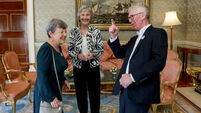
Terry Prone (right) was arrested by her style immediately: “I remember thinking wow, this woman has such presence on mic and camera. Her height gives her a sense of entitlement. Her success, I think, is that she has remained unchanged. She’s never taken on gimmickry and she is very smart. She listens like a hawk. And when it comes to saying, ‘Oh, wait a second,’ there is no one like her. She goes into death and painful areas without, ever, sounding mawkish. People say the most extraordinary things to her.”

‘I’m dying’. Nuala O’ Faolain Interview

Ah yes, Nuala. That interview in 2008, two months before Nuala died captured the nation. How did that come about?

“Nuala was a wonderful friend and I miss her unbelievably. I remember giving out stink to her for not being around for Obama’s inauguration. She had the combination of being serious about politics, and liking the absolutely not serious stuff like what Michelle was wearing, You had conversations with her that you could have with nobody else.”

The two had met for lunch. And Nuala announced that she was dying.

“She really wanted to do the interview. We did in a hotel bedroom and that was beneficial. It provided distance. We were hiding there together, and we were going, ruthlessly, through everything, no holes barred.

“We had a wobble at one stage and I asked did she want to stop and she didn’t. She was feeling bleak and she said that. Afterwards I rang my producer and said, ‘we could frighten half the country with this.’ “We listened back and we both felt it was important to air it, but we put a health warning in beforehand. We had Tony Bates on afterwards and he was perfect. And we put the Irish Cancer Society on standby with extra volunteers.

“The response was extraordinary.” She wipes away a tear. “I’d go round with letters and emails for Nuala, and she was enormously comforted by them. Some of the people who valued the interview most were dying. That was amazing.”

x

More in this section

Revoiced

Newsletter

Had a busy week? Sign up for some of the best reads from the week gone by. Selected just for you.

Cookie Policy Privacy Policy Brand Safety FAQ Help Contact Us Terms and Conditions

© Examiner Echo Group Limited