A helping hand
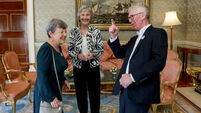
HEARTBREAKING images of malnourished children appeared in newspapers, and on our TV screens, this week as former President Mary Robinson travelled to the Horn of Africa to highlight the plight of millions of people affected by drought there.
Food shortages are affecting up to 12m people in parts of Kenya, Ethiopia and Somalia, in the worst drought in the region in 60 years.
The humanitarian crisis is being made worse by conflict in Somalia.
Robinson, who was accompanied by the chief executives of aid agencies, Oxfam Ireland, Trócaire and Concern, is not the only high-profile figure who has travelled to north-east Africa recently.
Sex and the City star and Oxfam ambassador, Kristin Davis, visited the Dadaab refugee camp in Kenya, and cried recounting her experience in a moving BBC TV interview.
The camp, one of a number for refugees in Kenya and Ethiopia, to which thousands of Somalis are fleeing their war-torn country in search of aid, has become overcrowded.
The visits to east Africa by Robinson and Davis are just two of countless examples of high-profile individuals working with charities and using their position and fame to successfully raise awareness of the plight of others.
“Participation of celebrities is very beneficial in attracting media attention,” says spokesman for Concern, Ambrose Duffy.
“The purpose of the (Robinson) visit was to try to draw attention to the terrible drought and to encourage people to donate money,” he says.
“It’s the worse drought in decades. People are starving. Millions are affected.”
Charities have been working with celebrities for years to raise awareness of their campaigns and to encourage donations.
Concern, which has projects in 25 countries, works with a small number of celebrities to promote its work, including Irish rugby star Rob Kearney, who travelled to Ethiopia in March to witness some of the charity’s work there.
“We have no way of knowing how much money working with celebrities helps us to raise for the various campaigns, but it has a significant impact,” says Duffy. He says that the organisation tries to associate with people who are, “reputable and who have a genuine interest in the cause.”
Actress Amy Huberman, chef Rachel Allen and singer Cathy Davy are among the Women of Concern ambassadors who have publicly supported a range of projects aimed at helping women abroad, including a micro-finance project in Haiti, which gives loans to women to help them set up businesses to earn money.
“It (working with celebrities) is definitely effective. When we invite people to an event ... such as joining Amy Huberman to run the mini-marathon, we get a great response. It definitely helps us,” says spokeswoman with the Women of Concern project, Liz Yeates.
Spokesman with Oxfam Ireland, Paul Dunphy, says working with celebrities allows the charity to reach new audiences.
“It’s a great way of getting the message out to people we would normally not reach,” Dunphy says.
“One good example is Kristin Davis in Kenya. A glossy magazine that might not publish an Oxfam report might be interested in doing something on her. It’s a fantastic avenue and we’re very grateful to celebrities and Oxfam ambassadors who come on board,” he says.
Oxfam works in 100 countries and Oxfam ambassadors include Archbishop Desmond Tutu, the music band Coldplay and the actor Colin Firth.
Comedian Deidre O’Kane and TV presenters Lucy Kennedy and Brendan Courtney are among the Irish celebrities the charity has worked with.
Other initiatives involving celebrities include Oxfam’s work with Irish band, Bell X1, on the Oxjam Music Festival, a ‘do it yourself’ fundraising festival each October.
Meanwhile, a number of leading Irish and international fashion designers and illustrators, including Joanne Hynes and Peter O’Brien, recently designed T- shirts for sale by Oxfam as part of the We Are Tee project.
Catherine McGinty, spokeswoman for Irish charity Trocaire, which funded 62 programmes in 31 countries in 2010, says one of the benefits of having celebrities travel to see projects abroad is that they are “an independent eye.”
“They are like your average person who donates to Trocaire. They want to see how the campaigns are making a difference,” says McGinty.
“People can relate to them. They are natural communicators,” says McGinty.
Broadcaster with 2FM, Paddy McKenna, who travelled to rural Mozambique with Trocaire in February, where he visited communities affected by cyclones and flooding, was deeply affected by the visit.
“I was struck by the poverty in the world and how safe and easy we have it. You could not go out there and not be bowled over by how little the people have,” says McKenna, who met locals from the Beipeia region. Their homes had been destroyed by a cyclone and they had been assisted by the charity in moving to an area of higher ground, less prone to flooding, and in building concrete houses capable of withstanding cyclones.
“I met a couple called Helena and Antonio Macanige, who had a new home. Helena told us about their home being hit by a cyclone and being stranded for three or four days in a hut, the roof of which had blown off,” says McKenna.
In stark contrast, the journalist and broadcaster also met a woman called Louisa Maria, a mother of 10 whose husband had died and who could not afford to send her children to school.
The family had no access to clean water and was drinking water from the local river, the Save, which was filthy.
“It was pretty upsetting to see how tough her life was. Trocaire were there to help and were encouraging her to leave the area and to move, but she was frightened about leaving and had been told there were bad spirits in the area they wanted her to move to,” he says.
“The organisation has a profound effect on the everyday lives of people,” says McKenna, who did not really know what Trocaire did prior to his visit to Mozambique.
“They work with a partner organisation called Ajoago, a local organisation, and their work is really targeted.
“Personally, I’ve read a lot of books about aid and you wonder is it actually getting to the people that need it. I was very impressed. They are doing a lot of good work,” says McKenna, who says it was one of the most amazing weeks of his life.
“I was struck by the Irish aid workers living in Africa. It’s a vocation ... to give up your life and home and family and to live among the most needy of people,” says McKenna, who reported from Mozambique to the Breakfast with Hector show on 2FM.
“It gave me incredible respect for the people that do that work. It is life-changing, vital work,” he says.
Trocaire has also worked with broadcaster Lorraine Keane, who promoted the Christmas Global Gift campaign in 2008 and 2009 and who travelled to Zimbabwe and Mozambique.
Meanwhile, singer Imelda May, footballer Graham Canty and boxer Katie Taylor took part in the advertising campaign for the recent Give it Up for Trocaire appeal.
Imelda May gave up her quiff for a day, Katie Taylor gave up watching boxing on TV, and Graham Canty gave up polishing the Sam MaGuire cup.
Chef Clodagh McKenna, who has recently become involved in Oxfam’s GROW campaign, says everybody should get involved with charities and charity work, if they can spare the time.
“That’s even down to calling into an elderly neighbour and making sure they are okay,” she says.
“You get a lot back. Doing something for somebody else … it’s a great feeling. It puts things in perspective and puts your own daily pressures in context.”
McKenna is involved in a number of charities, including The Pink Ribbon Campaign with the Irish Cancer Society, and MS Ireland.
Last year, she completed a motorcycle trip across Norway to raise money for Our Lady’s Children’s Hospital, Crumlin.
Her work with Oxfam is her most recent charity venture.
“They (Oxfam Ireland) just called me up and I loved the ethos behind it so I jumped on board. It’s a very worthy campaign,” she says of the GROW campaign.
“Sometimes, we can look at our own country and think we are really struggling and a lot of people are finding it hard, but in the Third World, so many millions are dying from starvation. It makes you think what can you do (to help)
“You can do something like giving €20 a month and it helps so much … or if it’s as little as €5. If everybody was giving €5 a month, it would make a huge difference to all of the Third World problems,” says McKenna.
Meanwhile, the charity UNICEF has some well-regarded ambassadors supporting its work, including golfer Rory McIlroy and rugby player Donncha O’Callaghan.
McIlroy visited Haiti in June and O’Callaghan was in Zimbabwe for the charity the same month.
“Celebrities attract attention, so they are in a position to focus attention on the needs of children, both in Ireland and overseas,” says UNICEF spokeswoman Julianne Savage.
Savage says that the charity recognised the power of celebrity in bringing the needs of children into the public spotlight, with the appointment of American actor Danny Kaye as the first UNICEF ambassador more than 50 years ago.
“They play a critical role in raising awareness of what we do and help us in fundraising for our work. We’re very heavily reliant on voluntary donations,” she says.
Other well-known UNICEF ambassadors include novelist Cathy Kelly and actors Stephen Rea, Gabriel Byrne, Pierce Brosnan and Liam Neeson, who was appointed a goodwill ambassador in March.
On the international stage, David Beckham, Robbie Williams and Susan Sarandon are just some of the charity’s international ambassadors.
Closer to home, spokeswoman for the Irish Cancer Society, Aishling Deegan says cancer awareness messages can be serious and heavy on their own, and that using celebrities, alongside real people, adds colour and humanity to the story.
“The general public identify with, and trust, celebrities and they add weight and draw attention to the message we are trying to get across,” she says.
“We ran a campaign for prostate cancer awareness recently … encouraging men to address the embarrassment factor around prostate cancer and to talk about it. It featured Bryan Dobson, Matt Cooper and Micheal O’Muircheartaigh.”
“The message to men was that it is okay to talk about these things, especially if those high-profile men were willing to.”
“We hope this will have an impact on men calling our helpline or talking to their GP, therefore resulting in prostate cancer being detected earlier and saving more lives.”
CEO of GOAL, John O’Shea says a visit to one of the charity’s projects by a GOAL patron, like rugby stars Jamie Heaslip and Gordon D’Arcy or former Wimbledon champion Pat Cash, draws media and public attention to the plight of some of the poorest and most deprived communities in the world, which would otherwise be “totally ignored.”
“Without such visits, most people in the relatively affluent West would have no idea of the daily struggle that others have to endure just to survive,” he says.
Speaking of the crisis in the Horn of Africa, O’Shea says Mary Robinson’s visit to the region was “very important. She (went) to a crisis point to lend her voice to that call,” he says.
But O’Shea says there are huge issues at play in the region.
These issues can only be dealt with by major governments and he is calling on the international community, including the United Nations, to take urgent action.
“The international community should use their influences to stop the war in Somalia, or else to send in the UN peacekeepers or NATO to provide a safe corridor to allow us (the aid agencies) to feed the people,” says O’Shea.
“There is no protection in Somalia. The people are inside in Somalia. They are starving. We’re talking about millions of people at risk.”
CONNECT WITH US TODAY



Be the first to know the latest news and updates