What's behind the increased focus on European border security?
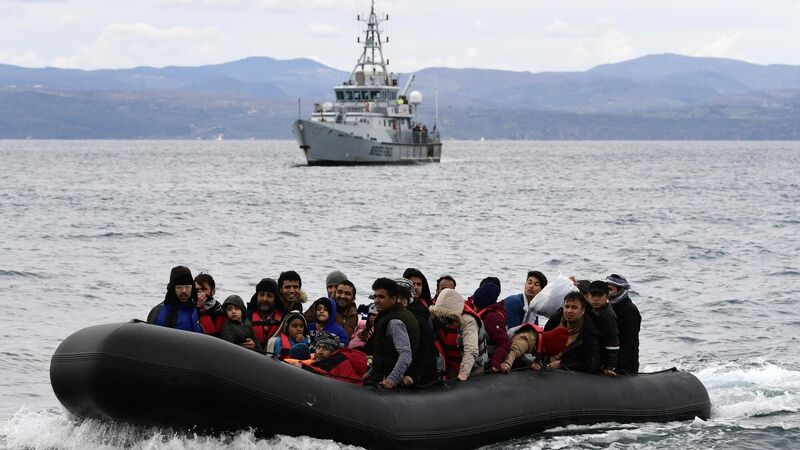
The harms caused by the border-industrial-security-complex are complicated and far-reaching, extending beyond the migrants who are most directly and seriously affected. File photo: AP/Michael Varaklas
The brutality of the border control and deportation policies of the Trump administration have rightly brought forth condemnation and no doubt many families in Ireland are fearful about the safety of loved ones in the United States.
In Europe, as well as the United States are witnessing an intensification of what is referred to in the academic literature as the ‘securitisation’ of migration.
People seeking to cross borders including, and perhaps especially those fleeing conflict or persecution, who are lawfully entitled to seek international protection, are increasingly being treated as security threats to be shut out, monitored and policed, rather than human beings deserving of and entitled to rights.
While the logic of securitisation has been shaping policy in the European Union for some time, border control has attained more central prominence in the last decade. This is reflected in massive increases in funding for border control.
The proposed 2028-2034 budgetary framework includes €15.4 billion for border management and €11.9 billion for the European border control agency Frontex which has significantly expanded in competencies, staffing and resourcing since 2019.
Read More
The European Pact on Migration and Asylum which comes into effect in June this year encompasses a suite of reforms aimed at deterring ‘irregular migration’. These include a controversial border procedure which effectively authorises border detention and a new return regulation which critics fear could usher in a deportations regime similar to ICE.
Ireland has signed up to the new pact and the International Protection Bill 2026 currently before the Oireachtas has been introduced to facilitate its implementation.
In the most tangible sense the “hardening” of European border policies is evident in the fortification of European borders. The European Parliament Research Service reported that external and internal border fences grew from 315km to 2048km between 2014 and 2022 raising concerns about illegal ‘pushbacks’ of people in need of protection.
Increasingly border fences are supplemented by sophisticated — and expensive — digital, including AI-powered, surveillance technology.
When we think of what is driving the securitisation of migration policy and erosion of human rights standards, what immediately comes to mind is the rising influence of far-right political movements who have successfully deployed anti-migrant rhetoric to leverage support.
Yet it is important also to look closely at the corporations who profit from the fortification and policing of borders and who have lobbied extensively for a more security-driven approach to migration management.
The term ‘border-security-industrial-complex’ is used by scholars and activists to refer to the network of relationships between private corporations and the public agencies and political entities involved in border security at the policy and operational levels.
In Europe as in the United States, some of the main actors in the border-security-industrial-complex are arms and defence corporations.
This includes major European defence companies as well as foreign firms, such as Israeli military technology firms Elbit systems and Israel Aerospace Industries (IAI) which have received lucrative contracts from Frontex and various European governments for border surveillance technology.
A decade ago the Transnational Institute published research highlighting that corporations profiting from conflict were also profiting from securing EU borders against those fleeing conflict zones. This report examined arms industry lobbying for enhanced border security measures and its success in capturing research funding.
More recent research from organisations such as the Corporate Europe Observatory, the Pulitzer Centre and Access Now have shed further light on the European ‘border-security-industrial-complex’.
It raises serious questions about transparency and accountability in detailing the extent of security and defence industry access to Frontex and other relevant European agencies through workshops and industry expos and a corresponding lack of influence of organisations with a human rights remit.
The harms caused by the border-industrial-security-complex are complicated and far-reaching, extending beyond the migrants who are most directly and seriously affected. Research indicates that border fortification causes significant economic, social and ecological harm without substantially enhancing security.
Policing of borders through digital technologies involves not only a huge financial cost, but adds to the environmental burden through increased demands for energy and water.
The billions allocated to border security and to research and development in border surveillance represent massive opportunity costs, drawing resources away from socially beneficial public expenditure such as housing and social services while feeding the machines of war and occupation.
Furthermore, the innovations in surveillance technology simultaneously shaping and shaped by security-driven border and immigration policies have profound implications for privacy and human rights, normalising erosion of democratic standards and facilitating the creep of authoritarianism.
The border-security-industrial-complex offers the illusion of safety to those within borders but in actuality peddles division and fear, eroding solidarity and trust which are the foundation of true security.
Its role in shaping migration policy requires much greater public scrutiny.
There is an important window in advance of the June implementation deadline for the Migration and Asylum Pact to ask searching questions of our public representatives at national and European level about who really benefits from the securitisation of borders.
- Dr Karen Smith is assistant professor in Equality Studies & Social Justice at the School of Social Policy, Social Work and Social Justice at UCD.
CONNECT WITH US TODAY



Be the first to know the latest news and updates