Paul Hosford: State must provide the facilities for sporting stars of the future
Sport Ireland found that there is a 19 percentage point gap between participation in sport at the highest and lowest socio-economic levels
Paul Hosford: State must provide the facilities for sporting stars of the future

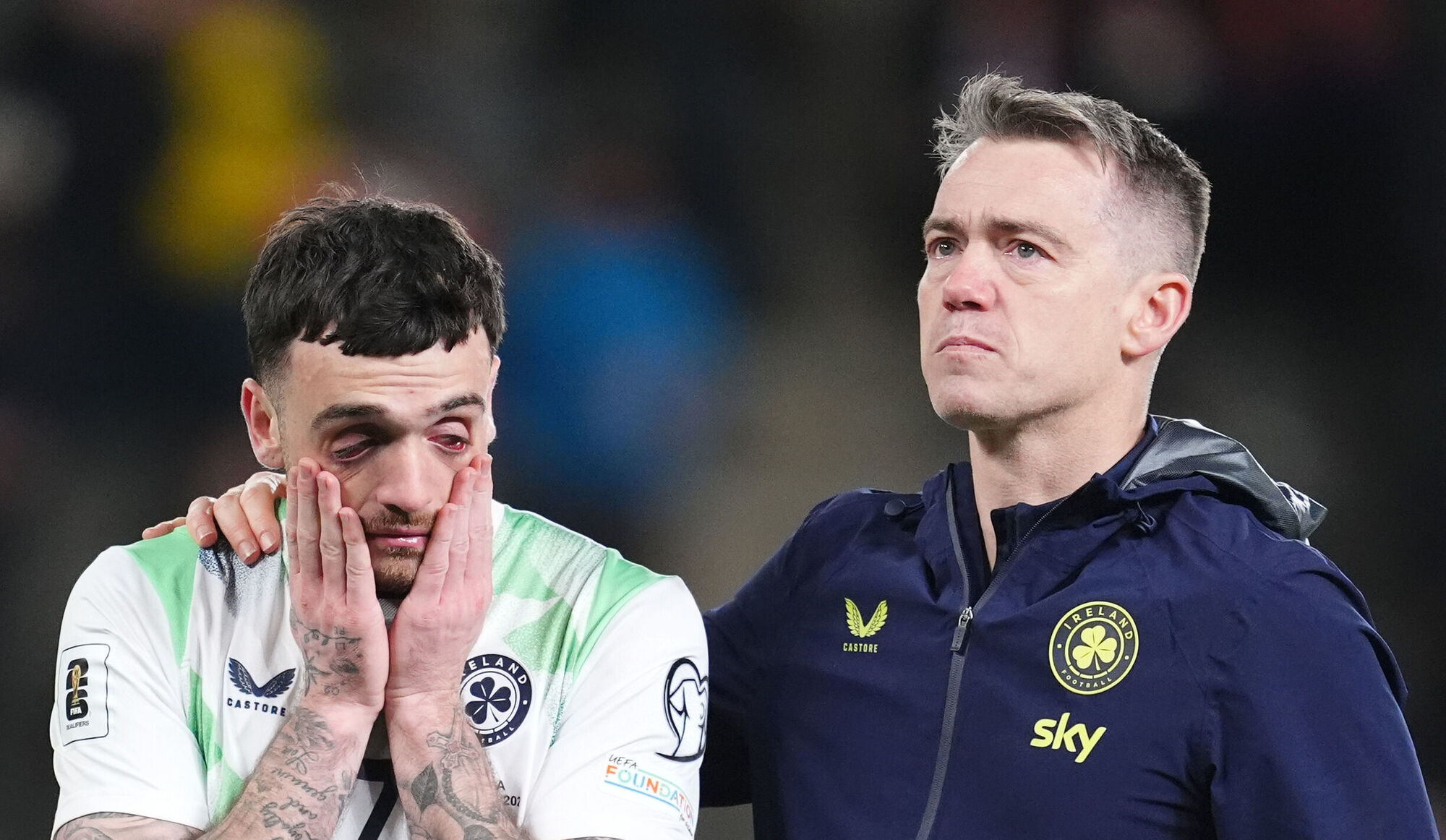
Republic of Ireland’s Troy Parrott is consoled following defeat to Czechia in the World Cup play-off semi-final match after a penalty shootout after extra-time at the Fortuna Arena, Prague, Czechia. Picture: Adam Davy/ PA

In the aftermath, as it sank in to those fans in the green corner of the Fortuna Arena in Prague that Ireland would have to wait at least another four years to reach a men’s football World Cup, the focus landed on the shoulders of one man.

Troy Parrott, whose six goals in Ireland’s last three games had made the dream of a summer tournament close enough to touch, stood in front of the 1,000 or so Irish fans who were lucky enough to have tickets for the away end — though several more had infiltrated the Czech sections of the stadium — emotional, but proud.

“We felt it, we felt it all week,” Parrott told RTÉ in the immediate aftermath of Ireland’s penalty shootout loss to Czechia when asked about the levels of support which had seen fans, seemingly, flood the Czech capital from all routes, landing by plane, train, automobile, kayak, and foot.

“We knew how much this meant to everyone, so I’m just really, really gutted that we couldn’t do it for everyone that has supported us: all of the Irish that are here, all of the Irish that are back home that’s been supporting us, thank you.

“Stick with us. It’s times like this where I’m so, so happy where I come from.”

The national pride, the raw emotion, the honesty. It is hard not to root for Troy Parrott.

And, so, you would imagine that on Friday and throughout the weekend, boys and girls will have been inspired to throw on their boots and runners and re-enact Parrott’s heroics in Dublin and Budapest and Prague. 

Except, in the place that made him, they will do so without a full-sized football pitch.

The issue had been raised in the Dáil on Thursday, many miles from the home of Slavia Prague, by Social Democrats TD for Dublin Central Gary Gannon, himself from the area.

Mr Gannon told Tánaiste Simon Harris during Thursday’s Leaders’ Questions session that there is not one full-sized football pitch in Dublin city centre.

“Troy comes from Portland Place in the heart of Dublin’s north inner city, a community that has produced extraordinary sporting talent, not because of what the State has provided but in spite of what it has not,” Mr Gannon said.

“We are very good in this country at celebrating our sporting heroes, with the jerseys, the flags and even, I hope, the open top buses soon.

Little investment in communities that produce sporting heroes

“What we are less good at is being honest about the gap between how loudly we celebrate these athletes and how we little we invested in the communities that produced them.

“There is not a single full-sized football pitch available to children in Dublin’s inner city, north or south. That is something I have raised on numerous occasions in Dáil Éireann.

“The only full-sized pitch in the locality at all is Croke Park,” he said, noting that GAA HQ isn’t exactly accessible.

But Mr Gannon was also keen to point out that it is not a case that sport is not funded in Ireland. Over a billion euro has flowed into clubs since 2018. 

Over a quarter of a billion euro was allocated to 3,048 community sports clubs and facilities in 2024 from the 2023 round of the Community Sports Facilities Fund.

But, what Mr Gannon was railing at was what an ESRI report from nearly 20 years ago had found: “Spending on sport is very likely to be regressive, with the less well off subsidising the activities of the better off.”

In a later paper Pete Lunn of the ESRI said: “There are strong links between the likelihood of playing sport and an individual’s demographic and socio-economic characteristics”.

“Hence, areas with a higher proportion of young people, students, and members of higher socio-economic groups are favoured by a straightforward comparison of participation rates.”

Gaps in participation in sport

In its Irish Sport Monitor, Sport Ireland found that there is a 19 percentage point gap between participation in sport at the highest and lowest socio-economic levels.

The monitor reads: “A persistent social gradient in the proportion that is active exists in terms of socio-economic status, with those from lower socio-economic groups being both less likely to be active and more likely to be sedentary.

“Sedentary rates amongst the lowest socio-economic group (20%) are far higher than observed amongst the most affluent group (7%).

“Primary school children from lower socio-economic groups have lower rates of weekly sports participation (87%) than their peers from higher socio-economic groups (95%).

“The socio-economic gradient increases at post-primary school, with 62% of post-primary level children from lower socio-economic groups participating in sport on a weekly basis, compared to 79% of their peers from higher socio-economic groups.”

But that participation in sport goes right beyond just playing as a child. 

Poorer people are far less likely to volunteer (14% v 7%), be members of sports clubs (43% v 25%) or attend events (21% v 16%) than their more well-off peers.

No access to land in poorer commuities

Mr Gannon’s Dáil contribution struck on one of the main obstacles that clubs and organisations in poorer areas have; access to land.

He said that to apply for capital works, clubs need to own land outright or hold a lease of at least 21 years’ duration.

This, he said means the “communities that already have facilities get more and the communities that have nothing remain locked out”.

“That is exactly why golf clubs in this State apply for this funding at exactly three times the rate of boxing clubs, not because golf matters more but because golf clubs and the like have the cultural capital to access the system.”

But those funding questions are a level above something as fundamental as access to a patch of grass upon which to play a game of football, to outstretch your leg recreating Parrott’s third goal in Hungary. 

Access to facilities is not a Dublin issue or even an urban one. They are more and more in demand and the Irish weather means that the few astro turf pitches dotted around are booked solid from October to April.

There is nothing like sport. Glorious, frustrating, heartbreaking sport. And, in Ireland, we love our sport. And we love the national football teams. 

Thursday was gutwrenching at its finale, but breathtaking in its build-up. 

A summer trip to the World Cup would have been a sight to see, instead of more waiting, more disappointment.

Troy Parrott is only 24 years of age. He is perhaps too young to carry a nation’s hopes on his shoulders, but he has done that admirably throughout this campaign to the point where when he urges fans to “stick with us”, the fans will.

But the national teams will need a next Troy Parrott, a next Katie McCabe.

And, right now, there is the chance that they cannot find a place to play football. 

In his response to Mr Gannon, Mr Harris said there is a chance to get the funding model right, to allow sport do more to tackle disadvantage and inequality and pledged to work with Mr Gannon in the city centre.

“Some things are political and some things just make sense to work on together and I am happy to do that,” he said.

Great things can be achieved when people pull together, even if they sometimes end in a penalty shootout.

If we want more nights like Thursday, more days like Budapest, the least we can do is give the kids inspired by today’s generation of players a place to play.

More in this section

Revoiced

Newsletter

Sign up to the best reads of the week from irishexaminer.com selected just for you.

Cookie Policy Privacy Policy Brand Safety FAQ Help Contact Us Terms and Conditions

© Examiner Echo Group Limited