Clodagh Finn: The story of the first female chair of a publicly quoted Irish company
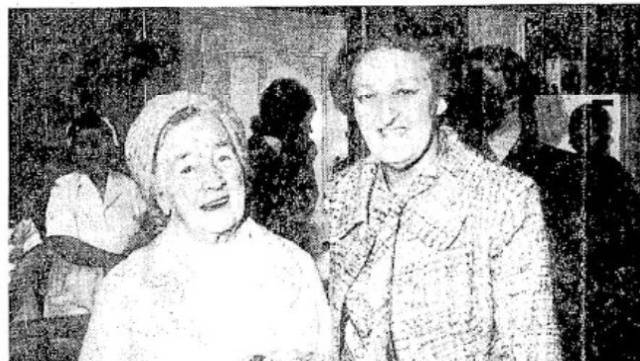
Margaret Hamilton Reid, chair of Switzers Department store, renamed the staff canteen ‘The Hammond Room’ to honour former employee Kitty Hammond, left, who 'turned out fine needlework' for the store over 60s year. Picture: The Evening Herald

If you know the name Margaret Hamilton Reid, you might remember her as the pioneering businesswoman at the helm of Switzer & Co department store in Dublin when, in the 1960s, it expanded to include Cashs of Cork, Todds of Limerick and Moons of Galway.
She was also an early feminist, a yachtswoman, a Girl Guide leader, an ecumenist, and a woman with enough sense of fun to chauffeur a car made up to look like a reindeer-driven sled during one Christmas charity event.
That little detail is contained in a newspaper snippet, the kind I love to find as they offer a unique insight into the person behind the position.
Another, from 1974, tells us something about a department-store chairman — she had no issue with the term — who knew that a business was nothing without its staff.
The previous year, Margaret Hamilton Reid renamed the staff canteen ‘The Hammond Room’ to honour former employee Kitty Hammond who, to quote the newspaper, “turned out fine needlework for Switzers over a period of 60-odd years”.
There’s a photo of the two of them, Mrs Hammond smiling and holding a bouquet of flowers, alongside the boss, who had just hosted a Christmas luncheon — complete with paper hats, crackers, and presents from management — for 30 former employees.
Read More
Of course the Switzer canteen has long gone. Brown Thomas now occupies the site on Grafton St and that name is over the aforementioned department stores around the country.
I wonder, though, how many of them — indeed, any shop, enterprise, or business anywhere? — have taken the step of naming a room after a faithful employee?
Having said that, I can think of a few. For instance, one of the meeting rooms in Euronext Dublin is named after Oonah Keogh, the woman who made world headlines when she became the first female stockbroker to trade there in 1925.
These enduring tributes provide an excellent way of preserving the memory of the people who have brought us this far. Too often people such as Kitty Hammond are lost to memory, although I have just the barest outline of her contributions (further details very welcome from any readers who might be able to provide them).
On the other hand, it is surprising how little there is about her employer, the very first woman to chair a publicly quoted Irish company.
The most easily accessible information comes from a lively and beautifully written obituary published just after her death, aged 97, in April 2010.
It gives us a tantalising glimpse into the life of a woman whose first memory, aged four, was of being lifted up at the bedroom window to see the fires raging on O’Connell St, Dublin, in the aftermath of 1916.
As an only child, she was destined to be introduced young to the family business which was co-founded by her grandfather, John Hamilton Reid, and John Wright Switzer in the mid-1850s.
She attended her first AGM at 15 years old — dressed in her school uniform.
Soon, she was sitting in the boardroom herself and, in her early 40s, she was elected chairman “after proving her worth in the face of male obstinacy”, to quote the obituary writer who clearly knew her.
The writer goes on to describe how Margaret — “both feisty and immensely generous in her support of many causes” — earned respect as a formidable businesswoman.
Her insistence on good business ethics was so ingrained that, it was said, the company’s books could be put on the communion table.
She also insisted on the company rule that the store would never stock anything that might be considered “detrimental to humankind”.
Her life outside of work is, perhaps, even more worthy of note. She was a Girl Guide for eight decades and was aide-de-camp to Lady Baden-Powell, the world chief guide, during her visit to Ireland in 1950.
Another newspaper cutting provides this insight: Margaret “introduced many novel ideas to guide work. For the girls in their teens, she organised beauty culture classes. She also taught them interior decoration; and, as a practical demonstration of the art, got them to redecorate the flat of an old Dublin woman on the North side."
On her sporting life, it offered this: “She owned one of the famous Dublin Bay 17-footers which, as helmsman, she steered to second place for the championship cup in its class this year.”
She chalked up several firsts in the sailing world, as first female committee member of the Royal Alfred Yacht Club, and the first lady member of the Royal St George Yacht Club.
She was a member of several organisations, national and international, and took an interest in a wide number of causes and concerns.
She was an environmentalist and a founding member of the Irish School of Ecumenics, promoting peace, dialogue, and reconciliation.
Cars were a passion too and she drove one of three Jensen Interceptors in Ireland, later exchanging it for a Jaguar. At 97, she renewed her driving licence and said her one regret in life was that she had never driven a Formula One.
Margaret Hamilton Reid also supported a refugee family from Kosovo, helping them to become Irish citizens.
There’s a certain symmetry in that because the man who co-founded the department store with her grandfather, John Wright Switzer, was descended from refugees himself. His forebears came from the Palatine community, a group of mostly Protestant people who fled persecution in Germany in the early 1700s.
In Ireland, landlords keen to have more Protestant tenants on their land granted leases to some of the refugees. About 150 families settled here, in Cork, Dublin, Gorey but principally in Rathkeale, Co Limerick.
That forgotten story is back in the spotlight because of Deirdre Kinahan’s captivating play, , which explores the often-difficult nuances of immigration, past, and present.

The Palatines’ experience carried an uncomfortable irony. As the playwright put it: “They were brought in by planters to be planters, so they were lost in a conflict not of their making … Their arrival could not be separated from the broader colonial story of the time where the Irish were being driven off the land.”
And yet, in the play, as in life, there is another side to the story. While many Palatines later emigrated to America, some stayed and gave back to their adopted country.
John Wright Switzer, for instance, set up a department store which would later be run by a woman who demanded the most stringent ethics in business.
In turn, she helped another refugee family who, no doubt, has gone on to make its own valuable contribution.
Kinahan’s play illustrates the challenges and complexities of immigration but, like the Switzer story, it also shows us that we might be better served if we thought of refugees not as a potential burdens but as benefits.
To return to Margaret Hamilton Reid. She died at home in 2010 following a short illness. She was 97 and, as we know from her obituary, she still had a driving licence.
Her funeral notice said: “Active in many national and international organisations, she was a Christian feminist, a philanthropist and an inspiration to others. An amazing lady, Margaret will be sadly missed by her family in Ireland and in South Africa and by a wide and international circle of friends.”
Surely she deserves to be the subject of a play herself or, at the very least, be given much more recognition.
CONNECT WITH US TODAY



Be the first to know the latest news and updates