Sarah Harte: If we can’t make AI work for us, I’ll meet you at the barricades
Even if you’re a fan of putting your fingers in your ears singing “la, la, la, I can’t hear you” — as many people are now, due to the current news cycle — you couldn’t avoid artificial intelligence (AI) this week.
The Meta layoffs sent shivers down the spine. The story also dominated the international news as the company’s axe fell globally. Driving across the country for work, the lead item on our news was the early-morning emails sent to Irish workers, telling them their roles were potentially affected. They landed at 4am. On a human level, you imagine their shock.
We were treated to an analysis of the 20% of Irish jobs affected, which was higher than the 10% expected. There was much discussion of the contagion factor, the idea that other tech companies will follow suit. And not just tech companies.
One legal person I spoke to told me that they are taking on far fewer trainees due to AI, but are not publicising it. Apparently, it’s a similar story in accounting. Behind the scenes, white-collar jobs are being quietly automated, with high-ranking executives minimising the great displacement.
Nobel Prize-winner in physics and computer scientist Geoffrey Hinton feared AI would replace jobs and might wipe us out as a race. Regarded as the father of AI, he famously left Google three years ago due to safety concerns about AI.
Read More
As an aside, Hinton is the great-great-grandson of George Boole, the 19th-century mathematician who laid the mathematical foundation for computers and AI.
The library in UCC is named after him.
It was only standing in front of the bronze statue of Boole at the weekend, on the beautiful, sunny UCC campus, that I learned of the connection. A brilliant young history and German graduate, Emma, gave us a fabulous 75-minute tour that included history, culture, and storytelling. I’d highly recommend this tour, whether you live in Cork or are visiting.

You would wonder what Boole would think of AI spelling disaster for workers, which is the tenor of most of the media coverage.
The Victorian Boole passionately advocated for labour rights and social reform. He was the sort of genius with a strong sense of civic duty that society produced then.
Meta chief executive Mark Zuckerberg has described layoffs as AI “flattening teams”.
He previously said: “We’re starting to see projects that used to require big teams now be accomplished by a single very talented person.”
The layoffs come as Meta posts sharply increased profits.
But don’t worry, because Elon Musk has floated the idea of a universal basic income in response to large-scale job displacement.
Is a world with few humans employed the future we really want? Imagine our adult children sitting at home with “leisure time” getting handouts from the state. At the same time, tech bros would continue to evade paying higher taxes and concentrate their power as inequality burgeoned even more.
How did we get to a point where a tiny class of supremely unfit tech overlords control global wealth and casually discuss making swathes of us unemployed?
Incidentally, Elon Musk’s civil lawsuit against OpenAI and its boss, Sam Altman, has just been thrown out by a Californian jury on the grounds that Musk waited too long to sue.
Altman supervised the launch of ChatGPT in November 2022.
The lawyer who represented OpenAI said at the trial’s conclusion that OpenAI would continue its mission to develop “safe AI for the benefit of all humanity”.
Hmmm... How’s that going?
OpenAI evolved from what was initially billed as a safety-minded nonprofit supposedly without fiduciary motives to a corporate beast that threatens to swallow us whole. We have half-watched like drones or modern-day serfs whose limbic systems and intellectual faculties have been shut down by dopamine hits from doomscrolling on our smartphones.
The Government told affected Irish Meta workers it would have their backs, but it’s not up to the challenge of regulating AI, and it’s not alone there.
Currently, the approach to regulating AI is woefully fragmented, with countries taking very different approaches. There’s little international coordination on the issue, with a dearth of AI governance protocols to balance innovation with risk. AI must be regulated even if, as some fear, it slows economic growth. (Economic growth for whom, by the way?)
Extreme, obscene wealth concentration creates political power that distorts democracy. It’s not just that some in the tech industry envisage us not working; it’s that if enough people are laid off, these AI-driven layoffs will also stoke the rise of populist politics.
Personally, I don’t imagine that people will sit around content with their basic-income handouts while oligarchs buy more private jets. No, they’ll be at the barricades because the public mood is already massively souring on AI.
Read More
It’s an economic and a democratic problem. How do we reverse the powerful hubristic tech tail wagging the dog, the dog being most of us?
Part of the solution is to tax the ultra-rich directly. Modern tax systems are abysmally failing to capture the enormous accumulation of asset-based wealth, creating economic oligarchies that should be dismantled from a competition or antitrust perspective, by the way.
Bernie Sanders, considered left-wing in America, explicitly argues for a direct wealth tax on billionaires and the ultra-rich to avoid societal corrosion. It’s obvious.
And plenty of economists, including Thomas Piketty and Yanis Varoufakis, have trenchantly agreed that democracy becomes unstable when wealth concentrations pass a certain threshold.
Piketty’s was a smash hit tome. He has warned that AI will turbo-charge economic inequality.
Varoufakis, the former Greek finance minister, has neatly described the unprecedented power the big tech companies wield as techno-feudalism and has some interesting ideas on democratising central banks.
I once had drinks with Varoufakis. He was a thoughtful, quiet man, although he did like to make a splash in that he drove a motorbike up the nave of a deconsecrated church in Kilkenny wearing a leather jacket.
It should be said that in a jaunty guest opinion in last Friday, the CEO of Goldman Sachs made the counterargument that, overall, things would be grand.
In the article — ‘I’m the CEO of Goldman Sachs. The AI Job Apocalypse Is Overblown’ — David Solomon presents AI as “a great leap forward for society”, conceding that it comes with “a few caveats”, including jobs in areas like accounting, banking, and law, seeing “many of their tasks automated”. Maybe he doesn’t see AI as a threat, or maybe it’s not in his interests to see it.
Taking comfort from the head of a firm dedicated to unadulterated greed, when wealthy Wall Street investors are pouring billions of dollars into AI, doesn’t feel reassuring, though. It feels like putting lipstick on a pig.
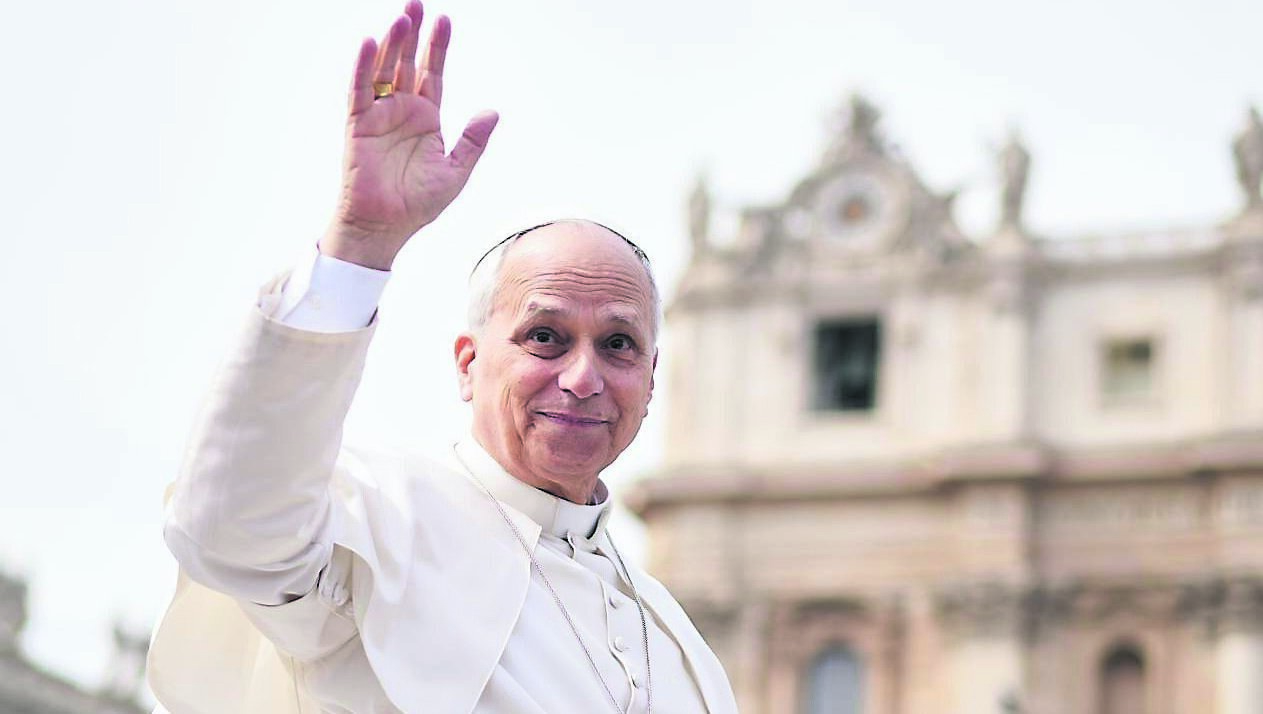
On Monday, Pope Leo issued his first sprawling papal encyclical, Magnifica humanitas: On safeguarding the human person in the time of artificial intelligence.
He warns leaders to regulate AI, so mass unemployment doesn’t become a “true social calamity”. He also sounds the alarm on AI power becoming concentrated in “the hands of the few”.
He’s bang on the nail.
The only firm conclusion I reached this week was that we should encourage our own children to pursue jobs with a front-facing human role, but that’s very much a question of thinking small.
We need big thinking, big changes, and fast. As a far from radical thinker, I never thought I’d write this sentence, but if we don’t get those changes, then bring on the revolution.