Mick Clifford: Michael Healy-Rae's exit highlights pressure from protests and lobby groups
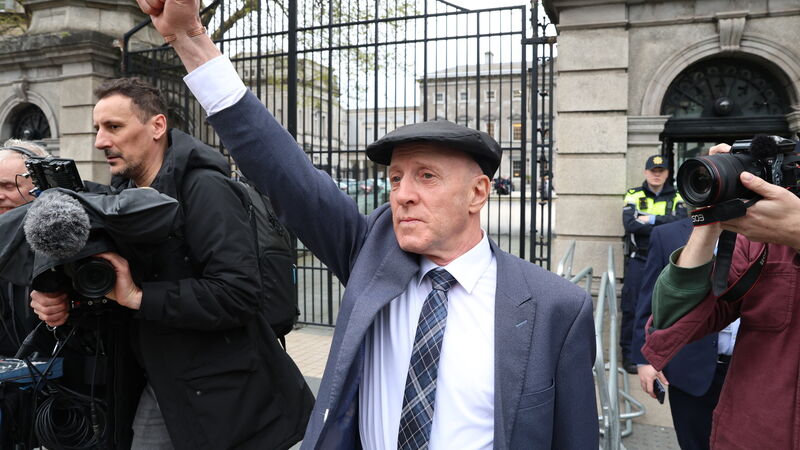
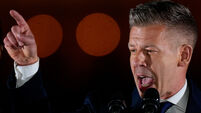
Kerry TD Michael Healy-Rae gestures to the protesters outside Leinster House ahead of voting no confidence in the Government over the fuel crisis. Picture: Stephen Collins/Collins
Michael Healy-Rae has seen businessmen begging on the side of the road.
That’s what he told the Dáil last Tuesday. He didn’t say which road, or whether the businessmen were extending a paper cup to passing traffic. But we must take him at his word, because he also emphasised that he is an honest man.
“When I see people begging on the side of the road, when I’ve seen grown men crying,” he told the Dáil about the fuel crisis, but particularly on how it impacts people — nearly all men — in business, to whom he can relate.
He met some of these businessmen in a pub in Killorglin early in the week, and they told him “how unhappy they were”.
As a result, he told the Dáil, he was resigning as a junior minister because the people of Kerry were unhappy over the Government’s handling of the fuel crisis.
Last weekend, Healy-Rae was part of that handling. He helped craft a package of measures and direct payments that could alleviate some of the pain being suffered as a result of the fuel crisis.
Read More
A good chunk of the measures, costing €750m in total, were disproportionately directed at hauliers, farmers, contractors, whom Healy-Rae and others appear to believe represent “the people of Ireland” in general and, in the Healy-Rae imagination, “the people of Kerry”.
Then he looked into his heart, and saw the begging and the crying of his kindred spirits, and realised it was time to switch sides in his own interests.
His status, along with that of his brother Danny, as a sole trader means that he doesn’t have to put up with anything that might impact on his attraction to voters.
Above all, he quite obviously was in terror of the greatest wound that can be inflicted on a politician these days — the manufactured accusation that they are 'out of touch with ordinary people'
So he took a hike from the Government, saying that the aid package wasn’t enough. How much does he want? €1bn? €2bn?
Who among the people of Ireland, including the people of Kerry, should forego other aid or services to pay for this package that is largely directed at his kindred spirits? That question doesn’t bother him anymore because he has left Government.
In opposition, he won’t have to make choices as to who should get and who should forego. In opposition, it’s all about how you shout it.
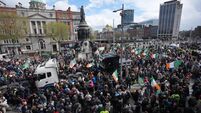
Protesters are 'workers'
Outside the Dáil, Healy-Rae indulged in the kind of ráiméis that spawned the “people of Ireland” waffle.
“The one thing I can say about the protesters is they were workers. Every one of them,” he said.
No doubt they are, but what about the other 2m or so workers in Ireland. Are their needs, their pain, any less? From his whole demeanour, Healy-Rae would appear to be believe so.
And yet, in another sense, it’s hard to blame him. If, for instance, this Government was recognised as standing for any coherent political philosophy, it might have occurred to the deputy for Kerry to stay the course in the name of the greater good. But all the indications are that this Government’s guiding light is simply to avoid any hassle from those who can shout loudest.
Look first at the response to the protests. The attitude appears to be to throw money at them to ensure there is not a repeat. Economist John Fitzgerald pointed out on RTÉ on Monday that there is a cost for this approach, borne in quiet desperation behind closed doors.
Giving money to businesspeople today will mean forgoing it next winter for 'householders who are going to be cold' and 'small farmers who can’t heat their homes'
He pointed out that not a single protester talked about people on low income heating themselves next winter in what we are told is a growing energy crisis worldwide.
“The Government tended to be the Robin Hood, taking from the better off and giving it to the poor. The protesters were the Sheriff of Nottingham and they won out,” he said.
That is how the Government works today. Look at the controversy over SNAs a few months ago. There was a cack-handed attempt to redirect SNAs to where the need was greatest. Instead of pulling back and addressing the issue properly, an extra €20m was thrown at it in order to quell opposition.
Who ultimately loses out? Most likely some who need the assistance the most. So it went with the posturing over Mercusor. The Government was afraid to endorse the deal in the name of the real — in this case — people of Ireland, opting instead to nod at beef farmers and pretend it was opposed to it in the full knowledge that it would go through.
The political capital foregone in Brussels with this messing will be felt down the line, but far from the loud voices. The same applied with the Vat reduction for the hospitality industry in last year’s budget. A powerful lobby, projecting ruin for its members, won over the Government.
Throw money at the problem
As with all choices on resources, those who need it more have in all likelihood lost out. The policy is to throw money at anything that might look like trouble, keep the head down, and don’t think of where better that money should be spent.
In each case, the Government has been visited by the ghost of the water charges debacle over a decade ago, terrified that it will be cast as “out of touch with ordinary people”.
Each lobby group, formal or informal, has perfected its pitch, presenting its members as living on the edge of want if it doesn’t get what it seeks.
Throw in the accelerant of social media and you have the perfect bonfire on which to burn any coherent political philosophy. The ultimate outcome is increasing alienation from those who are at the furthest reaches from the centres of power.
There is no leadership, either in Government or beyond
The main opposition party, Sinn Féin, aspires to lead, yet none of its spokespeople could bring themselves to condemn the intimidation of gardaí by a small element of the protesters last week.
The party’s primary political objective in these troubled times is the reunification of the country which, in my view, is an aspiration out of synch with the priorities of the vast majority of citizens.
In other countries, this kind of vacuum has been filled by populist right or far-right entities. It is notable that the one party to curry serious favour with the protests last week was Independent Ireland, the closest thing we have to a populist right party. What we also know from other countries is that this kind of politics usually end in economic tears.
Still, that never stopped anybody from successfully flogging the snake oil — nor multitudes from buying it out of frustration. The next few years will tell whether a market has been created here for such a product.
CONNECT WITH US TODAY
Be the first to know the latest news and updates