Mick Clifford: Gender discourse pays scant regard to those it most directly impacts

An orthodoxy about gender issues has been met with a backlash from those opposed to gender recognition: Many on both sides seem to have little regard for the tiny number of people it affects
Mick Clifford: Gender discourse pays scant regard to those it most directly impacts

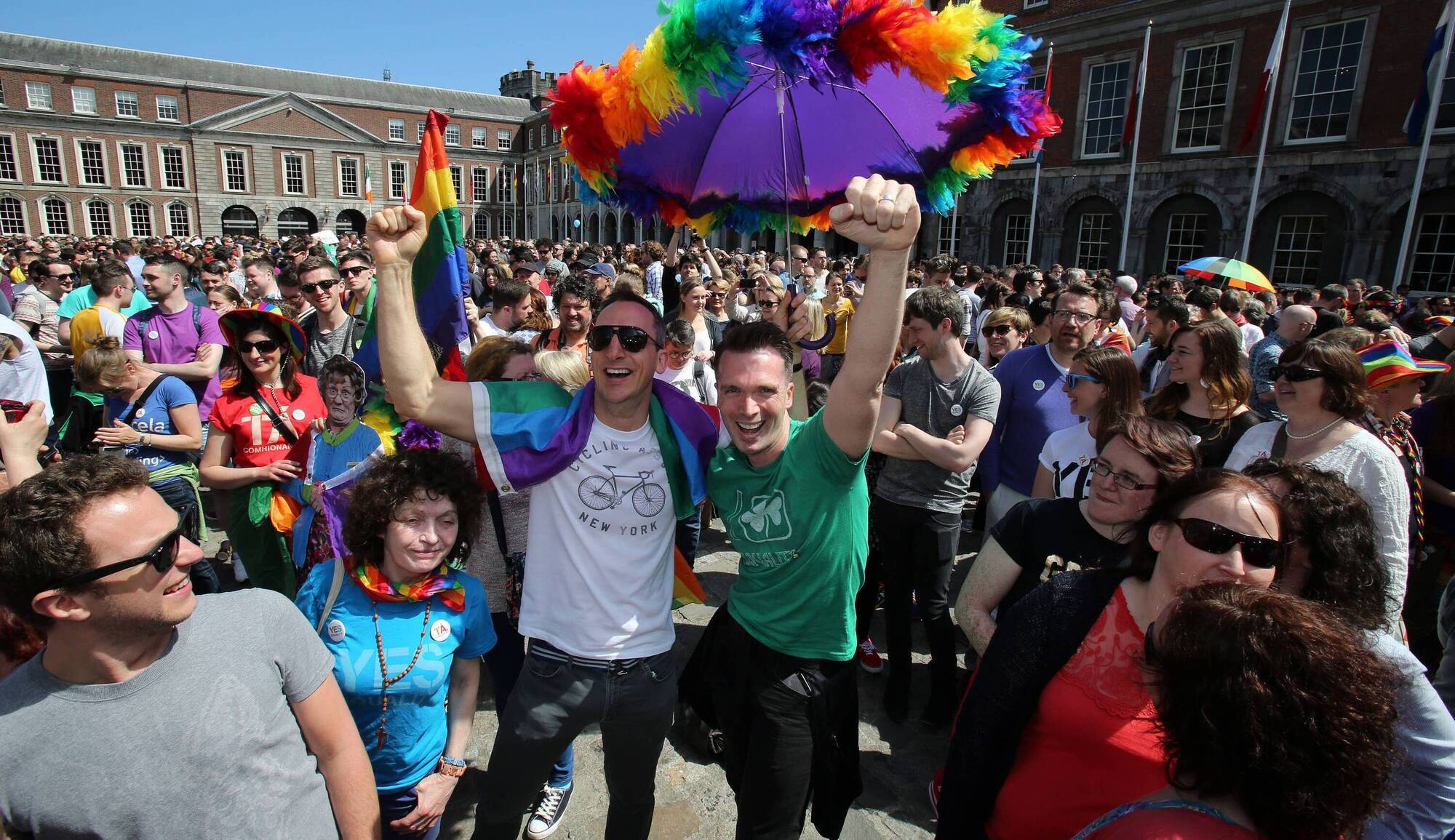
The compassion that helped drive the marriage equality referendum may have been forgotten by some who espouse a newer gender orthodoxy. And many of those opposed to the Gender Recognition Act seem similarly bereft of compassion. Picture: Paul Faith/AFP/Getty

Last Saturday, a conference of over 200 people, mostly women, took place in a Dublin city centre hotel. The event in The Alex was organised by a group called Wicklow Women 4 Women.

They had a range of speakers, including former RTÉ reporter Paddy O’Gorman, journalist Brenda Power, psychotherapist Stella O’Malley, and Independent Ireland TD, Ken O’Flynn.

The location of the event was not released until the day before it took place. This presumably was a precaution to ensure opposition to the meeting couldn’t be mobilised or a protest organised. There was reason behind such caution. A meeting like this two or more years ago might well have attracted protest. It would appear, however, that life has moved on from those days.

The premise for the gathering was to discuss ways to repeal the Gender Recognition Act, which came into being in 2015. The law provides for anybody who wishes to change their gender. Largely, it involves an administrative process which takes a few days to complete.

There was a feeling among those in attendance that the law was passed with little or no meaningful debate in the aftermath of the euphoria generated by the same-sex marriage referendum.

Small number of trans people

In 2024, the last year for which stats are available, 334 people were granted a gender recognition certificate. This was down from 350 the previous year. 

Different criteria apply to those under 18. In 2024, four people aged 16 or 17 applied, of whom three were successful.

Of the adults, 192 were for transitioning from male to female, while 142 were from female to male. These are all tiny numbers in a state with a population of over 5m.

Focus on male-to-female transition

The meeting in The Alex, to the greatest extent, cast the rights of people transitioning from male to female as being in opposition to those of women. This is a feature of debate in some quarters across the Western world at a time when the gender issue is front and centre of what we call the culture wars.

A lot of the discussion at The Alex concerned safe spaces. The general gist centred on a belief that some, if not many, who change their gender from male to female are liable to use entry to facilities like single sex bathrooms to prey on women. There is a dispute over the incidence of any such occurrence, but, as is standard for today’s world, a single or perceived incident can easily be blown up into a phenomenon if it fits neatly into an agenda.

Prisons and sport 

Paddy O’Gorman spoke of transgender women in female prisons. By his count, there have been four such cases, but in all of them the authorities have been alive to the possibility of trouble.

Another issue touched on was the participation of transgender women in women’s sport. From the outside, this certainly is worthy of debate. Already, a number of sporting organisations have in recent years formulated policies in this area. One of the speakers at the event was critical of the GAA, and particularly the Ladies Gaelic Football Association, for not elucidating a clear policy.

Psychotherapist Stella O’Malley spoke of the kind of issues that arise for young people today, which may lead to them questioning their gender. 

Kids today, she asserted, are encouraged online and elsewhere to believe in golden lives: “What they have been fed is that if you’re not happy, you should talk to an adult because you should be happy. 

"We have been fed the Hollywood idea, and it’s not true.”

This, O’Malley said, was often expressed physically if a young person didn’t like their body. “Life is unfair [they are told] and you could be a different person with a different name in a different body and call yourself something else.”

Her analysis rings sound as an explanation for some of the increase in young people questioning their gender. However, she also suggested that those in this situation are encouraged by “zealous parents”. That might require a little more research.

Absence of compassion 

Nowhere in the talks or panel discussions was any compassion expressed for the very small number of young people caught up in gender issues. It wasn’t expressly stated, but the impression was imparted that most at the gathering have no time for the idea that there are young people gripped with a primal need to change their gender.

A few years ago, the event would have attracted protests and concerted abuse online. 

Gender orthodoxy... 

There was, back then, an orthodoxy about gender issues that dictated any discussion on the matter was an attack on transgender people and emanated from far-right instincts.

The activists pushing that agenda appeared to have forgotten that the referendum on same-sex marriage succeeded because it was driven by a sense of compassion. That, in the trans debate that followed, was replaced by activists with an authoritarian approach.

To raise your head above the orthodoxy was to risk being labelled a bigot. Politicians were scared stiff of it, and the media, for the greater part, gave it a wide berth.

...and the backlash against it

Today, the shoe is firmly on the other foot. A change has come about, some of it attributable to a backlash against that oppressive orthodoxy. More of it is the washing onto these shores of the kind of political sentiment that is prevalent in growing parts of other Western states. Today, politicians are scared stiff of uttering anything that might attract the silly label of ‘woke’.

Matters around gender dysphoria get inflated beyond the issue itself. All you need to do is observe how Donald Trump throws it into speeches and immediately attracts a visceral reaction.

Last week, during his leader’s speech at the AontĂș party conference, Peadar TĂłibĂ­n mentioned that his was the only party in the DĂĄil that opposed what he called gender ideology. The audience broke into spontaneous applause as if the matter was something that impacted people in their daily lives.

Hate speech law on hold

Last week also saw the release of a report highlighting racism in schools. Yet we do not have an up-to-date law on hate speech largely because politicians are scared stiff that if such a law included gender as a protected category, there would be a visceral campaign of opposition.

For some reason, all sorts, right across the political and social spectrums, get very worked up about this issue, despite its direct impact on a very small number of mostly young people.

Unfortunately, those who are exercised about it tend to be so caught up in their beliefs, philosophy, or simply antagonism towards the politics of the other side that there is precious little consideration given to those whom it impacts directly. That would appear to apply irrespective of which side appears to hold sway in the public square at any particular time.

x

More in this section

Revoiced

Newsletter

Sign up to the best reads of the week from irishexaminer.com selected just for you.

Cookie Policy Privacy Policy Brand Safety FAQ Help Contact Us Terms and Conditions

© Examiner Echo Group Limited