Joyce Fegan: We must never lose our sense of compassion
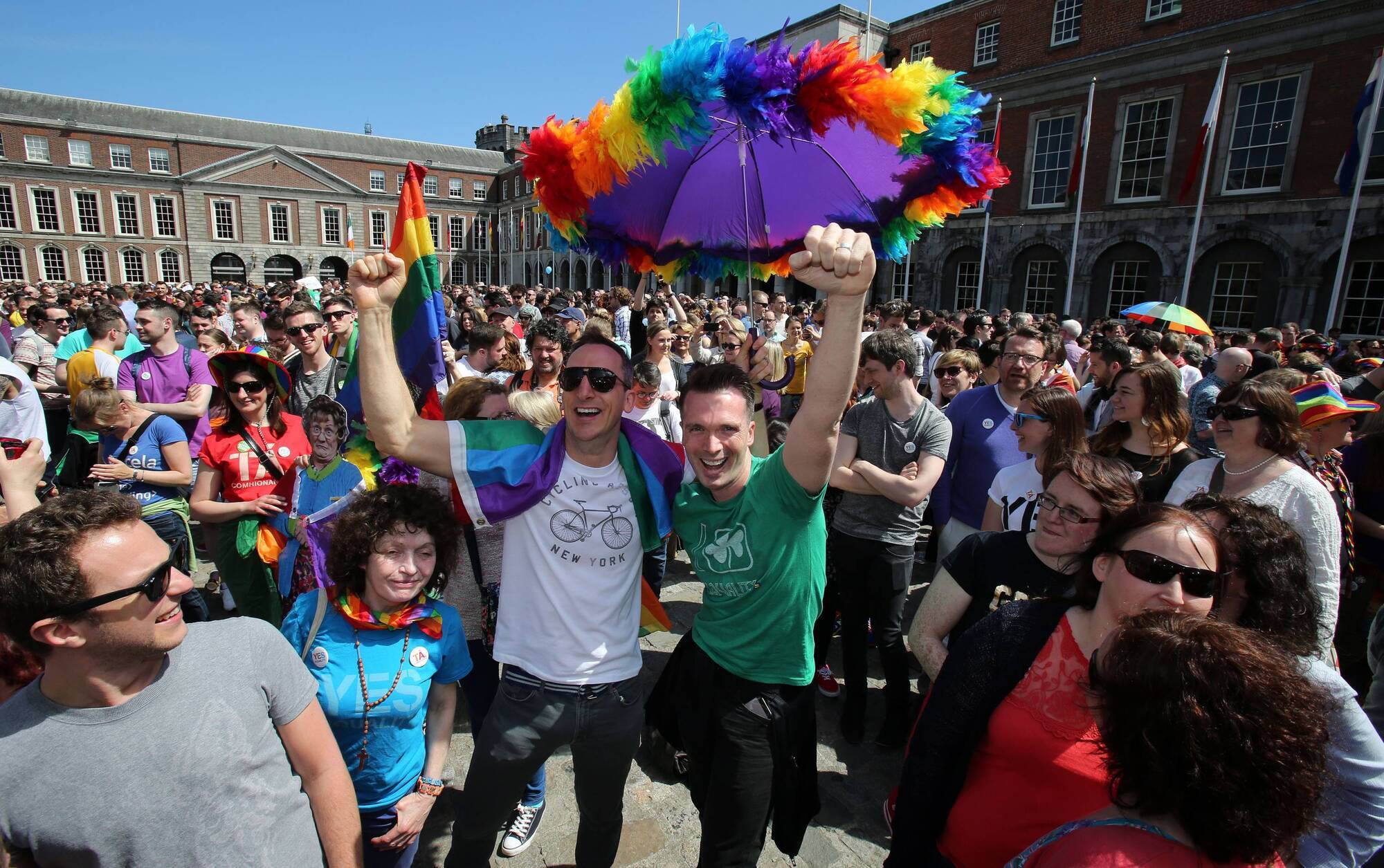
Supporters for same-sex marriage raise a cheer at Dublin Castle as they wait for the result of the referendum on May 23, 2015. Picture: Paul Faith/AFP via Getty Images
“It was a proud day to be Irish,” said the papers. It was Saturday, May 23, 2015, and we as a people had just voted to legalise same-sex marriage by popular vote — the first country in the world to do so.
What else did the foreign press say about us, the morning after the day before? Our vote was “hailed a social revolution”, according to . We were now a country “at the vanguard of social change”, said .
Men cried in one another’s arms, as decades of hate, bigotry, and discrimination were apparently swept away in a long overdue tide of unified respect, decency, and dignity.
We could hardly believe it ourselves when 1.2m of us voted Yes on May 22, 2015, in favour of “yes equality”.
It wouldn’t be long before we did so again, on Friday, May 25, 2018, when, this time, 1.4m of us voted yes to “care and compassion”, removing the ban on abortion from our Constitution.
In both referenda, the public debate felt divisive, but the conversations at kitchen tables and on doorsteps were anything but. In the private domains of our lives, we acted with decorum and then we voted with compassion.
Tomorrow, a march is to take place in Dublin City centre — the Solidarity March. Its sole purpose is to mark our country out as an “Ireland for all”, a place of “diversity not division”.
Look at that for wide society support
— Rory Hearne (@RoryHearneGaffs) February 15, 2023
Its going to be an important day
To say #IrelandForAll #Solidaritymarch#HousingForAll #End homelessness pic.twitter.com/7OBZT3PtQI
“We are calling for a national response of unity and solidarity against the racism that is being spread in our society by the far right,” say organisers.
The groups represented included Le Chéile, the National Women’s Council of Ireland, Fórsa, Siptu, Unite, Masi, Amnesty International, and Black and Irish, as well as local community groups.
During the locked down months and restrictions of the pandemic, the Far Right Observatory (FRO) in Ireland warned of bad actors spreading disinformation online, to honest, decent people connecting to the world, from their homes, mostly via social media and their smartphones. Conspiracies flourished.
We weren’t alone. The World Health Organization (WHO) addressed the trend globally, calling it an “infodemic” of misinformation.
“We’re not just fighting an epidemic; we’re fighting an infodemic,” said director-general of WHO Tedros Adhanom Ghebreyesus in March 2020 — flagging it very early.
Disinformation is the conscious spread of false information for financial or political gain. Misinformation, on the other hand, is the accidental spread of false information — like when you share a post you’ve seen online, or tell your neighbour about something you saw on your daily scroll.
It wasn’t long, then, before anti-mask protests were taking place on Irish soil. They gained little media traction. Newsrooms were, perhaps, making conscious choices to not amplify their message.
The pandemic moved on, so too did the news cycle, and those who had been gaining followers and fame for their conspiratorial views were left without content, and an engaged audience, as people got back to working, travelling, and socialising.
And then, in February 2022, Russia invades Ukraine, displacing approximately 8m people in the process.
The Irish rallied. In just two weeks, out of a population of 5m of us, we raised €17.5m for the Irish Red Cross alone, and 17,000 people pledged accommodation through the charity too.
There was plenty of compassion to go around.
Prams and buggies were gathered and left outside the arrivals hall of Dublin Airport, from Irish mothers to other mothers, who now found themselves trying to parent as refugees.
The war continued, and so too did preexisting, unaddressed Irish problems on Irish soil. Our ongoing rental and housing crisis continued unabated, and then the cost of living increased, as did inflation. All of this after two years of a pandemic.
The conditions created a sort of perfect storm. The handful of bad actors who had gained fame, followers, and fortune during the pandemic found new territory on which to act. Their rhetoric, about the type of Ireland they wanted, had long been doing the rounds on social media, only most of us were too busy to notice.
Talk of protests outside asylum seeker accommodation flared up online. They looked like they were going to be big affairs. The reason behind the protests started to sound almost valid, the national media started to take note, to address the issue, to allow “both sides” of the debate be heard.

Those against were a lot easier to get on the record. Then when push came to shove on the day, only a dozen or so people showed up. But the idea of these kinds of protests, at vulnerable people’s places of supposed refuge, started to spread.
The point has been made about free speech, and the right to protest and assemble, but another point exists in balance — we ordinarily protest on our country’s main thoroughfares, gathering at Parnell Square, down O’Connell St, over O’Connell Bridge, headed for Kildare St, until finally arriving at the gates of power — Leinster House. That’s been the accepted route of free speech in the past.
We haven’t form for protesting at the doors of the vulnerable.
This week, a premature newborn baby is experiencing the first weeks of her life in a room in asylum seeker accommodation. The room has had no heating for months. An Irishwoman who has struck up a friendship with the family went into town last weekend to give them some extra blankets. We only hope this premature baby was not woken from whatever slumber her tiny body needed as people protested outside her one-room home.
This same week, a democratically elected councillor in Ireland posted on Facebook that refugees were welcome. Nothing more, nothing less. Cue abuse underneath, referring to our elected official as a “parasite”. The abusive poster’s profile picture was of two young children.
It’s as if hate has become “politically correct”, the way in which to enact our free speech.
The organisers of tomorrow’s protest acknowledge the “dire straits” people in every one of our communities face — housing, hospital waiting lists, to name but a few. But they lay responsibility on those in power, not those without it.
“Ethnic minorities and refugees are more likely to be victims of the cost-of-living and housing crises,” they say.Â
“Rather than challenging the establishment, they are terrifying ordinary people in their homes.”
We can address our problems — assuming the political will is there — while also being a country that cares. The two are not mutually exclusive.