Mick Clifford: We must all unite against hate agenda
Every democracy requires a contest of ideas. Every society will have different opinions on aspects of culture that should be vigorously debated.  None of that, however, requires a stoking of divisions.
Mick Clifford: We must all unite against hate agenda

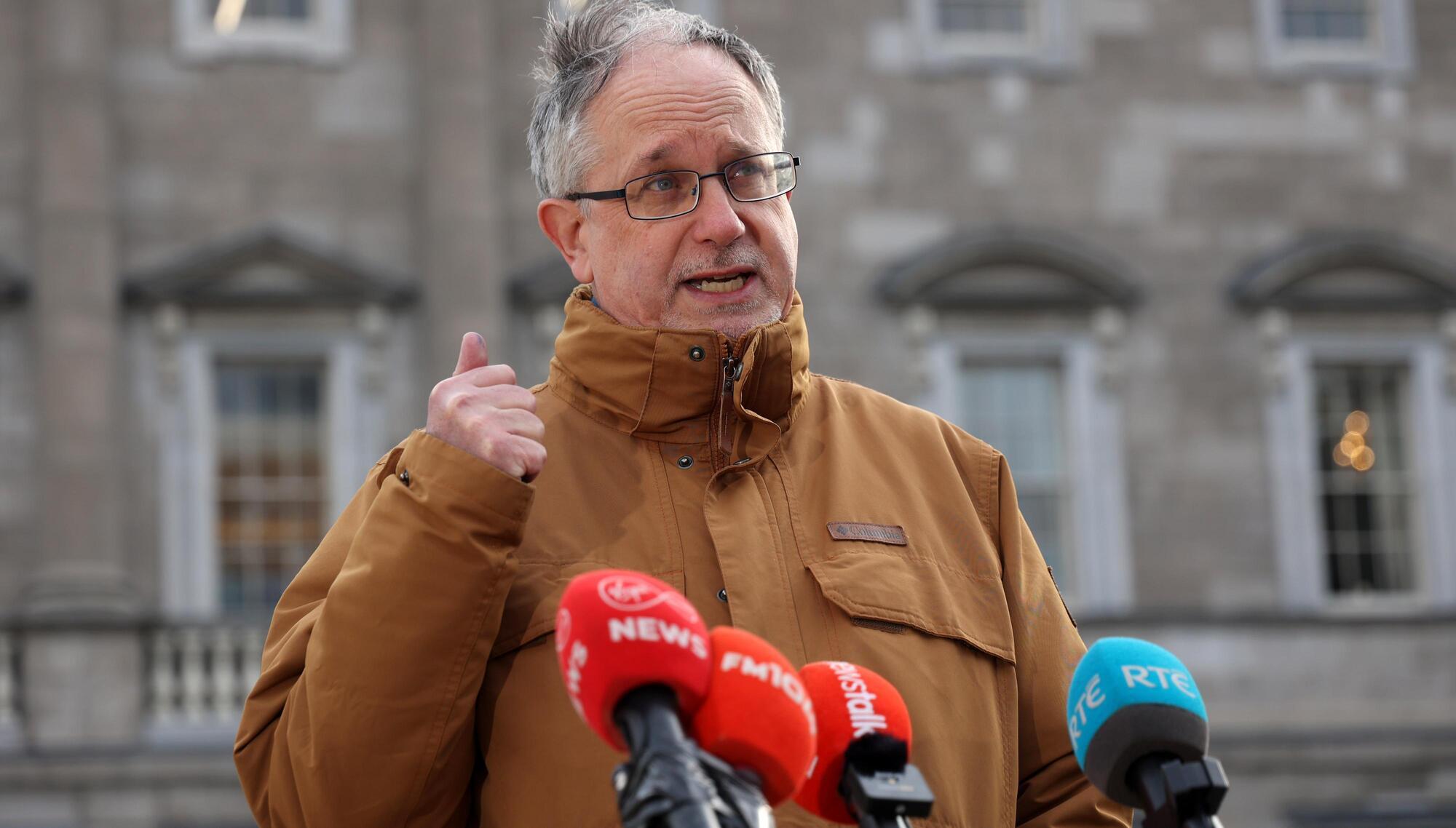
People Before Profit Mick Barry: "We need masses of ordinary people to rally against racism and fascism." Photo: Sam Boal/Rollingnews.ie

ON Wednesday, at Leaders’ Questions in the Dáil, there was an exchange between the Taoiseach and People Before Profit/Solidarity TD Mick Barry. The topic was the worrying level of protests against immigrants around the country.

Barry was laying blame for an increase in protests at the Government’s door over its woeful housing record. Leo Varadkar warned Barry to be careful in how he framed the problem.

“Racists and the far-right will blame whatever problem the country is facing on migrants,” Varadkar said. “That is the way it works and the way they think. If we have a housing crisis, it will be said the foreigners are taking our homes. If we have an unemployment crisis, it will be said the foreigners are taking our jobs. If we have high levels of crime, they will blame the foreigners for those.”

He has a point. It is entirely justified to criticise Varadkar over the appalling record on housing that successive governments — of which he has been a member for the last 12 years — have had. But the hate agenda of the far-right is a separate issue on which there is broad political consensus.

Mick, however, was on a roll. “We need a mass movement from below in Irish society on this issue,” he said. “That is why I am pleased that on Saturday, February 18, the Le Chéile coalition is calling people out on to the streets. We need masses of ordinary people to rally against racism and fascism. This needs to be a demonstration which is not just anti-racist, but anti-Government, as well, and calls for action on housing and the social crisis.”

The right kind of people?

This is confusing. Mick Barry and those of his political persuasion see themselves as the real bulwarks against the far-right. Yet in a national gathering to demonstrate solidarity with immigrants, he only wants those of a pure political persuasion, as he would see it, to attend. 

There is no room at this rally for the roughly 40-45% of people whom opinion polls suggest support the Government. Unless, of course, those wrong-headed people are willing to see the error of their ways.

There is no room for Varadkar, the son of an Indian immigrant, to show his solidarity with immigrants and asylum seekers because he is of the wrong political persuasion. So instead of a genuine cross-section of political and societal opinion coming out to marginalise those spreading hate, only one section, that which is considered pure in the eyes of some, is welcome.

Last February, a similar scenario arose. The National Women’s Council of Ireland (NWCI) hosted a rally outside Leinster House but only opposition politicians were invited to speak. The snub was pointed as every single opposition party was represented on the stage. 

The NWCI was established to further the agenda of achieving real equality for all women. Yet here the body was quite openly making a distinction between women who shared some of their values outside the organisation’s main focus, and those who maybe did not.

Fine Gael TD Jennifer Carroll McNeill reacted by suggesting a ‘them and us’ narrative was being created. “To me, it felt like the first time that we were moving into a ‘them and us’ when my experience working with the women’s council and with women’s rights across the Dáil and Seanad has been exceptionally collaborative,” she said.

Are women nationally best served by such an approach, or perhaps the council is now representing only those it considers the right kind of women?

The bad influence of social media

The fostering of divisions in politics and culture across the world is thriving right now. Once upon a time, not long ago, different sides contested ideas, often passionately, within a particular framework where both focused on the greater good for society as they saw it. 

Today, there often appears to be as much emphasis on attacking the bad faith of the other side, highlighting one’s purity in contrast with the impurity of opponents, as there is on ideas.

Some of this has been driven by the political upheavals that followed the economic collapse of 2008. More of it is down to a paucity of new ideas with which to demonstrate innovative thinking which might separate one side from another. But a huge part of it can be attributed to the rise in social media and its influence on politics, particularly by fostering division through anger.

In such a milieu, there is no room for the occasional issue, purpose, or national imperative on which all, or at least most, sides might be expected to stand shoulder to shoulder. For some, showing solidarity with the other crowd on anything is just too uncomfortable to bear, whatever is at stake.

One example of what happens if somebody strays from this fold occurred when Atheist Ireland’s Mick Nugent and the Iona Institute’s David Quinn revealed last August that they shared the occasional pint. The pair have passionately held opposing views on the role of Church and State and issues around sexual morality. 

In that respect, they got to know each other in radio studios over the years and found that away from the microphone and their views, they actually got on. After they spoke about this on Newstalk, Nugent got absolutely pasted on social media. 

Those who subscribe to his views on the Church hurled abuse at him for humanising Quinn, whom they considered the enemy. How could Nugent betray his own side, these keyboard clowns barked. How could he not be angry at Quinn in his every waking moment? 

The fare veered from surreal to ridiculous but was informed by the instinct to foster division and repulsion at the idea that the other side might actually be human too.

Niamh Bhreathnach made an extraordinary contribution to tackling educational disadvantages.

Another sign of the times came in the wake of the announcement last Monday of the death of Niamh Bhreathnach, who served as Labour Party Minister for Education between 1993 and 1997. She is remembered as the minister who abolished third-level fees, but the legacy of that decision is contested.

What is not contested is her extraordinary contribution to tackling educational disadvantages. Under her stewardship the Breaking The Cycle initiative got off the ground. In particular, the scheme introduced smaller class sizes and links between the school and home, both of which had a major impact on children in disadvantaged areas.

For anybody who purports to be interested in social justice, and particularly the origins of inequality in education disadvantage, Bhreathnach made a huge contribution. Yet outside her own party, her death brought public tributes only from Fianna Fáil and Fine Gael. 

Is it that a contribution to bettering society as a public service over two decades ago will only be acknowledged if it was done by somebody from the right kind of party?

Every democracy requires a contest of ideas. Every democratic government must be held to account by a robust opposition. Every society will have different opinions on aspects of culture that should be vigorously debated. 

None of that, however, requires a stoking of divisions. Doing so might benefit a small number of individuals or entities, but it does nothing positive for the vast majority.

More in this section

Revoiced

Newsletter

Sign up to the best reads of the week from irishexaminer.com selected just for you.

Cookie Policy Privacy Policy Brand Safety FAQ Help Contact Us Terms and Conditions

© Examiner Echo Group Limited