Sarah Harte: Democracy is gravely wounded but green shoots provide hope
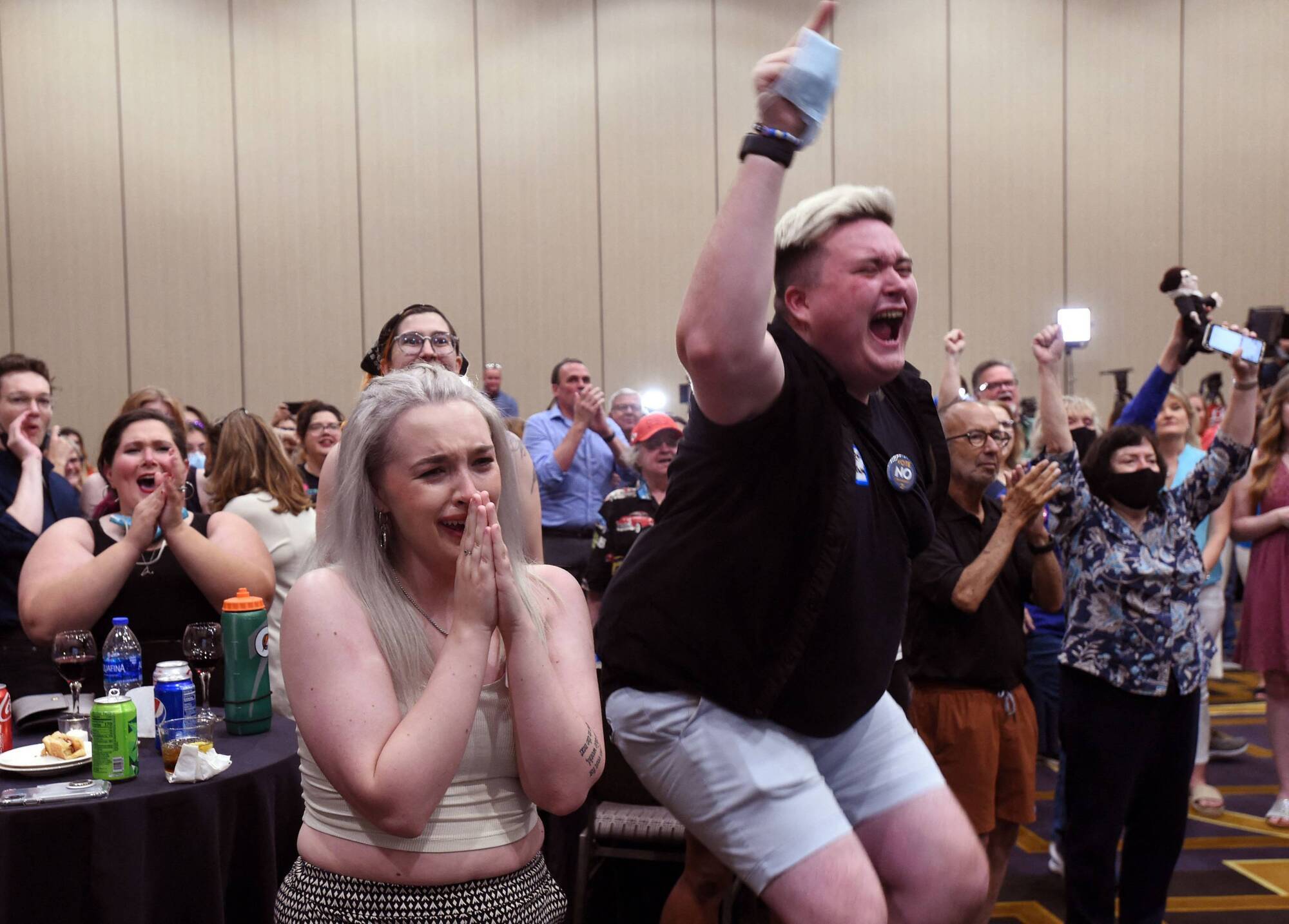
Abortion rights activists react to the failure of the recent Kansas state constitutional amendment on restricting abortion access. As the editorial in this paper pointed out, “900, 000 Kansans voted, compared with 473, 438 who turned out for a similar poll in 2018”. Picture: Dave Kaup/AFP
There are days when tuning into the news makes you feel like the world is going to hell in a handcart.
To name a few issues: the housing crisis, cost of living pressures, rising inflation, and the increased need for food banks. Globally: climate change and how we respond ; the threat of nuclear war from several quarters; China, and America scrapping; Russian continuing with its brutal invasion of Ukraine; and, if that wasn’t enough to contend with, a question mark over the fate of western liberal democracy.
In June, Hilary Clinton said, “we’re standing on the precipice of losing our democracy.” Joe Biden told a senior Democrat, “I certainly hope [my presidency] works out. If it doesn’t I’m not sure we’re going to have a country.”
Last week, an article on Nancy Pelosi’s controversial visit to Taiwan which has stoked Chinese anger contained the throwaway line “even as American democracy crumbles internally”.
In this paper, Fergus Finlay wrote that if the Democrats don’t read the writing on the wall and find somebody to take on Trump in the next election, then “democracy as we know it will begin to die”.
A recently published book by New York Times reporters, Jonathan Martin and Alex Burns, This Will not Pass: Trump, Biden, and the Battle for America’s Future, suggests the democrats’ elderly leaders are incapable of “grasping the brutal political forces swirling around them”.
A school of thought says that global liberty and democracy depend on what happens to America.
No week passes without mention of the growing cancer of authoritarianism, and the threat posed by the rise of so-called strong men: Putin, President Xi Jinping in China, Brazilian President Jair Bolsonaro, Viktor Orban in Hungary, and Trump who may enter the 2024 Republican presidential primary.
As one columnist put it last week, there is a booming trade in apocalyptic visions of the near future. “We are now in the midst of the most sustained global assault on liberal democratic values since the 1930s,” Gideon Rachman writes in The Age of the Strongman.
Read More
And contemporary liberal democracy is under attack from the right and the left.
Broadly speaking, the right thinks democracy is being undermined by identity politics and the overconcentration of power in minority groups and woke witch trials, with a permissive culture and moral laxity eroding the foundations of society.
The left thinks democracy has been hollowed out by the concentration of power in the hands of political, cultural, and economic elites who tolerate inequality and are too slow to respond to the needs and demands of citizens.
Self-fulfilling prophecy?
Dr Lawrence Davis of UCC’S Department of Government and Politics believes liberal democracy may be waning, but it is unclear what is emerging to take its place.
“Contemporary political scientists commonly speak about a global ‘crisis of democracy’, meaning widespread public disenchantment with the politics of representative democracy, reflected in declining voter turnout, membership of political parties, trust in politicians, and interest in mainstream electoral politics,” he says.
But he asks an important question, “does the constant repetition of a Hobbesian narrative that we are or soon will be engaged in a war of all against all become a self-fulfilling prophecy?”
So, with that in mind, here are some democratic green shoots, showing citizens participating in political decisions and policies that affect their lives and questioning what it means to live in a democracy.
Green shoots
Last week, an astonishing turnout in Kansas (a hotbed of sometimes violent anti-abortion activity) saw 62% of voters vote to preserve abortion rights after the Supreme Court struck down Roe. As the editorial in this paper pointed out, “900, 000 Kansans voted, compared with 473, 438 who turned out for a similar poll in 2018”.
What’s interesting is rural Republicans joined suburban Democrats in a broad coalition in a strong ballot-box reflection of their views, maybe not on abortion, but possibly of their dislike of government interference in their lives.
In July, AIB abandoned plans to go cashless in 70 branches. Small beer maybe given we bailed them out in 2009 but the U-turn followed a backlash from business groups, consumers, farmers, and rural organisations, showing the people were heard.
An interesting development, democratically speaking, is a proposal recently announced by Health Minister Stephen Donnelly to legislate for 100m Safe Access Zones around facilities providing abortion services which the Minister since said now requires further legal consideration.
Balance of rights
Critics say these exclusion zones go against fair democratic procedures infringing the constitutional rights of protesters to freedom of speech, freedom of association, and assembly which might preclude as one columnist put it “someone praying with rosary beads within 100m of a hospital”.
In any legal case testing the constitutionality of legislation, these rights would be balanced with a woman’s constitutional rights to privacy, bodily integrity, and dignity in accessing abortion services.
Because the right to protest is being curbed rather than removed, the extent of the curb would be central with the principle of proportionality coming into play. Incidentally, we ban canvassing at polling stations; a limitation of free speech.
A second criticism is that The Together for Safety campaign group’s input “in informing the development of legislative proposals” was disproportionate exposing the unhealthy influences of small NGOs on our democracy.
Together for Safety, a group of reproductive rights advocates, has said that “barristers, constitutional law experts, doctors, nurses, unions, gardaí, human rights and women’s advocacy organizations, abortion rights groups, activists and TDs, Senators, and Councillors from across the political spectrum” worked on the proposal.
The Department of Health will seek observations on the heads of bill (the bill is yet to be drafted) from the Irish Council for Civil Liberties, the Irish Human Rights, and Equality Commission, and the Office of the Director of Public Prosecutions.
The key question democratically is when taken as a totality does the collection of individuals with input into the bill represent the wider population so that the promise of democracy that each individual has a say is fulfilled?
Grassroots movements
Dr Davis has described “a long history of popular movements from below working together to resist regimes of domination and develop progressive and sustainable alternatives to them”.
He cites the 2020 Bernie Sanders presidential campaign as speaking to millions of Americans who envisaged people “getting organised and mobilised in grassroots social movements to contest power and forge participatory alternatives to elite democracy outside as well as inside the framework of elections.”
Last week, a cheering article in this paper reported about a new iteration of meitheal, the ancient tradition of communities working together. Voluntary co-operative groups in rural Ireland are opening community centres and coffee shops.
These enterprises owned by local people and operated on a not-for-profit basis are aimed at meeting the social and economic needs of a community in counties Cork, Tipperary, Sligo, Waterford, Clare, and Kilkenny.
Humble maybe but progressive grassroots movements like these are closer to the root ancient Greek understanding of democracy as a form of ‘popular power’. They are also the antithesis of the rabid destabilising capitalism which has led us to this rocky pass.
They potentially block attempts to fill the vacuum caused by discontent with contemporary liberal democracy to sow what Davis terms the “seeds of hatred and intolerance.”
We are particularly attuned to negative news in these tumultuous times but there may well be life yet in the democratic old dog.
CONNECT WITH US TODAY
Be the first to know the latest news and updates








