Mick Clifford: We can't lose compassion for refugees

Mick Clifford: We can't lose compassion for refugees

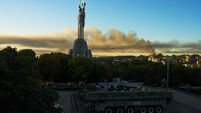
 Ukrainian refugee Vira Horniak from Uzhhorod, who is now living in the Quality Hotel in Redbarn, recently took part in a march to Youghal to thank Irish people for their hospitality and solidarity with her country.  Picture: David Creedon 

Here are some extracts from an Irish government memo about refugees who arrived in this jurisdiction.

“Refugees are not always just frightened people who are thankful for the assistance being given them,” the memo declared. “Some of them can be very demanding and ungrateful, even obstreperous and fractious — as well as, particularly in the case of teenage boys, destructive.”

Another difficulty, it went on, was “casual people” arriving and declaring themselves refugees. The memo warned that “many who have no good reason to leave their homes inevitably do.”

That wasn’t written for the current government, nor a recent one. It doesn’t reference refugees from the developing world who have come here in search of a safe haven. Instead, it dates from 1973 and concerns Catholics who fled south from sectarian violence in the northern statelet.

The memo hasn’t dated well. Most people accept that those who came across the border were in fear of their lives, or, at the very least, fled an inhospitable environment where they were potential targets based on their minority status. The assessment was heavy with the kind of tired and inaccurate tropes that are often thrown around about refugees, their plight, and their motives. In reality, the vast majority of people who up sticks and seek out sanctuary somewhere else have a damn good reason for doing so. And when they do find a new home they tend to be grateful and take any opportunity to better their lives. Society at large would do well to remember that as we may be facing into a turbulent time in dealing with the challenges of welcoming refugees.

A new and strange juncture was arrived at this week in Ireland’s relationship with modern-day migration. The state has run out of accommodation. The Citywest campus in Dublin, which opened as an overflow facility in March, is now operating beyond capacity. On Wednesday night, 250 people had to sleep in Dublin airport

Since the start of the year, around 6,500 people have arrived here under the International protection system, up 190% from 2021. On top of that, nearly 41,000 Ukrainians have relocated here as a result of Putin’s savage war.

“We will from a policy perspective prioritise those fleeing war, or very vulnerable situations,” Taoiseach Micheál Martin said on Thursday. “That will have to be our prioritisation in terms of response and accommodation.”

The government’s task is unenviable. What constitutes war and very vulnerable situations? Who exactly will be turned away? Unlike our neighbours across the Irish Sea, Martin is not coming at this from an ideological position. 

He is not, as is increasingly popular in various parts of the world, using immigration as a political tool. His problem is there doesn’t appear to be much in the way of accommodation for those currently arriving here

NGOs such as the Irish Refugee Council have suggested alternative approaches that could open up vacant housing. These must be explored but don’t hold your breath. Any form of accommodation is at a premium right now. This, after all, is at a time when some students are forced to sleep in cars, those without a permanent address have to scramble and grab whatever is going and the cost of renting is punitive in the extreme. None of it is going to be easy.

Cruel regime

The last time there was anything approaching this level of refugees entering the country was in the late 1990s. The response at that time was to instigate a cruel regime in order to eliminate what was described as a “pull factor”. Direct provision is now seen as wholly unsuitable, if not downright inhumane, as a way of housing asylum seekers. We can only hope that a more enlightened approach informs the government’s actions this time around.

The practicalities of accommodation are the most immediate challenge, but a related one will be to ensure that there will not be a backlash against refugees, wherever they are arriving from. So far, there has been broad acceptance of our obligations to assist some of the most vulnerable people on the planet. So far, there has been little political or social traction in “othering” refugees. Maintaining all of that in the face of the evolving situation will be difficult.

A taste of what may be to come was on view during the week in Kinnegad, Co Westmeath. Around seventy asylum seekers, nearly all of whom are men, are being accommodated in a local hotel. A public meeting heard about the lack of services in the town already, which is a legitimate concern in many communities around the state. But one of the big issues is the residents’ gender. One woman who was interviewed said she feared for the women and children in the town, asking whether these asylum seekers have been vetted.

She added that she would still have concerns if the residents were “Irish men”. 

Would the same concerns be present if a large group of young men arrived down from Dublin or Cork unvetted to work on, say, a construction project in the town? Or is this more about the tired and inaccurate tropes?

Fears, even when misplaced, are often real. As more pressure will inevitably come on to find accommodation, leadership will be required to ensure that society at large retains the understanding of those looking for a safe haven. Right now, large chunks of the population are struggling with a cost of living crisis, so maintaining compassion for those whose struggles are of an even greater magnitude will not be easy. But what is the alternative?

While the current situation may be transitory, there are going to be serious and growing challenges with immigration in the long run. Much of the increased shift in populations will be attributable to climate change. Already, there are parts of Africa that are becoming inhabitable, largely because of the difficulty of living off the land. Those who exist in these poorest corners of the world contributed least to the ravages of climate that are now becoming increasingly frequent, such as the heatwave currently being experienced in mainland Europe. Where is the justice in that?

The very least society at large can do is to maintain perspective in the face of pressure.

x

CLIMATE & SUSTAINABILITY HUB

More in this section

Revoiced

Newsletter

Sign up to the best reads of the week from irishexaminer.com selected just for you.

Cookie Policy Privacy Policy Brand Safety FAQ Help Contact Us Terms and Conditions

© Examiner Echo Group Limited