Maeve Higgins: Why New Yorkers 'keep going' after subway attack
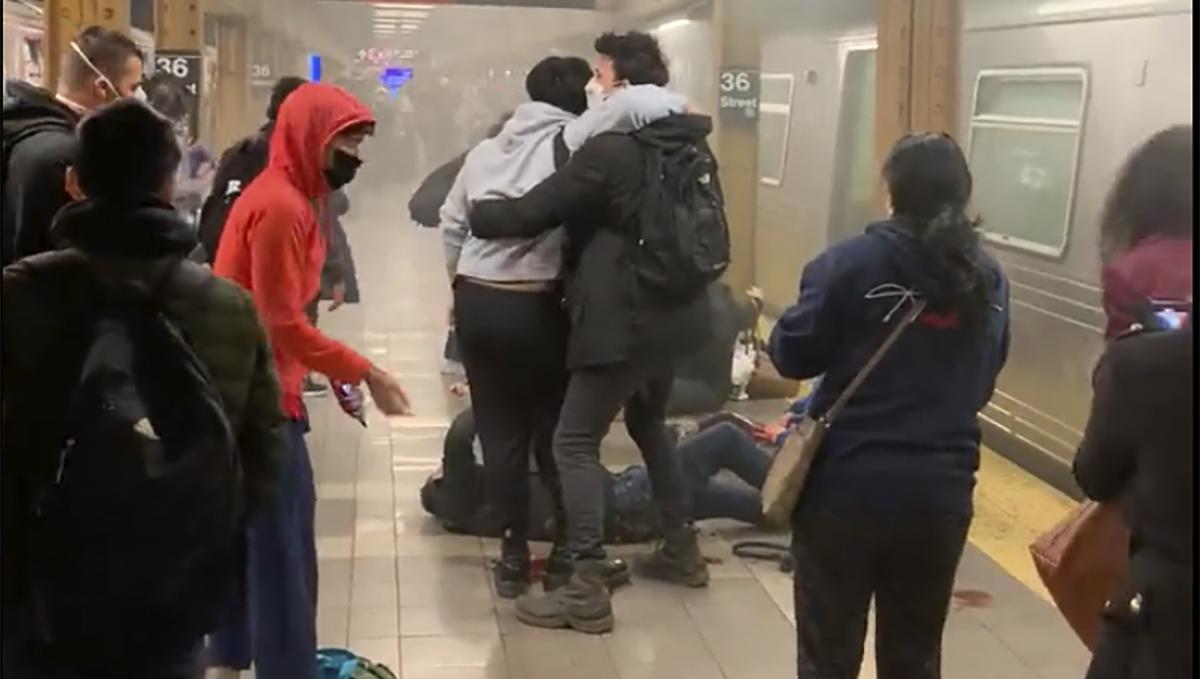
A person is aided outside a subway car in the Brooklyn borough of New York, Tuesday, April 12, after a gunman filled a rush-hour subway train with smoke and shot multiple people. Picture: Will B Wylde via AP
On Wednesday, a full day after the attack, the suspect, a 62-year-old man named Frank R James, was still on the loose. I took the subway that Wednesday morning, and there was a loud chorus of emergency alerts sent to everybody’s phones. Everyone on my carriage checked their devices, and individually but simultaneously read a warning from the New York Police Department with a brief description of the suspected gunman and a number for a tip line.
There were slight grumbles from a couple of passengers, then we went back to politely ignoring each other on our way to work and school.
It’s a strange time to be in the city and getting the subway, but that is what many of us are doing. What is the alternative? It would be stranger not to. My friend Kevin summed it up when I asked him how he feels about taking the train these days. “Stoic,” he tells me.
"Trains seem dicier, but I’m always late. I don’t have cab fare, and I sure as hell ain’t walking.”
The conversation around safety on the subway has grown a whole lot louder these past few years, as the pandemic decimated ridership and more homeless and mentally ill people took shelter underground.
I’ve written in this newspaper before about the horrifying rise in hate crimes against Asians and Asian-Americans, including the murder of Michelle Alyssa Go, who died after a man shoved her onto the tracks in front of a moving train at Times Square in January.
It was Ms Go’s death that made commuter Saedi Burke consider taking more precautions for her own safety, saying: “I’m not Asian, I’m Middle Eastern and I live in Brooklyn.
"I have never carried mace in NYC, but I’m going to start.”
Ms Burke has made other changes too. She explained she is careful now to stand in the middle of the platform, to keep the volume in her headphones low, and make sure she’s aware of her surroundings. Other women told me they have also become more vigilant, using alternative modes of public transport where they can, or using a ride-share app or hailing a taxi.
A Chinese-American commuter named Diana has to get from Brooklyn to mid-town Manhattan for work three times a week, and via direct message on Instagram, she told me: “Ever since Covid really took hold at the start of 2020, I just got really antsy about taking the subway into the city, not just for anti-Covid reasons but also because of the increasing number of Asian hate crimes.”

Terrified of being attacked or pushed onto the tracks, she bought and learned to ride a motorcycle. Diana still takes the train, but less often. This week, she was grateful that she decided not to go into the office on Tuesday, because she would have taken the N train on the same route the shooter took.
Aisling Spital lives in Brooklyn and commutes too, but she has more public transport options than most others: "I live right next to the NYC ferry and take that when I can.
"I avoid the subway at all costs.”
The subway remains an essential part of life for many who do not live close to or cannot afford other options. On my Wednesday-morning commute, despite the gunman still on the loose, the train was busy. There were construction workers, schoolkids, and tourists packed into my carriage. Aside from being vital to the city’s various functions, the subway is a beloved and important New York City institution. Another rider, Gaela LaPasta, told me: “I used to revel in the occasional weirdness of the subway during late nights. Now, I’m nervous.”
On a recent late-night subway ride home from a show, I felt on edge too, but not unsafe exactly. There were the usual groggy drunks, a couple of distressed homeless people, a woman holding an entire rotisserie chicken still steaming hot, and a man passed out with a needle still stuck in his arm.
I am determined to keep using the subway myself, because I understand how vital public transport is to my community, and because it’s cheaper for me and better for the environment than a car.
And despite the recent horrors that have befallen the subway, it remains statistically safer than cycling or walking around the city. Last year 273 people were killed on the city’s streets, including pedestrians, motorcyclists, bikers, and people on mopeds. Cars can be deadly weapons, drivers can and do kill, but the violence is more acceptable, somehow less shocking, certainly less talked about than what happens underground.
Even before Tuesday’s disgusting attack, the conversation around safety and policing had reached fever pitch following mayor Eric Adam’s decision to deploy hundreds more NYPD officers into the subway system.
A former transit cop himself, the mayor seems beholden to the idea that police create safety and peace, which is patently not the case. New Yorkers remain baffled as to how we fund the biggest and most expensive police force in the country while an apparently mentally ill and physically out-of-shape senior citizen can shoot 10 people on a train, leave his gun and his credit card at the scene, and continue to roam around the city for more than 24 hours until calling the police on himself.

On Twitter this week, users shared videos of police harassing homeless people less than five minutes away from where the shooter sat sunning himself and waiting to be identified, and we shook our heads in disbelief.
While it is easy to sit in shock about the billions spent on this militarised force with scant evidence that they are making the city a better place to live, it’s actually about more than that. It’s about keeping a level head and understanding how best to extricate each part of this latest wave of problems and deal with them humanely, and for the long term.
Guns, xenophobia, individualism, militarism — take your pick. These are the poisonous forces that rise up and challenge New Yorkers simply trying to go about their day, and sometimes there are frightening and terrible consequences.
Most times though, we escape, and we are still alive. Our eyes are open and we can see these forces and these challenges clearer than ever before.
So we take the train, we get on the bike, we keep going. Where we end up, the direction and the actions we deliberately take? Well, that is the next challenge.