Maeve Higgins on Cop26: Forget how it is and focus on how it could be
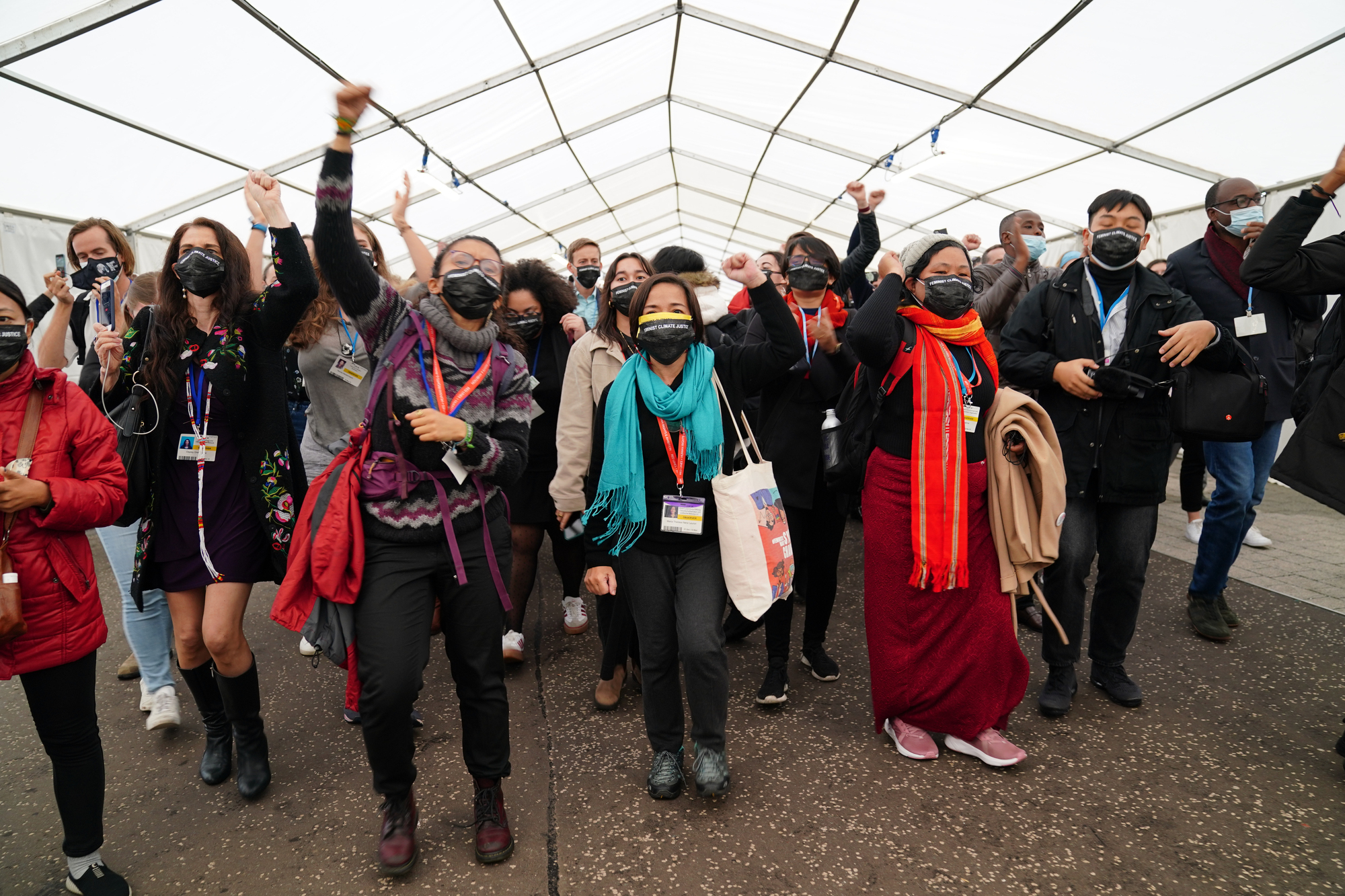
Climate activists hold a demonstration in the venue during final day of the Cop26 summit in Glasgow. Picture: Jane Barlow
"This is how it is, and this is how it must be" is most often said by those who want 'it' to stay that way, those with an investment in how 'it' is, those who benefit from keeping 'it' just the way it is.Â
The first part is usually accurate, the part about the status quo.Â
The second part, about the status quo being fixed and unchangeable, is absolutely a lie. Transformation and evolution are standard. Massive changes happen all the time. Nothing is permanent. Â
Previously unimaginable scenarios play out in front of us all the time, and we quickly begin to see these new realities as "how it is". Germans tore down the Berlin Wall; black Americans fought like hell for the right to vote; Irish women won the right to healthcare in the form of abortion rights.Â
But the tension between how things are and how they could be is always present, never more so than these past two weeks at Cop26. The UN has brought almost every country on Earth for global climate summits together for the past decades — these summits are called Cops — which stands for Conference of the Parties.Â
In Glasgow, the 26th annual summit has just ended — the organisers billed it as "the world's last best chance to get runaway climate change under control".
Yesterday was the summit's final day, and hundreds of representatives of global civil society, the People's Plenary, walked out of the convention centre after lambasting what was happening inside.Â
These people represented environment and development NGOs, trade unions, grassroots community campaigns, faith groups, youth groups, and migrant and racial justice networks.Â
As they left, they held up red ribbons to signify the red lines crossed by Cop26 negotiations, and they yelled and chanted, "another world is possible".Â
The reported that the indigenous activist Ta'Kaiya Blaney Tla A'min Nation told the meeting before the walkout: "Cop26 is a performance; it is an illusion constructed to save the capitalist economy rooted in resource extraction and colonialism. I didn't come here to fix the agenda — I came here to disrupt."
Following the progress of the negotiations and the reaction from activists kept my anxiety high all week. As I processed the updates of Cop26 online, I kept jumping up from my desk and away from my laptop.Â
Any distraction would do; I darted away for endless cups of tea, scrolled my way through half of Instagram, and even made a trip to the dreaded post office.Â
Perhaps you've been avoiding news from Glasgow, too, because you know that understanding the implications of Cop26 will require some complex intellectual analysis as well as some deep heartbreak.

Head out of the sand now, because I am a grown-up, in the lucky position to learn and think and write about climate chaos rather than living through it in my own body. I am keen to figure out where the US landed at the end of Cop26 and what that might mean for Americans and the population of the rest of the world. I am trying to unpick what is real and to see how it is and how it could be.Â
UN secretary general Antonio Guterres opened with the following, unsparing remarks: "So, as we open this much-anticipated climate conference, we are still heading for climate disaster. Young people know it. Every country sees it. Small island developing states — and other vulnerable ones — live it. For them, failure is not an option. Failure is a death sentence."Â
On November 1, US president Biden said: "It's simple: Will we act? Will we do what is necessary? Will we seize the enormous opportunity before us? Or will we condemn future generations to suffer?"Â
As I write this on Friday evening, there is a draft agreement on the table. This is most likely not the final text. Although the conference was officially due to end on Friday, revisions will continue, possibly right throughout the weekend.
One stated goal was to secure global net-zero emissions by mid-century and keep 1.5C within reach. Last week the Climate Action Tracker, the most reliable and respected climate analysis coalition, announced that temperature rises would top a disastrous 2.4Cby the end of this century, based on the short-term goals countries have set out at Cop26.Â
Meanwhile, the UK Met Office warned that a billion people would be affected by extreme heat stress if the climate crisis raises the global temperature by just 2C. Part of this means even if we are sitting in the shade, sweating as much as possible, the heat will kill us within six hours. In other words, an absolute nightmare.Â

As Chair of The Elders Mary Robinson put itin a courageous and righteously emotional interview on Sky News: "You can't negotiate with science."Â
She did not hold back on criticising her fellow leaders on their lack of ambition and urgency, pointing out that countries such as China, Russia, Brazil, and even Australia are still in "still in fossil-fuel mode, not in crisis mode".Â
Then she slammed Saudi Arabia for the "dirty games" they play. "What Saudi Arabia has been able to do is take language out of a lot of the [Cop26] text," Mrs Robinson said.Â
"They've taken out the language that refers to youth, human rights, gender equalities … Saudi Arabia is there when it matters, and they kind of block things."Â
According to Reuters, this claim that Riyadh is using procedural delay tactics to block a solid deal is backed up by several officials involved in the Glasgow negotiations.
The second goal was about countries already hit by devastating climate chaos "to protect and restore ecosystems and to build defences, warning systems, and resilient infrastructure and agriculture to avoid loss of homes, livelihoods, and even lives".Â
But to deliver on those first two goals, developed countries must make good on their promise to mobilise at least $100bn in climate finance per year by 2020. This deadline has already been missed, obviously, but progress has been made these last two weeks.
Thousands of people from all over the world worked incredibly hard to get even the most incremental changes to the status quo. They have negotiated in good faith to make these shifts towards progress, which is reflected in the latest draft of Cop26.
I'm not interested in demeaning their valiant attempts to save the future of humanity.Â
Grim indeed, but just because that is how it is now, that is not how it must be. So, having processed what just happened, I remind myself that transformation is possible. I do not accept the version of the future laid out by Cop26. I'm switching focus now to how it could be.
CLIMATE & SUSTAINABILITY HUB