Maeve Higgins: Comedians are stumbling their way back to funny
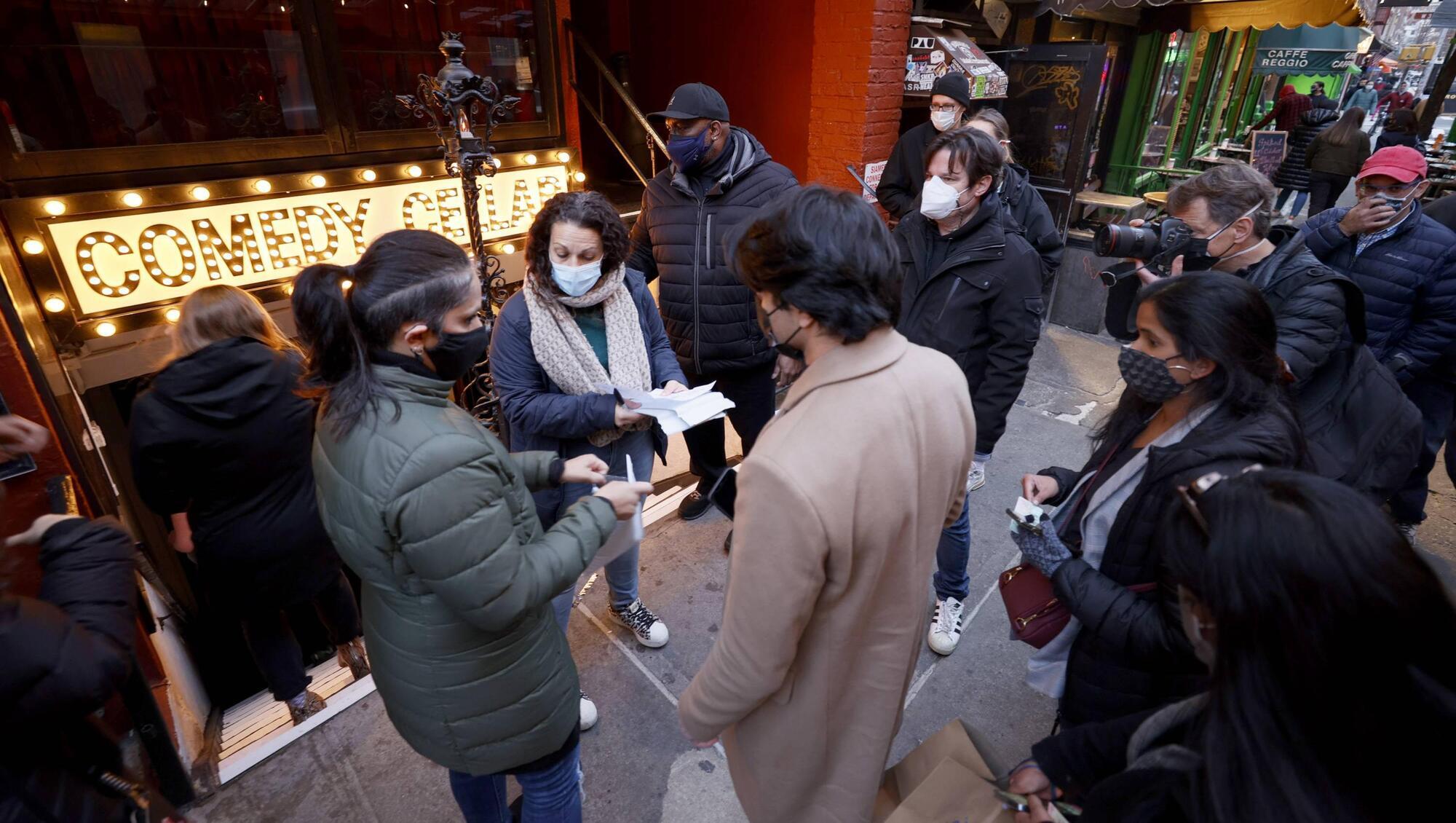
Audience members line up outside the Comedy Cellar on April 2, 2021, in New York City. Picture: Michael Loccisano/Getty Images
BACKSTAGE at New York’s iconic comedy club, Comedy Cellar, masked and standing in front of a poster that says ‘Cover Your Cough!’, comics Sam Morril and Ray Romano discuss being back performing.
“Well, it seems like people are dying for it,” says Romano. There’s a pause, and then both men burst out laughing. “Wait, that’s a bad choice of words — a real bad choice.”
That moment appears in Morril’s documentary 'Full Capacity' about the reopening of the city’s clubs.
The strangeness of this time, and the humour we use to meet it, is being felt around the world as comics and audiences emerge into a world that has changed massively, and is still in churn.
Since 2018, I’ve hosted a show in Brooklyn called Butterboy, with friends Aparna Nancherla and Jo Firestone. Each week, five stand-ups do short sets and another friend, Donwill, is the DJ. In March 2020, as the virus appeared in upstate New York, our producer Marianne Ways called a halt to it. Now, we are back.
Tonight! Sept 27 @butterboycomdy w/ hosts @maevehiggins & #JoFirestone
— butterboycomedy (@butterboycomedy) September 27, 2021
+ music by @donwill
• 8pm @littlefieldnyc
~featuring~@Justsydnyc@mattkoff@AshGavs
@KhalidNYC
@leresatee
* Tix at the door or https://t.co/PdtQCw7b7P pic.twitter.com/GG1sSamtHg
So, after 14 years of doing comedy and 18 months of doing whatever the opposite of comedy is, I went back on stage — back to standing under lights and sharing my amplified thoughts with a group of strangers.
In the past, I’ve felt more comfortable on stage than off; now I was unsure of what to say and how to act.
In the US alone, 700,000 people have died from a terrible plague. The rest of us have been separated from one another physically, psychologically, and politically. Our lives have changed utterly. Can we step into this new and evolving space with … jokes?
My pre-pandemic material was irrelevant, and I was all over the place. I tried out some new stuff and lost faith in it even as I was saying it. The audience were sweet, but I felt like apologising to them. Repeatedly saying ‘sorry’ on stage is generally not a good sign. I felt extremely weird.
Then I watched Luke Mones, a wonderfully silly and talented comic, articulating just how I was feeling.
We’re all just pretending like we haven’t lost our minds; we’re just walking around like everything is normal, like I just ate brunch in a plastic bubble in the bike lane, everything is fine," he said.
"Oh yeah, the rest of the world is on fire and I experienced true loneliness the last 18 months.
"My true circle of friends is much smaller than I thought it was, but I just had an omelette in the middle of the street!”
Door to door atheist pic.twitter.com/zHvnxqH1Si
— Luke Mones (@LukeMones) September 26, 2021
This is one of comedy’s gifts; naming what is happening around you, giving you something to relate to and recognise, no matter how unfamiliar the landscape is.
Stand-up comedy is immediate in the way few other crafts manage to be. Unlike theatre or film, when we have an idea for what we call (in an appropriately diminutive fashion) “a bit”, we can write it and deliver it the very same day, often working it out in real time.
Naturally, that can be an appalling thing to sit through, and it is a very shaggy process, but it can also reflect reality with great specificity and make the audience feel less alone.
I spoke to Dublin-based stand-up Gearoid Farrelly, who spent the pandemic doing some virtual shows, but mainly in thrall to every whim of his rather plain-looking but charismatic cat Boots.

In the cautious months earlier this year, Farrelly began to perform at outdoor, strictly monitored shows. His first show back was in July at the Séamus Ennis Arts Centre in Naul, Dublin, where “audience members were in pods and escorted to toilets, and everything was executed with military precision, which was a brilliant way to come back because safety was prioritised”.
Farrelly went on to the UK to do support for Sarah Millican, one of the biggest stars in Britain. Covid restrictions in the UK are looser, and were practically gone during the small and beautiful window before the Delta variant lunged into view. Farrelly described those shows as unlike any he’d ever been a part of, particularly when the customary smattering of applause in the seconds between the lights going down and the performer appearing on stage quickly built to a roaring welcome.
"They would erupt and it would drag on," he said.
It was a big cathartic moment, where the crowd realised we had all been through something. It was incredibly emotional to feel a show you’re part of is the line drawn under something like that.”
Sadly, the line has been erased and redrawn many times since then, and we understand that Covid will be with us for a long time.
Comics and comedy clubs are determined to keep going, and nobody wants to go back to the days of virtual or outdoor shows. I never could face the shows that popped up in parks and people’s backyards in the past 18 months. For a comedy show to work, the atmosphere must be tightly controlled. I was put off by the multiple and unpredictable challenges of weather, acoustics, and the rambling general public.
Rosebud Baker is a wonderfully dark and hilarious comic living in New York. In Sam Morrill’s documentary, she relives one outdoor performance that made her question her compulsion to do comedy in such circumstances.
I was in Central Park in the daylight and I was telling a joke about abortion. And no one laughed except for a child in the distance. I heard a child’s laughter and I thought: ‘I am mentally ill’."
Perhaps this urge to make strangers laugh at all costs is indeed mental illness, in some form. The impulse to do comedy has always struck me as something quite desperate. Of course, desperation is not without its charms. When you play it right, it can lead to a fun time with strangers.
I mean, when is the last time you had a fun time with strangers? To me, even the possibility seems like a miracle.
I asked comedian Josie Long about being one of the relatively few performers who did shows at the usually packed Edinburgh Fringe Festival. She is pregnant and told me she found herself constantly weighing up the risks to both herself and the audience, even when everyone was vaccinated and taking appropriate Covid precautions. Ultimately, she felt it was worth it.
Once I was on stage, it felt amazing, glorious and as if nothing had changed. It felt like a precious, free, and playful space again,” she said.
That first night back, watching from backstage, my eyes were drawn again and again to the rows of people sitting in the audience. They were masked up, chuckling, and laughing, and clapping, and I felt a curious surge of love for them.
They could stay at home and literally lie in bed as they watch any number of perfect comedy shows on TV or online. Instead, they come out on a weekday night with a severe weather warning in place.
They line up and show a security person their vaccination certificate and their ID. They hand over money and take a seat. Then they spend 90 minutes with us, willing us on as we stumble our way back to funny.

Subscribe to access all of the Irish Examiner.
Try unlimited access from only €1.50 a week
Already a subscriber? Sign in
CONNECT WITH US TODAY
Be the first to know the latest news and updates